Every founder who has been burned by outsourcing tells a version of the same story. The demo looked great. The hourly rate looked even better. Six months later they were sitting on a codebase nobody could read, a launch date that had moved three times, and an invoice that had quietly doubled. They did not get scammed. They just hired the way you hire when you are optimizing for price instead of for outcomes.
Here is the thing nobody selling you a dev team will say out loud: outsourcing software development is not cheaper by default. Done well, it is faster, more flexible, and yes, often more cost-effective than building an in-house team from scratch. Done badly, it is the most expensive way to not ship a product. The difference between those two outcomes is almost never the country your developers sit in. It is how you scoped the work, who you vetted, and what you put in the contract.
We wrote this from the delivery side of the table. Grovant builds software under other companies' and agencies' brands, so we have seen the briefs that set a project up to win and the ones that doom it before a line of code is written. This guide is the version we wish more clients had read first.
$618B
Global software development outsourcing market in 2026
up from $564B in 2025
9.6%
Projected annual market growth through 2031
heading toward $977B
~1.2M
Projected US software developer shortfall
demand far outpacing supply
The market context matters because it explains why this is no longer a fringe decision. The software development outsourcing market is on track to hit roughly $618 billion in 2026 and nearly $977 billion by 2031, a 9.6 percent compound annual growth rate. This is not businesses cutting corners. It is how a large share of software now gets built.
What outsourcing software development actually means
"Outsource software development" is a single phrase that hides four very different arrangements. Choosing the wrong one is the first place projects quietly go sideways, because you end up managing a vendor like an employee, or treating an employee-style team like a vending machine.
1. Staff augmentation
You rent individual developers who slot into your team, your standups, your tools, and your process. You manage them day to day. This is the right model when you have a strong technical lead in-house and you just need more hands or a specific skill (a React Native developer, a data engineer) for a defined stretch.
2. Dedicated team
A partner assembles a long-term squad (developers, a QA engineer, sometimes a project manager) that works only on your product. It feels like an extension of your company, but the partner handles hiring, retention, and HR. This suits ongoing product work where continuity matters more than a fixed end date.
3. Project-based or managed delivery
You hand over a defined scope (a mobile app, an internal dashboard, a SaaS MVP) and the partner owns delivery end to end: estimation, build, QA, and handover. You manage outcomes and milestones, not individuals. This is ideal when you know what you want built and you want one accountable team to ship it.
4. White-label development
A specialized version of managed delivery for agencies and consultancies. The partner builds under your brand, so you sell and own the client relationship while a senior team delivers the work unbranded. This is how an agency offers custom software, mobile apps, or a SaaS build without hiring an engineering department. We will come back to this, because it is its own discipline.
Why teams outsource in 2026 (it is not what it used to be)
The old story was simple: outsource to cut costs. That story is fading fast. In Deloitte's Global Outsourcing Survey, the share of organizations naming cost reduction as their primary driver fell from around 70 percent in 2020 to roughly a third in the most recent survey. What replaced it? Access to talent and the ability to move faster.
That shift makes sense the moment you look at the talent math. The US Bureau of Labor Statistics projects software developer employment to grow 17 percent between 2023 and 2033, far above the average for all occupations, while the domestic pool of senior engineers cannot keep up. Estimates put the US developer shortfall in the range of 1.2 million by 2026. When you cannot hire the senior engineer you need at any price within your timeline, outsourcing stops being a cost play and becomes a capacity play.
The three reasons that actually hold up in 2026:
- Speed to a working team. Hiring one senior developer in-house takes months. A good partner can stand up a vetted team in weeks.
- Access to skills you do not have. You need a specific stack or capability (machine learning, mobile, a particular cloud) for one project, not forever.
- Focus. Founders and agency owners want to spend their hours on product, sales, and clients, not on running a recruiting and engineering-management function.
Cost still matters, of course. It is just no longer the headline. And as we will see, the teams that chase the lowest rate are usually the ones who end up paying the most.
Outsource, hire in-house, or use freelancers?
Outsourcing is one of three ways to get software built, and the right choice comes down to timeline, budget, and how permanent the need really is. Here is the honest comparison, without the vendor spin.
- Hire in-house. Best when software is core to your business and you need it forever. You get full control and deep context, but you carry the recruiting time (months in this market), salary plus benefits (a US senior runs well over $150,000 fully loaded), and the cost of a bad hire you cannot easily reverse.
- Hire freelancers. Best for small, sharply-defined tasks on a tight budget. Cheap and flexible, but you become the project manager, the quality control, and the integration layer. One freelancer going quiet mid-project can stall everything, and coordinating several is a full-time job of its own.
- Outsource to a team or partner. Best when you need a whole capability delivered, not just extra hands. You get a managed team, built-in QA, and continuity if one person leaves, without the fixed cost of employment. You trade a little direct control for accountability and speed.
Most companies end up blending these. A common and healthy pattern: keep one senior engineer or technical lead in-house to own architecture and direction, and outsource delivery to a partner who can scale the team up or down as the roadmap shifts. Context stays in the building. The cost structure stays flexible.
What it actually costs: onshore vs nearshore vs offshore
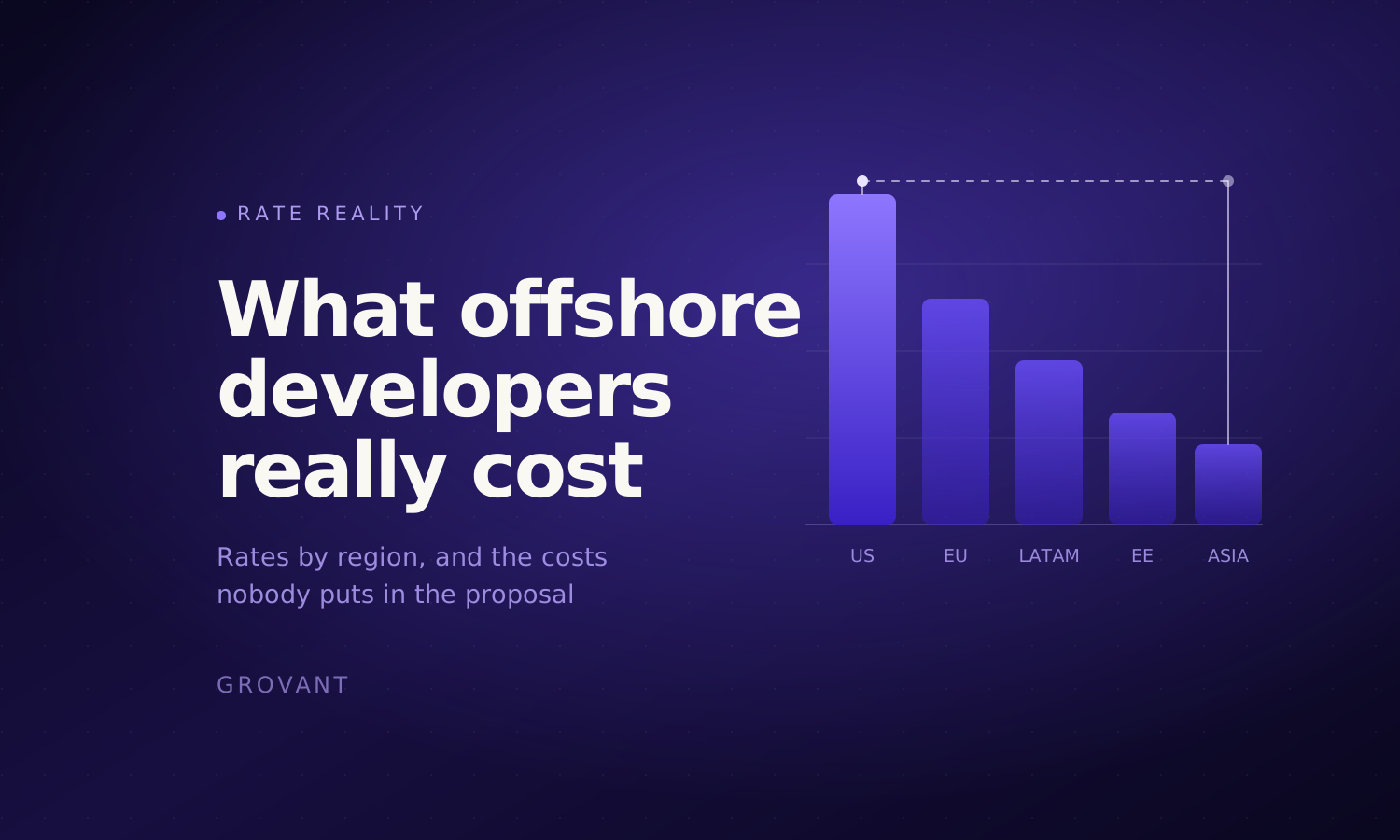
Rates vary more by geography than by anything else, and the gap is large enough to change your entire budget. Here is the current lay of the land, drawn from 2025 to 2026 rate data across regions.
$75 to $150+/hr
Onshore (US) senior developer
highest overlap, highest cost
$30 to $70/hr
Nearshore (LATAM, Eastern Europe)
roughly half of US rates
$15 to $50/hr
Offshore (Asia)
lowest rate, widest time gap
On paper, offshore looks like a 40 to 70 percent saving over onshore. Sometimes it is. But the hourly rate is the least reliable number in this entire decision, because what you pay for software is not hours. It is working, maintainable software that ships. A $20 per hour developer who needs three times the hours and produces code your next team has to rewrite is not cheaper than a $60 per hour developer who gets it right.
Nearshore has quietly become the smart middle. You get rates around half of onshore, but with overlapping working hours and closer cultural and language alignment. That overlap is not a soft benefit. It is the difference between a question answered in an hour and a question answered tomorrow, which over a project is the difference between weeks gained and weeks lost.
Why outsourced builds fail (the part the sales deck skips)
Being honest about failure is the most useful thing a guide like this can do, because the failure modes are predictable and almost all of them are preventable. Per Dun & Bradstreet's long-running outsourcing research, roughly 20 to 25 percent of outsourcing relationships fail within two years and about half within five. Those are not freak accidents. They cluster around a handful of causes.
- Communication breakdown. The single biggest one. Communication problems hit around 42 percent of outsourcing clients. Time-zone gaps and unclear ownership turn a one-day question into a one-week delay.
- Bad vendor selection. Poor partner choice is behind close to 29 percent of failures. The flashy portfolio hid a junior bench and a sales team that overpromised.
- Scope creep and fuzzy requirements. Vague briefs invite 20 to 30 percent budget overruns. If the scope lives only in your head, every change is a renegotiation.
- IP and security gaps. Concerns over intellectual property keep a quarter of companies from outsourcing critical work, and the fear is not irrational when contracts are thin.
The codebase always tells you the truth about a team. You can fake a portfolio and rehearse a sales call, but you cannot fake clean, documented, tested code. Ask to see it before you ask for a quote.
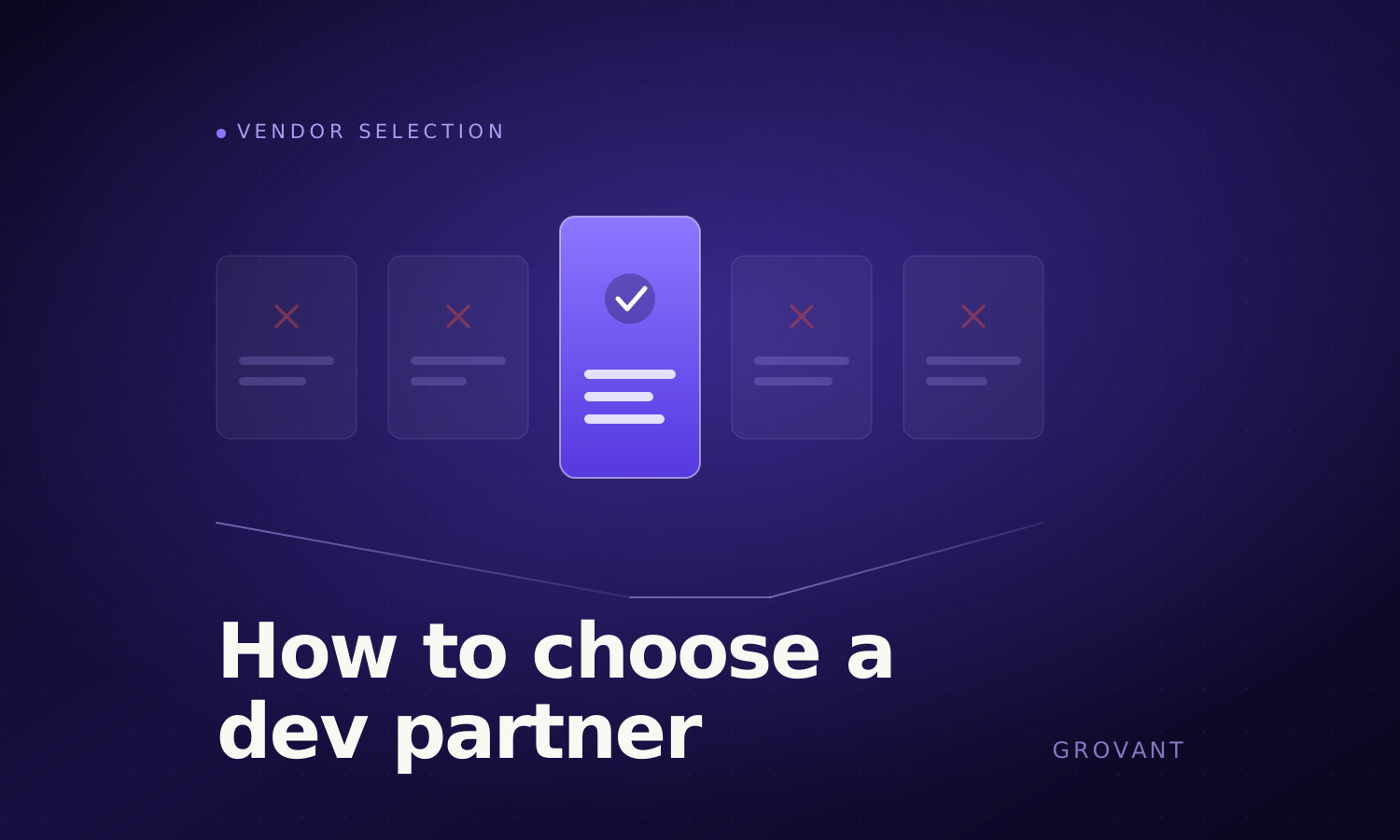
How to vet a software development partner before you sign
This is the section that earns its keep. The goal of vetting is not to find the cheapest team or the slickest pitch. It is to find a team that can build the specific thing you need, communicate while they do it, and hand you something you can maintain after they leave. Run every candidate through the same questions.
Ask to see real code and talk to the actual engineers
Request a code sample or a walkthrough of a past project's repository, and insist on speaking with the developers who would work on your build, not just the account manager. A serious partner will say yes. If the people on the sales call are not the people who will write your code, you are buying a bench you have not met.
Check references for projects like yours
Anyone can show a highlight reel. Ask for two references on projects of similar size, stack, and complexity, and ask those references one question: what went wrong, and how did the team handle it? Every real project has a problem. How a partner recovered tells you more than a flawless case study.
Pressure-test communication
How fast did they reply during the sales process? How clear were their written answers? Do they have a defined cadence (standups, weekly demos, a shared board) or do they go quiet between invoices? Communication during the courtship is the best version of the communication you will ever get. It only gets harder under deadline pressure.
Read the contract like the codebase depends on it
Three clauses are non-negotiable. First, IP assignment: the code and everything created is yours, in writing, on payment. Second, source-code access: you get the repository, not just a deployed app you cannot edit. Third, an exit clause: how you offboard, what gets handed over, and what documentation you receive. If a partner resists any of these, walk.
How to set it up so it actually works
Vetting gets you a good partner. Setup gets you a good project. The first month sets the tone for everything that follows, so treat it deliberately.
- Write the brief before you shop. Document the problem, the users, the must-have features, the nice-to-haves, and the definition of done. A clear brief is the cheapest insurance you can buy.
- Start with a paid pilot. Before a six-month commitment, run a small, paid, time-boxed first task. You learn more about a team from two weeks of real work than from two months of sales calls.
- Fix the communication cadence on day one. A daily async update, a weekly live demo, a shared board you can see at any time. No dark weeks.
- Insist on demos over status reports. Working software shown every week beats a green status that turns red at the deadline. If you cannot see it run, assume it does not.
- Bake in QA, not bolt it on. Testing and code review should be part of the process from the start, not a phase you discover was skipped when bugs surface in production.
The agency angle: white-label software development
If you run an agency, outsourcing software development looks a little different, because your client is the one who has to be happy, and your brand is the one on the line. This is where white-label delivery comes in: a partner builds the software under your name, your clients never see them, and you keep the relationship and the margin.
The logic is the same one that drives agencies to resell SEO without hiring an in-house team or to offer white-label web development. You win the project, a senior team delivers it under your brand, and you never carry the fixed cost of an engineering department between contracts. For app builds, internal tools, dashboards, and SaaS MVPs, it lets a marketing or design agency credibly say yes to work it could never staff alone.
The vetting bar is higher, though, because a white-label partner is failing in front of your client, not just you. Everything above applies, plus one more: confidentiality. The partner should sign a mutual NDA and ship everything unbranded, so the work is unmistakably yours. That is exactly how Grovant's white-label development is set up.
So, should you outsource software development?
If you have a clear idea of what you want built, a realistic budget, and the discipline to vet properly and stay involved, then yes. Outsourcing is how a huge share of good software now gets built, and the talent math in 2026 only makes the case stronger. The companies that win with it are not the ones who found the cheapest team. They are the ones who scoped the work, chose a partner on substance, and ran the relationship like the asset it is.
If you are still optimizing for the lowest hourly rate and you have not written down what success looks like, slow down. That is the exact recipe behind every horror story at the top of this guide. Fix the brief first. The right partner is worth waiting a week to find.