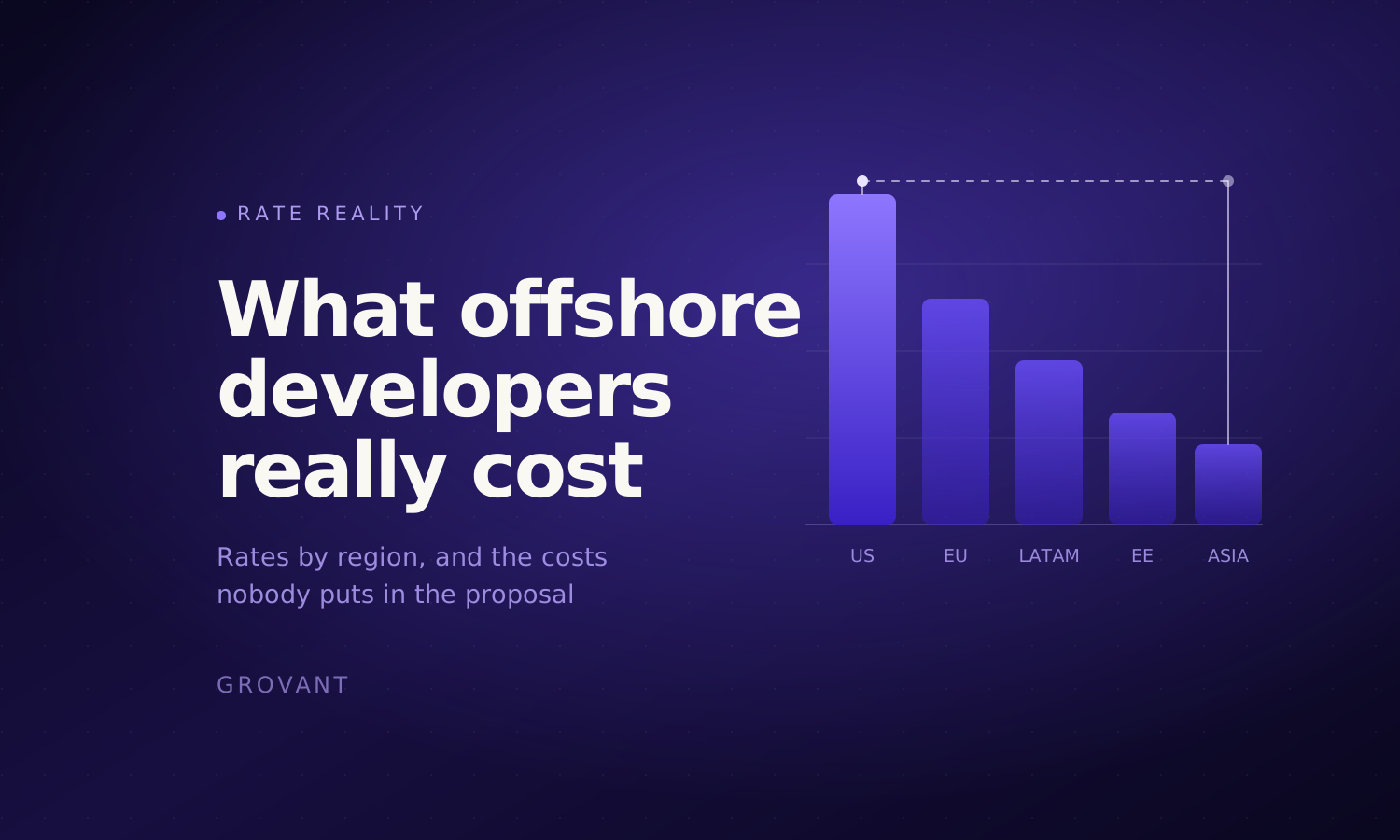
Offshore developer rates went down in 2026. Not slightly, and not in one region.
According to Accelerance's 2026 global rates guide, which benchmarks billing rates across more than 100 firms, Latin America fell 7.1 percent year on year, Central and Eastern Europe fell 4.4 percent, and Asia fell roughly 8 percent. UK contract software engineer day rates tell a similar story: ITJobsWatch puts the median at £700 a day, down 11.11 percent on the year.
So this is the cheapest offshore development has been in years. Great. Except the rate was never the number that decided whether you saved money.
Olivier Poulard, who runs Accelerance, put it about as plainly as anyone in the industry does. Rates matter, "but they are not the same as costs." That distinction is the whole article.
We build software under other companies' brands, so we quote this work constantly and we see what the invoice looks like twelve months later. Below are the real 2026 numbers, what you are actually comparing them against, and the four costs that turn a cheap rate into an expensive year. Let's dive in.
−4% to −8%
Offshore billing rate change in 2026
across LATAM, CEE and Asia
$133,080
Median US software developer wage
BLS, May 2024
30.1%
Share of US compensation that is benefits
BLS, March 2026
The actual 2026 rate bands
Here is where I have to be honest about the data, because most articles on this topic are not. Search "offshore developer rates" and you will find dozens of confident country-by-country tables. Almost all of them are published by companies selling offshore development, with no source, and the numbers contradict each other.
So this table only contains figures from Accelerance, a specialist that publishes its methodology and benchmarks a defined partner network. Where I do not have a defensible number, the row says so.
| Region | Junior | Senior | Change on 2025 |
|---|---|---|---|
| Latin America | $33 to $45/hr | $60 to $75/hr | down 7.1% |
| Central and Eastern Europe | $31 to $39/hr | $64 to $76/hr | down 4.4% |
| Asia | $24 to $31/hr | $31 to $41/hr | down about 8% |
| North America | Not published in the free guide | Not published in the free guide | n/a |
| Western Europe | Grouped into CEE by this source | Grouped into CEE by this source | n/a |
Look at the senior column for a second. Asia tops out around $41 an hour while Latin America starts at $60. That is not a quality gap, it is a timezone and market-maturity gap. Latin American firms charge a premium for overlapping with US working hours, and plenty of buyers happily pay it.
What you are actually comparing against
Most offshore cost comparisons are rigged, and usually not on purpose. They put an offshore hourly rate next to a US developer's salary. Those are different units.
The US Bureau of Labor Statistics puts the median software developer wage at $133,080 as of May 2024. But wages are not what an employee costs. BLS Employer Costs for Employee Compensation for March 2026 shows benefits make up 30.1 percent of total compensation for private industry workers, with wages at 69.9 percent.
Apply that split to the median developer wage and total compensation lands around $190,000 a year, of which roughly $57,000 is benefits. To be clear, that specific figure is my arithmetic on two BLS numbers rather than something BLS publishes. But the direction is not in question: the salary you have in your head is about 70 percent of the real cost.
And that is before you have hired anyone.
SHRM's 2026 recruiting benchmarks, based on 4,657 members surveyed between November 2025 and January 2026, put median cost per hire at $1,300 for nonexecutive roles and median time to fill at 39 days. Worth flagging: the "$4,700 average cost per hire" number you will see quoted everywhere does not match SHRM's current published data. We went looking for it and could not trace it to anything current.
| Cost line | Figure | Source |
|---|---|---|
| Median US developer wage | $133,080/yr | BLS, May 2024 |
| Benefits share of total comp | 30.1% | BLS ECEC, March 2026 |
| Implied total compensation | about $190,000/yr | Our calculation from the two BLS figures |
| Median cost per hire, nonexec | $1,300 | SHRM, 2026 |
| Median time to fill, nonexec | 39 days | SHRM, 2026 |
Run it properly. A senior CEE developer at $70 an hour on a normal full-time year is roughly $145,000 in billings. Against a fully loaded US cost near $190,000, that is a real saving of about 24 percent. Meaningful, absolutely. But it is not the 60 or 70 percent that offshore marketing implies, and if you built your budget on the bigger number you are going to have an awkward conversation in Q2.
The four costs nobody puts in the proposal
This is where cheap engagements get expensive. None of these appear on a rate card, and all four are real.
1. Rework, which is the biggest one by far
Stripe's Developer Coefficient study, run with Harris Poll across more than 1,000 developers and 1,000 C-level executives, found developers spend 17.3 hours of a 41.1-hour week on maintenance work. That is 42 percent of the week, with 13.5 hours going to technical debt and 3.8 hours to outright bad code. Stripe put the global opportunity cost at around $85 billion a year.
That study is from 2018, so treat the precise number as dated. The mechanism has not changed, and it is why a cheap team can cost more. If a $30 an hour team produces code that needs 50 percent more maintenance than a $60 an hour team, the cheap team lost money somewhere in year one and you will not see it on any invoice.
There is a 2026 wrinkle here too. Google's DORA 2025 report, covering nearly 5,000 technology professionals, found AI adoption correlates with more change failures and more rework, and describes AI as "an amplifier, magnifying an organization's existing strengths and weaknesses." A partner with weak review discipline does not get better with AI. They get faster at producing work you have to fix.
2. Your own management time
Somebody on your side writes the specs, answers the questions, reviews the pull requests, and runs the calls. That person has a salary.
If managing an offshore team eats 25 percent of a senior engineer's week, you have added something like $45,000 of internal cost to the engagement, and it never shows up in the comparison spreadsheet. Deloitte's 2024 Global Outsourcing Survey of more than 500 executives found 70 percent say their vendor management function is not fully mature. Most buyers have not built the thing that makes outsourcing work, let alone budgeted for it.
3. Turnover on their side
Indian IT majors reported voluntary attrition between 12.8 and 15.1 percent in the first quarter of FY26: Wipro 15.1 percent, Infosys 14.4 percent, TCS 13.8 percent, HCL Tech 12.8 percent.
Put that against NASSCOM's figure of a 5.8 million person industry growing net headcount about 2.2 percent, and you get a market churning several hundred thousand people a year while adding a fraction of that. The person who learns your codebase has a meaningful chance of leaving within a year, and their replacement gets paid to learn it again on your time.
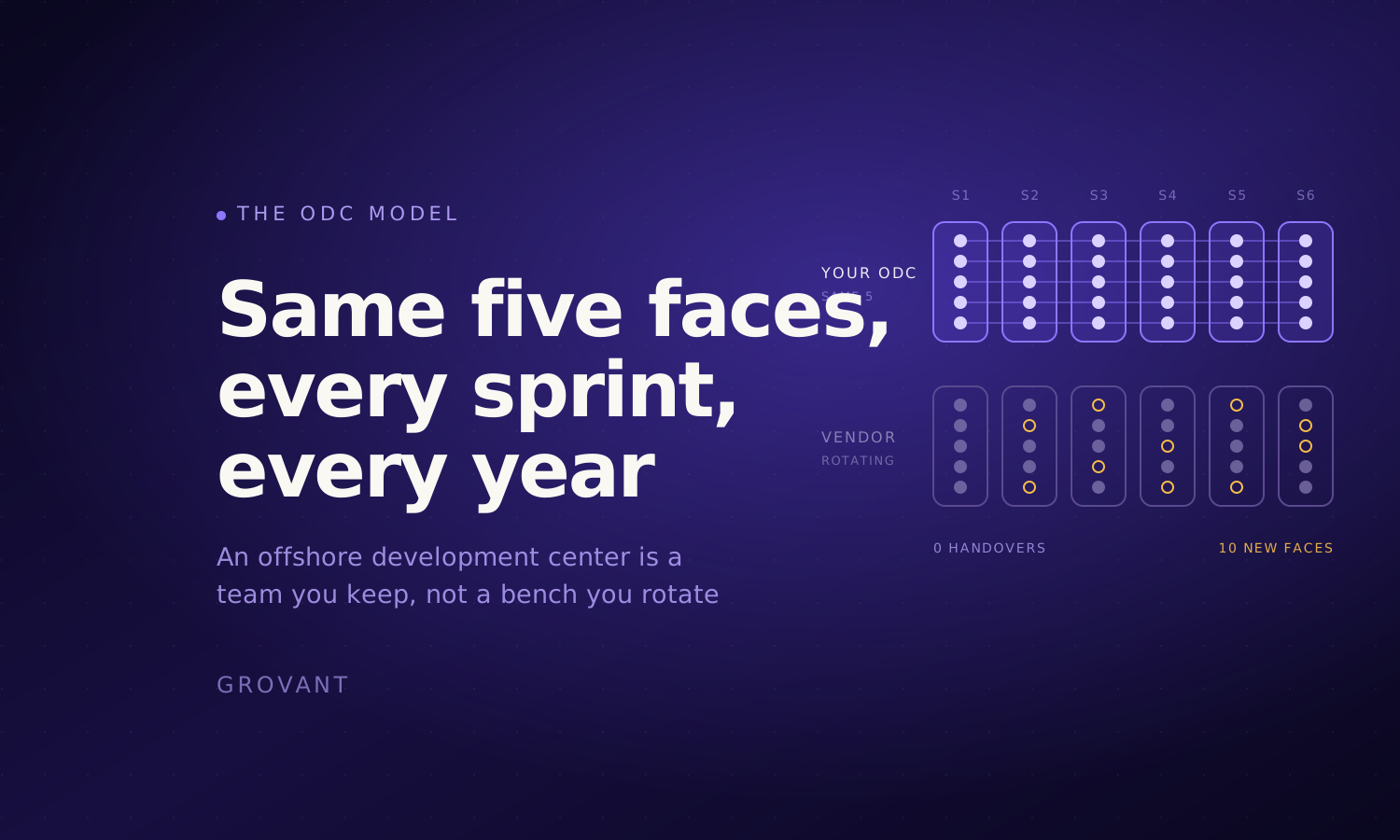
This is why named key personnel clauses matter more than the rate you negotiated.
4. Onboarding, which is real but badly measured
Every source claiming senior engineers take six to twelve months to reach full productivity is an HR software vendor's blog with no data behind it. We looked. So instead of quoting a fake number: expect the first four to six weeks to be slower than the quote assumes, and hold something back in the budget for it. That is our own delivery experience, not a statistic, and we would rather say so.
Does the cheapest region win?
Usually not, and the reason is timezones rather than talent.
Asia's senior band at $31 to $41 an hour is genuinely the lowest, and there are excellent engineers across the region. The cost is communication latency. If your team is in New York and your developers are in Karachi or Manila, a question asked at 4pm gets answered tomorrow. Two of those in a week and you have lost a sprint day to waiting.
That matters more than most buyers expect, because communication is not a soft issue in this work. It is the leading cause of failure. A peer-reviewed study in PLOS ONE surveyed practitioners across Pakistan, Malaysia and Saudi Arabia and ranked the categories of problems that cause software development outsourcing to fail. Communication came first, ahead of management, requirements, and cultural differences. The top three individual issues were all communication-related, things like deficient informal correspondence and delayed replies.
So the honest framing is this. Buy Asia rates when the work is well-specified and asynchronous, like a defined backlog or a mature product with clear tickets. Pay the Latin America or CEE premium when the work needs conversation, which means anything early-stage, exploratory, or architecturally undecided.
| Your situation | Where the money is best spent |
|---|---|
| Defined backlog, stable architecture, clear acceptance criteria | Asia rates, async process, strong written specs |
| Early-stage product, requirements still moving | LATAM or CEE, pay for the timezone overlap |
| You have no senior engineer in-house to direct the work | Managed delivery anywhere, never staff augmentation |
| Regulated data, or IP you cannot risk | Nearshore with a real contract, not the lowest bidder |
Why rates are falling, and what it means for you
Accelerance attributes the 2026 decline to competition, automation, and AI-augmented developer supply. More firms chasing the same buyers, with tooling that makes each developer nominally more productive.
Here is what that means practically. Falling rates are a buyer's market, so negotiate. But falling rates also compress margins, and compressed margins are exactly when a vendor starts quietly staffing your project with cheaper people. The bait and switch gets more likely in a soft market, not less.
So use the leverage on terms rather than purely on price. A named senior engineer written into the contract is worth more to you than another $5 an hour off the rate.
And a genuine counterpoint worth knowing, because it complicates the story: ManpowerGroup's 2026 survey of over 6,000 US employers found only 9 percent are sourcing talent globally from cost-effective markets in response to talent scarcity. Upskilling, at 27 percent, and raising wages, at 25 percent, are far more common. Offshoring is not the default answer that offshore marketing suggests. It is one option that works well for specific situations.
How to price your own decision this week
Forget the rate comparison. Build both numbers properly and compare them once.
- Your in-house cost: target salary, times 1.43 to add the BLS benefits load, plus about $1,300 cost per hire, plus 39 days of not having anyone in the seat.
- Your offshore cost: quoted rate times realistic annual hours, plus 20 to 30 percent for your management time, ramp-up and rework.
- Compare those two. Not the salary against the hourly rate.
- Then check the non-financial ones: hours of timezone overlap, who specifically is assigned, what happens to the code if you leave.
- Run a two-week paid pilot before committing to a year. It is the only way to find out whether the rate you were quoted reflects the team you will get.
Do the maths honestly and offshore often still wins, just by less than the brochure claims. Do it dishonestly and you will spend the year explaining a variance.
If you are earlier in this process, our guide to outsourcing software development covers the delivery models and failure modes, and how to choose a development partner has the vetting questions and contract terms worth arguing about. If you are weighing a long-term dedicated team rather than a single project, see what an offshore development center is and what one costs to run.