A year ago, "ChatGPT ads" was a rumor. In February 2026 it was an invite-only test that, according to AdExchanger's reporting, came with a $200,000 minimum commitment and a $60 CPM.
Today? Any eligible business in 89 countries and territories can sign up, set a $25 daily budget and launch the same afternoon. More than 100,000 advertisers already have, according to OpenAI.
That's a huge shift in under a year. And it means most of what you'll read about ChatGPT ads is already out of date. So everything below comes straight from OpenAI's own announcements and its advertiser Help Center. Where a number comes from press reports instead, we flag it.
Let's dive in!
$25/day
Minimum daily budget in the US
OpenAI Help Center
$3 to $5
OpenAI's suggested starting max bid per click
OpenAI Help Center
1.2 billion
People using ChatGPT each week
OpenAI, Oct 2026
What are ChatGPT ads?
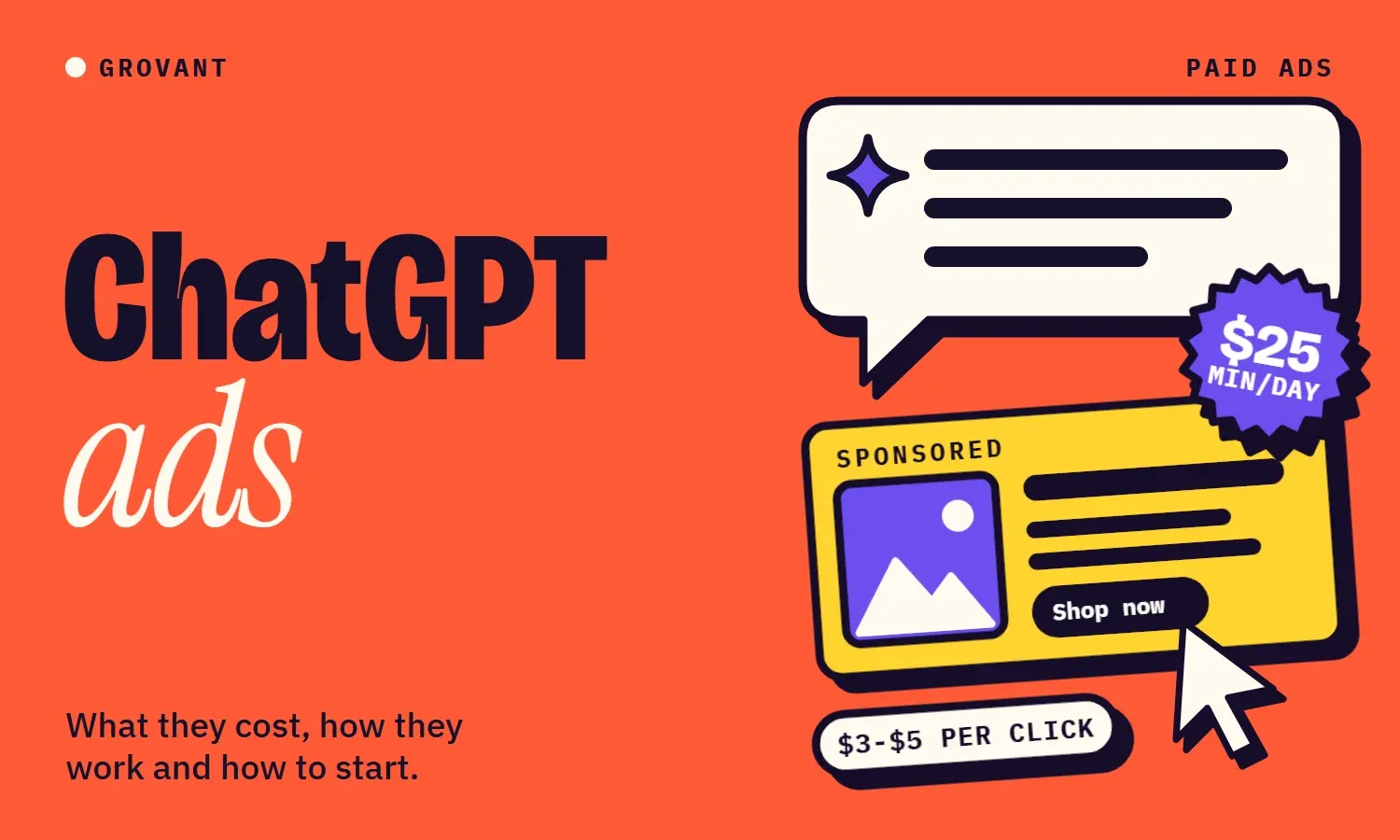
ChatGPT ads are paid placements that appear in ChatGPT, clearly labeled as sponsored and kept separate from the answer. According to OpenAI's Help Center, each ad shows the advertiser's name, logo, a headline, a short description, an image and a link to your landing page.
There are currently two places an ad can show up:
- Below a ChatGPT response. One ad unit, with one or several images. This is the main format.
- During image generation. A multi-image visual ad that shows while ChatGPT creates an image, then disappears when the image is ready. Announced on 5 October 2026 and first tested with US advertisers. Search Engine Roundtable spotted it live in ChatGPT on 10 November.
Who sees them
Only logged-in adults on the Free and Go plans. Plus, Pro, Business, Enterprise and Edu accounts don't get ads, and OpenAI doesn't show them to accounts it identifies as under 18. Free users can also switch to an ads-free mode in exchange for lower message limits, and Temporary Chats never show ads (OpenAI Help Center).
Why does that matter? Because if you sell B2B, many of the senior buyers you'd love to reach use ChatGPT through a paid company plan. They'll never see your ad. Free and Go users lean toward consumers, students, freelancers and small business owners, so build your offer around them.
Do ads change ChatGPT's answers?
No, according to OpenAI. Ads "run on separate systems from our chat model", and advertisers can't shape, rank or alter responses. Advertisers also never see conversations, only aggregated numbers like views and clicks. Which means one very practical thing: you can't buy your way into the answer itself. Getting recommended in the organic response is still an SEO and GEO job, which we cover in our guide to ChatGPT SEO.
How ChatGPT ads are matched to conversations
If you've run Google Ads, forget most of what you know here. There are no exact-match keywords. Instead, OpenAI's system picks ads based on "expected relevance and outcomes", using:
- The context and intent of the current conversation
- Your ad's landing page, title and copy
- Context hints you write at the ad group level, describing the conversations, topics or keywords where your offer is relevant
- Your targeting choices: countries (and, for most campaigns, states, cities or postal codes), platforms and optional custom audiences
- If the user has ad personalization on: past chats, memory and past ad interactions
OpenAI is explicit that context hints "are not exact-match keywords and do not guarantee delivery in specific conversations." When several ads are eligible, it ranks them on a mix of relevance and bid.
Here's the thing most advertisers will miss. Your landing page and ad copy aren't just there to convert. They're part of the targeting. A vague page about "solutions for growing businesses" gives the system nothing to match. A page about "payroll for restaurants with tipped staff" does.
Two targeting details catch people out. To target only the US you must explicitly include the United States (excluding other countries isn't enough), and new self-serve accounts may only be able to advertise in their home country until they build some history (OpenAI Help Center). Custom audiences need at least 25,000 matched users for inclusion targeting, and personalized ads aren't available in the EEA or Switzerland yet.
How much do ChatGPT ads cost?
Good news first. There's no minimum commitment anymore. In the US you need a daily budget of at least $25, and OpenAI recommends starting with a maximum bid of $3 to $5 per click for click campaigns. What you actually pay is set by the auction, so it depends on who else wants the same conversations.
One big change landed on 9 November. New campaigns no longer use a hard maximum bid. Click campaigns bid to a Target CPC and conversion campaigns to a Target CPA: you name the average you want to pay, and the system manages each individual bid. Or you can skip the target and let intelligent bidding chase results within your budget. Campaigns still on Max Bid or Max CPC have until 1 January 2027 to switch (OpenAI Help Center). With no history yet, OpenAI's $3 to $5 click guidance is a sensible first Target CPC. Once you have a few weeks of data, OpenAI suggests setting targets from your recent actual CPA or CPC.
The three ways to buy
| Objective | You pay for | Best for |
|---|---|---|
| Views | Every 1,000 impressions (CPM) | Awareness and new product launches |
| Clicks | Each valid click (CPC) | Driving traffic to a page with one clear next step |
| Conversions | Valid clicks (oCPC) or impressions (oCPM), while the system optimizes for a conversion event | Sign-ups, leads or purchases, once tracking is set up |
How the daily budget really works
Your daily budget is an *average* over a Sunday-to-Saturday week, not a hard daily cap. OpenAI can spend up to twice your daily budget on a single day, but never more than seven times it across the week (OpenAI Help Center). A $100 daily budget means up to $200 on a busy day and no more than $700 for the week.
The minimum depends on your billing currency. A few examples from OpenAI's table:
| Billing currency | Minimum daily budget |
|---|---|
| US dollar | $25 |
| British pound | £15 |
| Euro | €15 |
| Canadian / Australian dollar | 25 CAD / 25 AUD |
| Indian rupee | ₹725 |
| Pakistani rupee | 2,100 PKR |
| UAE dirham | 65 AED |
What a starter test buys you
So what does the minimum actually get you? At $25 a day and OpenAI's suggested $3 to $5 per click, roughly 5 to 8 clicks a day, if your bids clear the auction.
Over a month, that's about $760 in spend for around 150 to 250 visits. Enough to learn something, not enough to scale anything. And to be clear, that's our arithmetic, not a forecast. Real CPCs depend on how crowded your category is.
Compare that with launch day and you'll see how fast this moved. AdExchanger reported a $200,000 minimum and a $60 CPM when the pilot opened in February, and Digiday reported that a later $50,000 minimum was dropped when self-serve opened to US businesses on 5 May 2026. OpenAI itself never published those figures, so treat them as history, not a price list.
ChatGPT ads timeline: from pilot to self-serve
| Date | What changed | Source |
|---|---|---|
| 9 Feb 2026 | Ads test starts in the US for logged-in adults on Free and Go | OpenAI |
| Feb 2026 | Reported $200,000 minimum commitment and $60 CPM, agency partners only | AdExchanger (reported) |
| 26 Mar 2026 | Expansion announced to Canada, Australia and New Zealand | OpenAI |
| 5 May 2026 | Beta self-serve Ads Manager opens, CPC bidding added, Conversions API and pixel launched | OpenAI |
| 5 May 2026 | Reported $50,000 minimum spend dropped | Digiday (reported) |
| 11 Aug 2026 | Ads live in the UK, Mexico, Brazil, Japan and South Korea | OpenAI |
| 18 Aug 2026 | Expansion across Europe | OpenAI |
| 23 Sep 2026 | Expansion to Southeast Asia and Taiwan | OpenAI |
| 5 Oct 2026 | Visual ad format during image generation; new measurement and attribution partners | OpenAI |
| 21 Oct 2026 | Expands to 26 more countries, 89 in total; OpenAI says over 100,000 advertisers have run campaigns | OpenAI |
| 9 Nov 2026 | Target CPA and Target CPC replace Max Bid and Max CPC for new campaigns; the old options retire on 1 Jan 2027 | OpenAI Help Center |
| 10 Nov 2026 | Visual ads during image generation spotted live in ChatGPT | Search Engine Roundtable (reported) |
| 12 Nov 2026 | Aleph named exclusive ChatGPT Ads reseller in 44 countries, alongside self-serve and technology partners | OpenAI |
How to advertise on ChatGPT: step by step
Here's the process, based on OpenAI's quickstart guide:
- Check availability. The legal entity that will be billed must be based in a country where self-serve is available. The availability list covers the US, UK, Canada, most of Europe, India, Pakistan, the UAE and others.
- Create your account at ads.openai.com. Sign in with an OpenAI account on your work email, add your logo, set up billing and complete account verification.
- Create a campaign. Pick the objective (Views, Clicks or Conversions), a bidding strategy (Target CPC for clicks, Target CPA for conversions, or intelligent bidding), budget, dates, countries and platforms (Android app or web, desktop web, iOS app or web).
- Build ad groups around one intent each. Write context hints describing the conversations you want to show up in, like "comparing payroll software for a 20-person company".
- Write the ads. Title, description, image and landing page. Add UTM parameters to the URL so your analytics can tell ChatGPT traffic apart.
- Submit for review. Every ad is checked against OpenAI's ad policies before it runs.
- Set up conversion tracking. Use the pixel or Conversions API, or connect a partner. OpenAI lists integrations with Shopify, HubSpot, Hightouch, Tealium, LiveRamp and attribution tools like AppsFlyer, Triple Whale and Northbeam.
- Watch the numbers. Impressions, clicks and CTR update about every 15 minutes. Spend can lag 7 to 8 hours, so a $0 spend figure doesn't mean nothing has been charged.
Example context hints by business type
Context hints work best when they describe the situation a buyer is in, not just a product name. These are our illustrations of the approach, not OpenAI examples:
| Business | Weak hint | Stronger hints |
|---|---|---|
| Payroll software | payroll software | comparing payroll tools for a small business; switching from spreadsheets to payroll software; how to pay contractors in several states |
| Roofing company | roofer | roof leaking after a storm; cost to replace an asphalt roof; how to choose a roofing contractor |
| Online skincare store | moisturizer | skincare routine for dry skin in winter; fragrance-free moisturizer options; gift ideas for someone into skincare |
| B2B marketing agency | marketing agency | how to get more leads for a small business; outsourcing Google Ads management; hiring an agency vs a freelancer |
What you can't advertise on ChatGPT
OpenAI's ad policies are stricter than Google's or Meta's. Ads also never appear next to conversations about personal health, mental health or politics.
| Status | Categories |
|---|---|
| Not allowed | Political ads, gambling, alcohol and tobacco, recreational drugs, adult content and dating, counterfeit goods, specific job or housing listings, unsupported wellness claims, scams |
| Restricted, US only, case by case | Financial services (for example credit cards, insurance, mortgages, brokerages) and health services (for example dental, vision, health insurance, medical devices); proof of licensure may be required |
| Restricted, US only | Legal services, only from advertisers licensed where the ad is shown |
| Generally fine | Software, SaaS, e-commerce, B2B services, education, travel, home services, consumer products |
Your landing page is reviewed too. It has to match the ad, and claims about pricing, results or comparisons have to be accurate.
ChatGPT ads vs Google Ads vs Meta Ads
| ChatGPT ads | Google Search ads | Meta ads | |
|---|---|---|---|
| What triggers the ad | Conversation context plus your context hints | The search query, via keywords | Audience targeting and the algorithm |
| Buying options | CPM, CPC, conversion-optimized, with Target CPA and Target CPC bidding | Mostly CPC and smart bidding | CPM-based with many optimization goals |
| Who sees it | Adult Free and Go users only | Anyone searching | Facebook, Instagram and other Meta users |
| Measurement maturity | New: pixel, Conversions API, growing partner list | Very mature | Very mature |
| Best use today | Testing a high-intent new channel | Capturing existing demand | Creating demand and retargeting |
Do ChatGPT ads actually work? The early results look promising, but keep in mind who picked them. In its October announcement, OpenAI cited partner data showing WeightWatchers' attributed cost per acquisition on ChatGPT ads was 15.3 percent lower than its blended paid-search benchmark (DV Rockerbox), and that 93 percent of Portland Leather's visitors from ChatGPT ads were new to the brand (Triple Whale). Those are real case studies. But they're the best ones OpenAI chose to share, not averages. Nobody launches a new ad platform with their worst results.
Running ads for clients rather than your own brand? The same channel-by-channel logic applies, just with more moving parts. Our white-label Google Ads playbook and white-label Meta ads guide cover how agencies price, staff and report on those two channels today.
Should your business run ChatGPT ads?
Our honest take? Test it. Don't move your budget into it yet.
Think of it like a new restaurant opening in town. Worth trying, definitely not where you book your wedding dinner. Here's how to tell whether your business should be in the first wave:
| Run a test now if | Wait if |
|---|---|
| People research your category by asking questions (software, travel, home services, e-commerce) | You sell in a restricted category like finance or health outside the US |
| You already track conversions properly and can judge a new channel | You can't measure leads or sales from your website yet |
| You can spare $750 to $1,500 for a month-long test | Your Google and Meta campaigns aren't profitable yet |
| Your buyers use free AI tools (consumers, students, small business owners) | You only sell to enterprise teams on paid ChatGPT plans |
A four-week test plan
| Week | What to do | What to check |
|---|---|---|
| Before launch | Set up the pixel or Conversions API, add UTM tags, build one landing page per buyer situation | A test conversion shows up in Ads Manager and in your analytics |
| Week 1 | Launch one Clicks campaign with two or three ad groups, $25 to $50 a day, Target CPC of $3 to $5 | Ads pass review and start serving; CTR by ad group |
| Week 2 | Pause the weakest ad group, rewrite its hints and copy, raise bids only where delivery is limited | Cost per click and landing page engagement |
| Weeks 3 to 4 | Hold settings steady so the numbers mean something | Cost per lead or sale against your Google and Meta numbers for the same offer |
One warning before you start tweaking. Spend data lags by 7 to 8 hours, and the daily budget can double on a single day. So a scary-looking Tuesday means nothing on its own. Judge the week, not the day.
Don't skip the organic side
Here's what a lot of advertisers will get wrong. Ads only appear below the answer. The answer itself, where ChatGPT names the brands it recommends, can't be bought. Being recommended there depends on your content, your reviews and how often other sites mention you. Claim your free business profile through the ChatGPT Business Hub, and treat ads and organic AI visibility as two halves of the same plan.
Not sure if ChatGPT ads fit your business, or how they'd sit next to your Google and Meta campaigns? That's exactly the kind of question we help brands and agencies answer. Start with our Google Ads management page and get a second opinion before you spend.
Want us to deliver this for you?
One senior specialist, start to finish. Free proposal, no pressure.