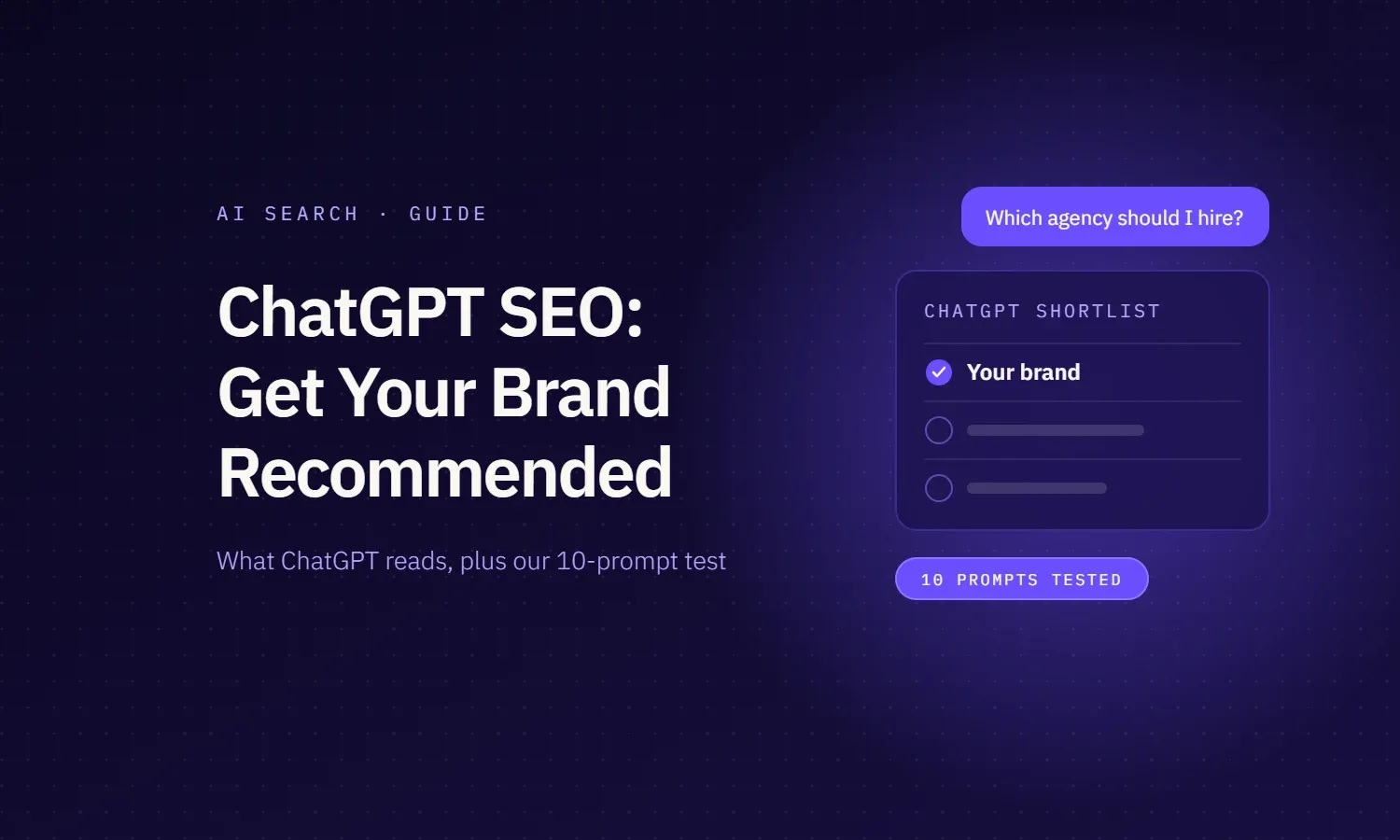
ChatGPT SEO is the work of getting your brand named when buyers ask ChatGPT who to hire. For those questions, ChatGPT usually searches the web first and builds its shortlist from what it finds: third-party roundups, review platforms such as Clutch, and the facts brands state plainly on their own sites. In our test of 10 buyer prompts, every answer was built this way, and none of the recommended brands got there by paying.
You cannot buy a place in the answer. You can raise your odds with five actions, in the order we would do them:
- Make sure ChatGPT can find you (allow OAI-SearchBot, get indexed in Bing).
- State the facts buyers filter on, in plain sentences, on your own pages.
- Get onto the roundups and review sites ChatGPT cites.
- Earn mentions where your buyers already talk.
- Run the same prompts every month and fix what is missing.
What ChatGPT reads, according to OpenAI
OpenAI publishes how its crawlers and search features work. Most ChatGPT SEO advice skips this, so here is what the official docs say and what each part means for your brand.
| Source | What it does | What you control |
|---|---|---|
| OAI-SearchBot | Crawls pages so they can appear in ChatGPT search answers | Allow it in robots.txt. Sites that block it are not shown in search answers (only as plain navigational links). Changes take about 24 hours to apply. |
| GPTBot | Crawls content that may be used to train OpenAI's models | A separate setting. Blocking GPTBot does not remove you from search answers. |
| ChatGPT-User | Visits a page when a user's question needs it | Not used to decide what appears in search. OpenAI notes robots.txt rules may not apply to it. |
| Third-party search providers | ChatGPT may send search queries to providers such as Bing | Check that your key pages are indexed in Bing, not only Google. |
| Product feeds | Merchants can submit product data for shopping results (live in the US) | Optional. ChatGPT can also read your site without a feed. |
| Ads | Sponsored listings, labelled and shown apart from the answer | OpenAI states that ads do not influence the answers. An ad does not put you in the answer. |
The takeaway: ChatGPT's recommendations come from the open web. There is no separate index to submit to and no paid route into the answer, which is why ChatGPT SEO sits inside generative engine optimization rather than apart from it. The work is getting the right facts onto the pages ChatGPT actually pulls.
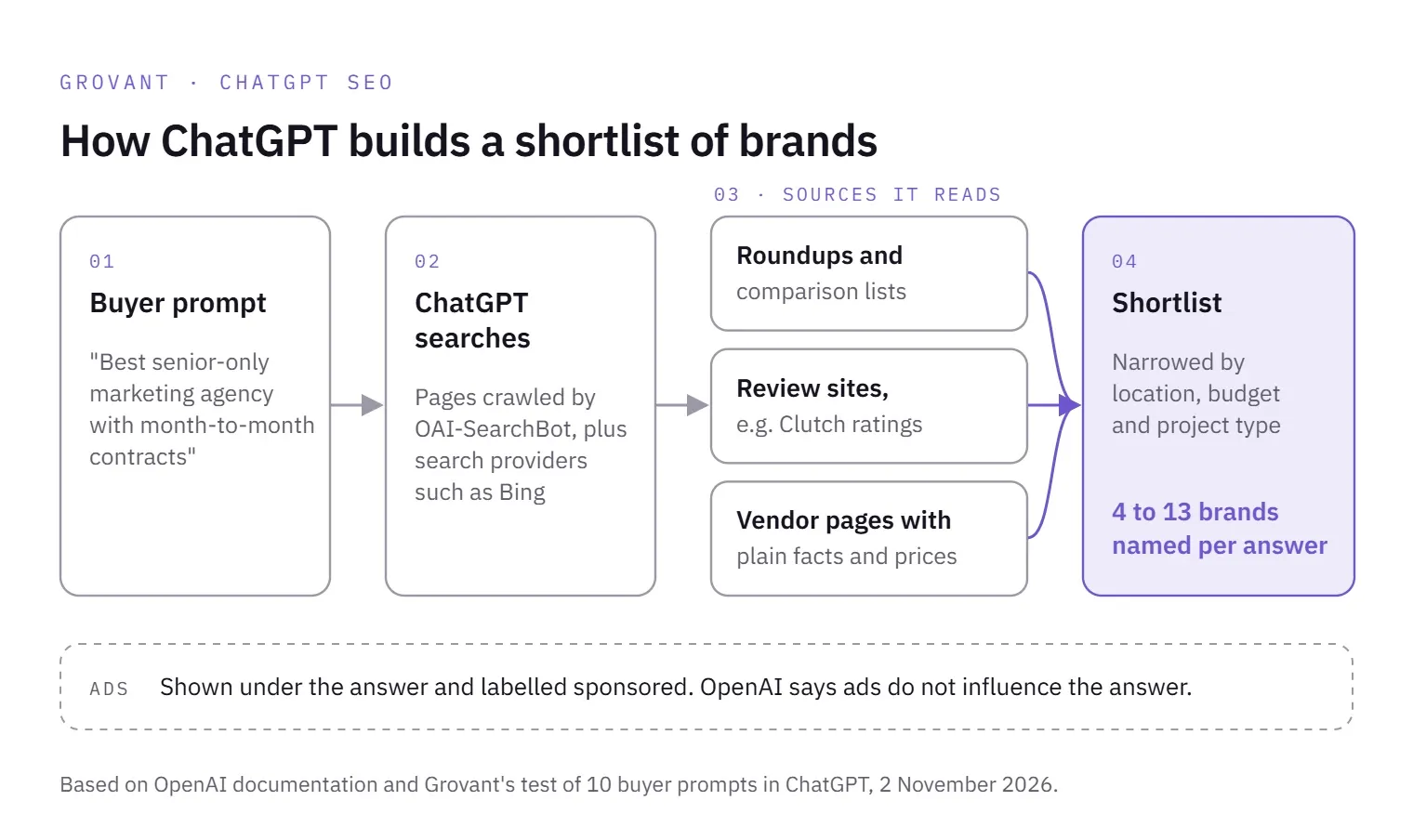
Our baseline test: 10 buyer prompts in ChatGPT
On 2 November 2026 we ran 10 buyer-style prompts in ChatGPT (free plan, logged in, default settings). Each prompt went into a fresh chat. For every answer we recorded how many companies were recommended, what evidence the answer leaned on, and whether Grovant was named. The prompts cover services we sell, so this is also our own starting point.
| Prompt | Companies named | Grovant named? | Evidence ChatGPT showed |
|---|---|---|---|
| 1. Best white label SEO company for agencies | 5 | No | Vendor sites and third-party roundups |
| 2. Which agency should a B2B startup hire for SEO | 5 | No | Comparison articles |
| 3. White label PPC management for agencies | 13 | No | Provider pages and a 2026 comparison |
| 4. Web design agency for startups that want to own their Figma files | 5 | No | Vendor pages stating Figma ownership |
| 5. Best Google Ads agency for small businesses in the US | 5 | No | Clutch ratings and review counts |
| 6. Company to build an AI agent for customer support | 4, plus 3 software tools | No | Vendor service pages |
| 7. Best offshore development company for a dedicated team | 4 | No | Clutch ratings and vendor pages |
| 8. Best B2B PR agency for SaaS startups | 5 | No | 2026 industry roundups |
| 9. White label Meta ads management for agencies | 6 | No | Vendor pages (pricing, NDA, reporting) |
| 10. Best senior-only marketing agency with month-to-month contracts | 5 | No | Vendor pages (contract terms, prices) |
In total ChatGPT named 57 companies (54 different ones). Grovant was not one of them.
What the test showed
- Grovant appeared in 0 of 10 answers. That includes prompt 10, which describes how we work almost word for word. This is our baseline, and it is the honest starting point for most young brands.
- Third-party proof did the heavy lifting. Several answers were built from roundups and comparison lists, and two (prompts 5 and 7) quoted Clutch ratings and review counts directly, such as "4.9/5 from 370 Clutch reviews".
- ChatGPT repeats what vendors state plainly. For the Figma prompt it favoured agencies that say on their own site that clients own the files. For the month-to-month prompt it repeated terms like "30-day rolling contracts" and published starting prices. If a fact is not written on your page, ChatGPT has nothing to quote.
- Location changed the answer. Our test account is outside the US. In 4 of 10 answers ChatGPT added agencies from our own country without being asked, and in a fifth it asked whether we wanted local providers. OpenAI's help docs confirm that ChatGPT shares a general location with its search providers, so test from the market you sell to.
- Ads appeared, but apart from the answer. At least 6 of 10 answers had a labelled sponsored listing underneath, with a note that ads do not influence ChatGPT's answers. None of the advertisers appeared in the recommendations.
- Every answer ended with filter questions about budget, location or project type. ChatGPT uses those to narrow the shortlist, so your pages should answer them: who you serve, where, and roughly what it costs.
How to get recommended by ChatGPT: 5 steps
1. Make sure ChatGPT can find you
- Check that your robots.txt allows OAI-SearchBot. You can block GPTBot (training) and still allow search, because OpenAI treats them as separate settings.
- Submit your sitemap in Bing Webmaster Tools and confirm your service pages are indexed there, since ChatGPT may run its searches through providers such as Bing.
- Put key facts in plain page text, not only inside images, PDFs or sliders.
- An llms.txt file is optional. We cover what it does and does not do in our llms.txt guide.
2. State the facts buyers filter on
In our test, ChatGPT quoted contract terms, starting prices, file ownership and locations straight from vendors' pages. Write those facts on your service pages, one per sentence:
- Who you serve (company size, industry, region).
- What is included, and what is not.
- How you price, even if it is a range or a custom quote.
- Contract terms, notice periods and who owns the work.
- Who actually does the work, and where they are based.
Use the same wording on your site, your profiles and your listings. Conflicting facts give ChatGPT a reason to pick someone clearer.
3. Get onto the lists ChatGPT cites
Run your buyer prompts, open the sources on each answer, and note which roundups and review sites keep appearing. Then work through them: collect reviews on the platforms it quotes (Clutch appeared twice in our test), ask the authors of relevant roundups to consider you with real details, and publish honest comparison pages of your own.
4. Earn mentions where your buyers talk
ChatGPT searches the open web, so useful answers in communities such as Reddit and LinkedIn, guest pieces in industry publications and podcast appearances all add to what it can find about you. Answer the question properly first; a mention of your brand does not need a link to count.
5. Keep pages fresh, then test again
Update facts when they change and show a last-updated date on key pages. Then re-run your prompts every month to see what moved, as shown below.
How to check if you rank in ChatGPT each month
You do not need a paid tool to start. This is the method we used above:
- Write 10 to 20 buyer prompts. Mix "best X for Y", "who offers X", "A vs B" and problem-led prompts such as "how do I fix X".
- Use a fresh chat for every prompt. A Temporary Chat keeps your past conversations and memory out of the answer.
- Test from your buyers' market. Location shaped 5 of our 10 answers. If you sell into the US from elsewhere, ask a contact there to run the prompts, or use a tracker that runs them from US locations.
- Record the same fields each time: whether you were named, your position, which competitors were named, and which sources were cited.
- Run each prompt more than once. Answers vary between runs, so one result is a sample, not a rank.
- Compare month to month and act on the sources you are missing from.
| Prompt | Named? | Competitors | Sources cited | Next action |
|---|---|---|---|---|
| Best senior-only marketing agency with month-to-month contracts (2 Nov 2026) | No | 5 | Vendor pages | State contract terms on service pages |
Once you track more than a handful of prompts, a tool saves time. We compared the options on price, platforms and limits in our guide to AI visibility tools.
Where Grovant fits
We ran this test on our own brand first, and the baseline is zero. Over the coming months we are applying the five steps above to grovant.co, and we will publish each monthly re-test on this page, whatever it shows.
If you would rather have senior specialists do this for your brand, our SEO services cover the technical setup, the on-page facts and the third-party work that ChatGPT draws on. We work month to month, on a custom quote.
Sources
- Overview of OpenAI crawlers, OpenAI
- Testing ads in ChatGPT, OpenAI, updated 7 May 2026
- ChatGPT search, OpenAI Help Center
- ChatGPT for merchants, OpenAI
- Grovant baseline test, 10 prompts in ChatGPT, 2 November 2026