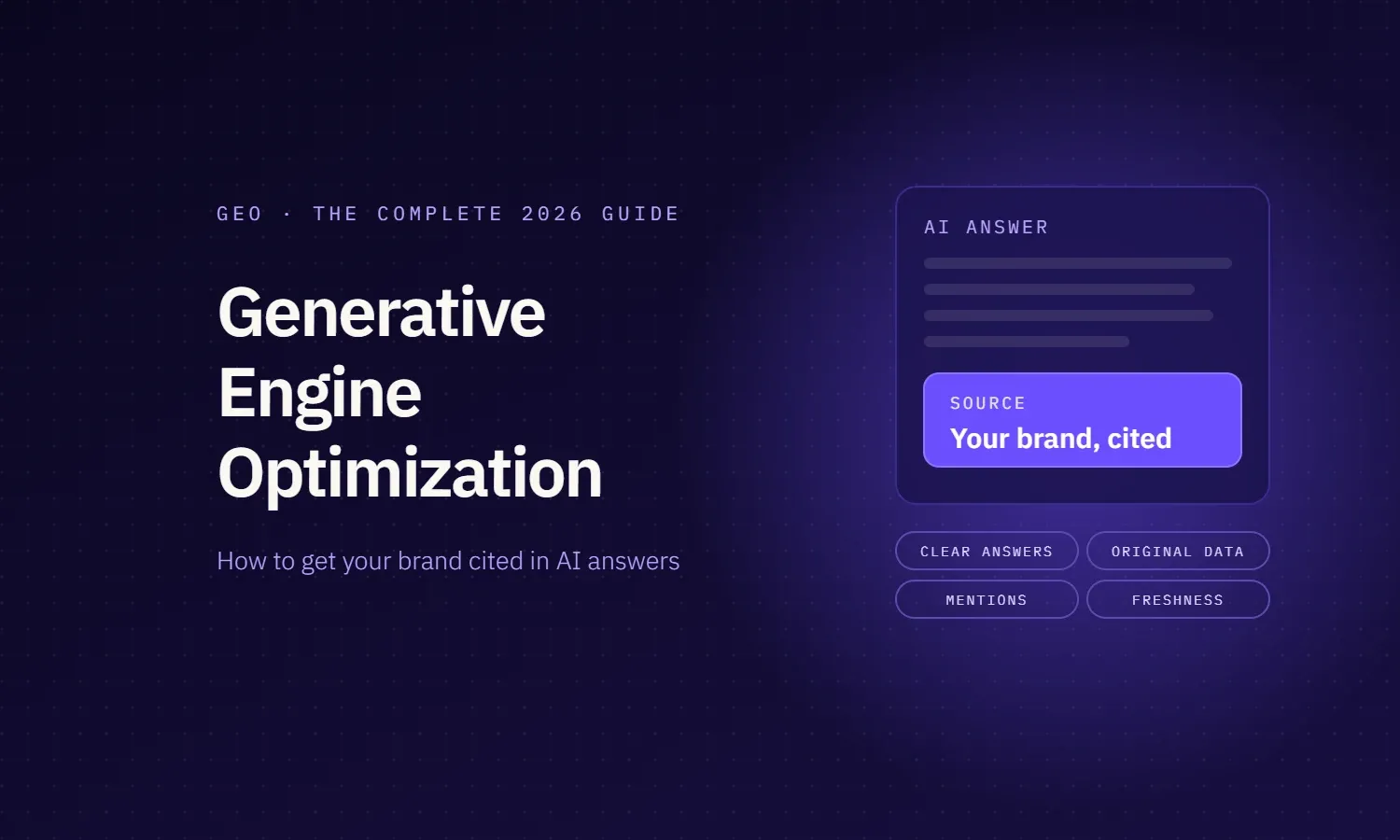
Generative engine optimization (GEO) is the practice of shaping your content and reputation so AI engines such as ChatGPT, Perplexity, Gemini and Google AI Overviews mention and cite your brand in their answers. GEO does not replace SEO. Most AI answers still draw on pages that rank well, so GEO is SEO plus extra work on clarity, evidence and reputation.
How GEO differs from SEO and AEO
The three terms overlap. The difference is where the answer appears and what counts as a win.
| Aspect | SEO | AEO | GEO |
|---|---|---|---|
| Goal | Rank pages in search results | Win direct answers, snippets and voice results | Get cited or mentioned in AI-written answers |
| Where | Google and Bing results pages | Featured snippets, People Also Ask, voice assistants | ChatGPT, Perplexity, Gemini, AI Overviews, AI Mode |
| Win looks like | A click from a ranking | Your text shown as the answer | Your brand named or linked in the AI reply |
| Main levers | Relevance, links, technical health | Concise answers, question formatting | Clear answers, original data, mentions, freshness |
For a deeper side-by-side, read our guide to GEO vs SEO.
How AI engines choose sources
AI engines search, read a handful of pages, then write an answer and cite some of them. Three dated studies show what that means for brands.
| Study | Date | Finding |
|---|---|---|
| Aggarwal et al., Princeton and IIT Delhi (KDD 2024) | 2023, revised Jun 2024 | GEO methods raised visibility in AI answers by up to 40%. Adding quotations and statistics worked best; keyword stuffing scored below baseline. |
| Pew Research Center | Data Mar 2025, published Jul 2025 | Users clicked a normal result in 8% of Google visits with an AI summary, vs 15% without. Only 1% clicked a link inside the summary. |
| Ahrefs, 300,000 keywords | Data Dec 2025, published Feb 2026 | When an AI Overview shows, the top-ranking page gets a 58% lower average click-through rate. |
Two lessons follow. First, AI engines favour content with evidence: quotes, numbers and sources. Second, being the cited source matters more than ranking alone, because fewer people click through.
Sources: GEO paper, Pew Research, Ahrefs.
The 4 levers AI engines reward
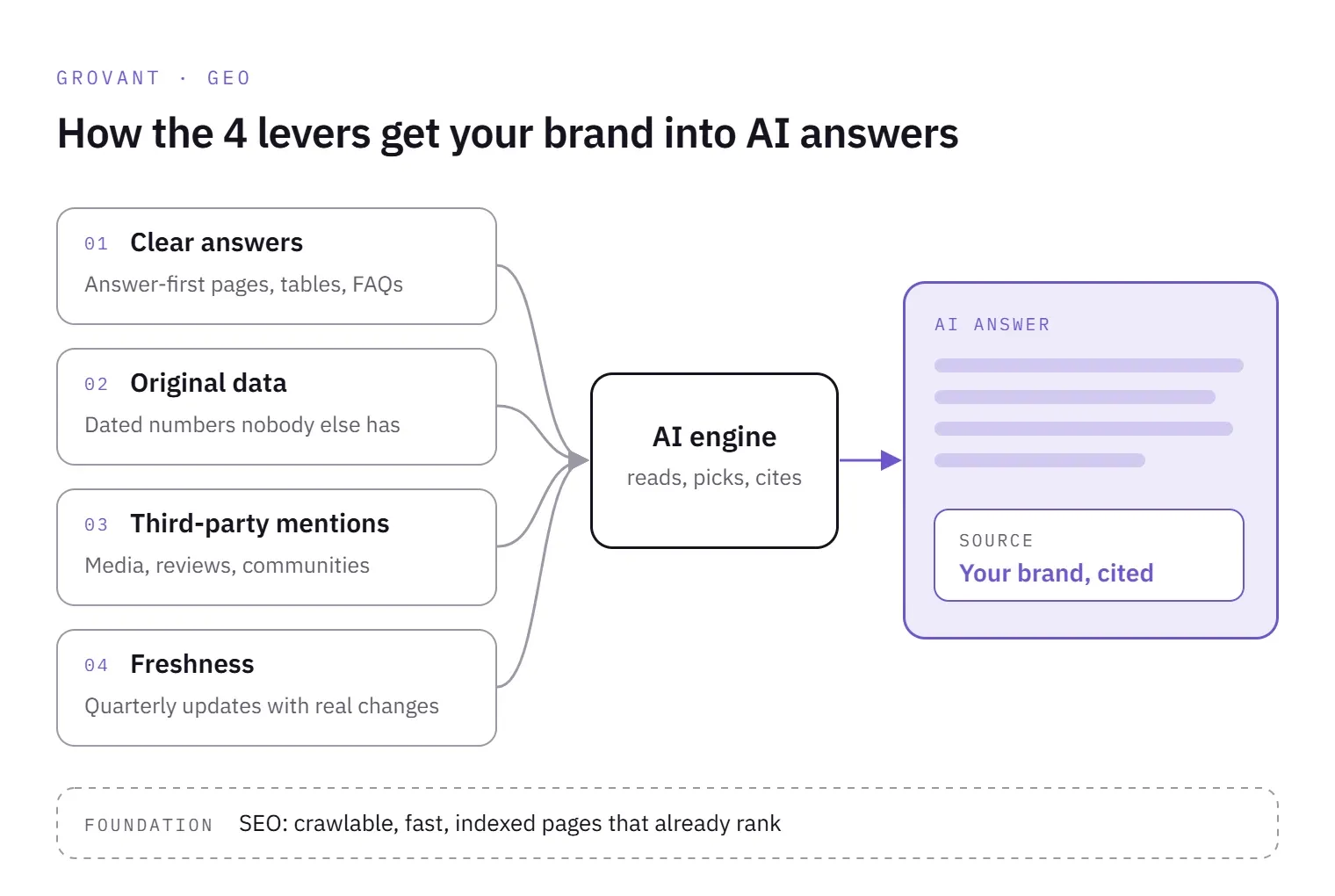
1. Clear answers
AI engines lift short, self-contained passages. Put the direct answer in the first one or two sentences under each heading, then add the detail. Use question-style headings that match how people ask, and keep one idea per paragraph.
- Open each page with a one-sentence definition or verdict
- Use tables for comparisons and numbered steps for processes
- Add an FAQ block with full-sentence answers
This is the same discipline behind a good SEO content strategy: one page, one question, one clear answer.
2. Original data
The GEO paper found that adding statistics and quotations gave the biggest lift. Data nobody else has is the strongest version of that. Publish your own numbers: survey results, pricing benchmarks, before and after results, or patterns from client work. Date every figure and name the source.
3. Third-party mentions
AI engines trust what others say about you more than what you say about yourself. Pew found Wikipedia, YouTube and Reddit are the most cited sources in Google AI summaries. Earn mentions where your buyers read: trade media, review sites, podcasts, Reddit threads and industry lists.
- Get quoted as an expert in trade and industry media
- Keep review profiles and directory listings complete and current
- Answer real questions in communities, without spam
For agencies that want to offer this to clients, see white label GEO.
4. Freshness
AI engines prefer current facts, especially for prices, tools and anything with a year in the query. Review key pages every quarter, update numbers and examples, and show an honest "last updated" date. Change real content, never just the date.
A note on llms.txt: an llms.txt file can help AI tools find your best pages, but it is not a ranking lever on its own. We cover what it does and does not do in Does llms.txt help AI search?
What we see in real analytics
We analysed Google Analytics 4 and Search Console data for a travel website in South Asia, including Search Console's new Generative AI report. The data covers two back-to-back 28-day periods between late August and mid-October 2026. It is one site, so treat it as a field note, not a benchmark.
Finding 1: About 3 in 10 Google impressions now come from AI features
Search Console's Generative AI report shows how often pages appear in AI Overviews and AI Mode. For this site, AI features logged about 86,200 impressions in the latest 28 days, against roughly 282,000 total Search impressions. That is close to a third of all visibility, and it held steady: about 85,400 in the 28 days before (+1%).
| Page (AI feature impressions) | Prior 28 days | Latest 28 days | Change |
|---|---|---|---|
| Region guide A | 8,297 | 16,065 | +94% |
| Region guide B | 10,567 | 14,555 | +38% |
| City guide | 2,248 | 3,188 | +42% |
| Local hiking trails list | 5,157 | 3,695 | -28% |
| National hiking guide | 3,285 | 781 | -76% |
The steady total hid big moves underneath. 155 pages appeared in AI features, 45 of them new compared with the prior 28 days, and the top 5 pages took almost half of all AI impressions. Broad region guides that answer "what is" and "where is" questions gained, while both hiking pages lost ground, one of them by 76% in a month. Track AI visibility page by page, not just as a site total.
The report shows impressions only, not clicks, so it tells you where you appear, not what it earns you.
Finding 2: Why AI clicks alone mislead you
Over the same two periods, visits from AI assistants told a very different story from AI impressions.
| Source (GA4 sessions) | 25 Aug to 21 Sep | 22 Sep to 19 Oct | Change |
|---|---|---|---|
| ChatGPT | 108 | 56 | -48% |
| Gemini | 11 | 16 | +45% |
| Claude, Copilot, Perplexity and others | 9 | 0 | -100% |
| All AI sources | 128 | 72 | -44% |
| Google organic | 2,109 | 2,030 | -4% |
| Bing organic | 41 | 33 | -20% |
In Google's AI features the site was seen as often as before (+1%), yet visits from AI assistants fell 44% and the number of AI sources sending traffic dropped from six to two. Judged on AI clicks alone, this would look like a bad month. Judged on visibility, it was a steady one.
The lesson: AI referral traffic is small (about 2% to 4% of sessions here) and swings from month to month. Use it as one signal next to AI impressions and citation tracking, never as the only GEO metric. Also note that some AI visits arrive without a referrer, so GA4 undercounts them.
Finding 3: Good rankings on questions, almost no clicks
In Search Console (21 Sep to 18 Oct 2026), question-style queries such as "what is", "where is" and "best" earned 7,881 impressions at an average position of about 5 to 6, but only 35 clicks (0.44% CTR). One guide ranked at position 1.2 for 386 impressions and got zero clicks. This pattern is consistent with the answer being shown on the results page, in an AI Overview or a snippet.
Finding 4: People now search like they prompt
Queries of eight or more words included full requests such as "plan a weekend trip to a nearby national or state park". These long, conversational queries read like AI prompts: 56 of them earned 344 impressions and just 1 click.
Finding 5: Brand searches convert
Searches for the brand name had an 8.4% CTR, about 17 times the site average of 0.5%. People who already know your name click. That is why third-party mentions matter so much in GEO.
How to measure GEO
Measure GEO with three signals, because no single tool shows the full picture.
| Signal | Where to find it | What it tells you |
|---|---|---|
| AI referral traffic | GA4 Traffic acquisition, filtered to chatgpt.com, perplexity.ai, gemini.google.com and copilot | Visits AI engines send you (undercounted when no referrer is passed) |
| AI Overviews and AI Mode impressions | Search Console Generative AI performance reports (launched June 2026, rolling out to some sites) | How often your pages appear in Google AI features; clicks are not shown yet |
| Citations and mentions | Manual prompt tracking or an AI visibility tool | Whether AI engines name or link your brand for buyer questions |
How we track prompts at Grovant
- List 20 to 50 questions your buyers ask, one per service or topic.
- Map each question to the page that should answer it.
- Every month, ask each question in ChatGPT, Perplexity, Gemini, Google AI Overviews and Claude.
- Score each answer: Cited (linked as a source) = 2, Mentioned (named, no link) = 1, Not present = 0.
- Track the total score over time, and fix the pages behind the lowest scores first.
AI answers change from one run to the next, so look at the trend across months, not one result. To automate the checks, see our comparison of the best AI visibility tools.
Source: Google Search Central blog, June 2026.
A step-by-step GEO plan
- Get the SEO basics right. AI engines lean on pages that already rank, so fix crawling, speed and indexing first.
- Pick your prompts. Write down the questions buyers ask AI about your category, and run the baseline score above.
- Rewrite key pages answer-first. Add a one-line answer, question headings, tables and an FAQ block to each page mapped to a prompt.
- Publish one piece of original data. A benchmark, survey or before-and-after result that others will quote.
- Earn third-party mentions. Expert quotes in trade media, reviews, community answers and industry lists.
- Refresh every quarter. Update facts, prices and examples on pages that matter, with an honest updated date.
- Measure monthly. Prompt score, AI referral traffic and AI impressions, judged on the trend.
Summary: the 4 levers at a glance
| Lever | What to do | How you know it works |
|---|---|---|
| Clear answers | Answer-first openings, question headings, tables, FAQs | Your text quoted in AI answers |
| Original data | Publish dated numbers nobody else has | Others cite your figures |
| Third-party mentions | Media quotes, reviews, communities, lists | Brand named in AI answers; branded search grows |
| Freshness | Quarterly updates with real changes | AI answers quote your current facts |
Where Grovant fits
GEO works best as part of SEO, not as a separate project. Our SEO team runs both: one senior specialist owns technical fixes, answer-first content, original data and the monthly prompt score.
Every engagement starts with a free audit and a custom quote based on scope. Terms are month to month.
Sources
- Aggarwal et al., GEO: Generative Engine Optimization (arXiv, KDD 2024)
- Pew Research Center: Google users are less likely to click on links when an AI summary appears (Jul 2025)
- Ahrefs: AI Overviews reduce clicks, update (Feb 2026)
- Google Search Central: Search Generative AI performance reports (Jun 2026)