On 14 October, a Google results page showed up with something new on its left edge: the AI Mode chat sidebar, sitting right next to the classic blue links.
Google hasn't announced it. Most people can't see it yet. And in June, a senior Google search executive said publicly that there is no plan to make AI Mode the default for Chrome searches.
Here is our take, and the evidence behind it: Google doesn't need to flip a default switch. Through 2026 it has been rebuilding the results page around AI Mode one small, easy-to-miss step at a time. And the one tool that should tell you what this costs your site, Search Console, can't.
1B+
monthly AI Mode users
Google I/O, May 2026
2x
AI Mode queries, every quarter
"more than doubling" since launch
8%
of visits clicked a result with an AI summary (15% without)
Pew Research Center
4
spam updates in 2026, against 2 core updates
Google Search Status Dashboard
What actually showed up on 14 October
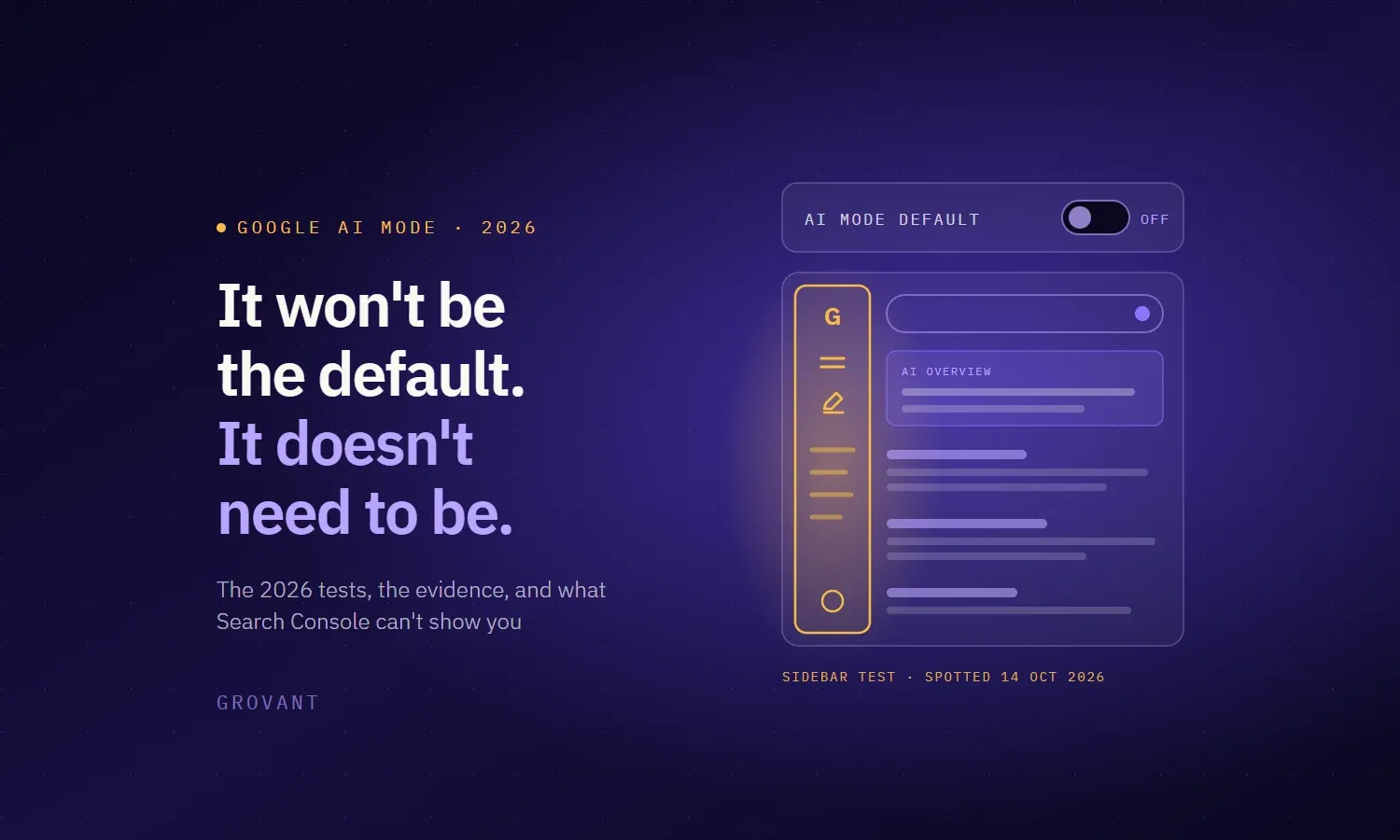
Search Engine Roundtable's Barry Schwartz reported a screenshot from Damien Andell showing the vertical sidebar from AI Mode on the main web results page: the small "G" logo, your AI Mode chat history, a button to start a new AI Mode chat, and a settings icon. Scroll down and the regular results are still there.
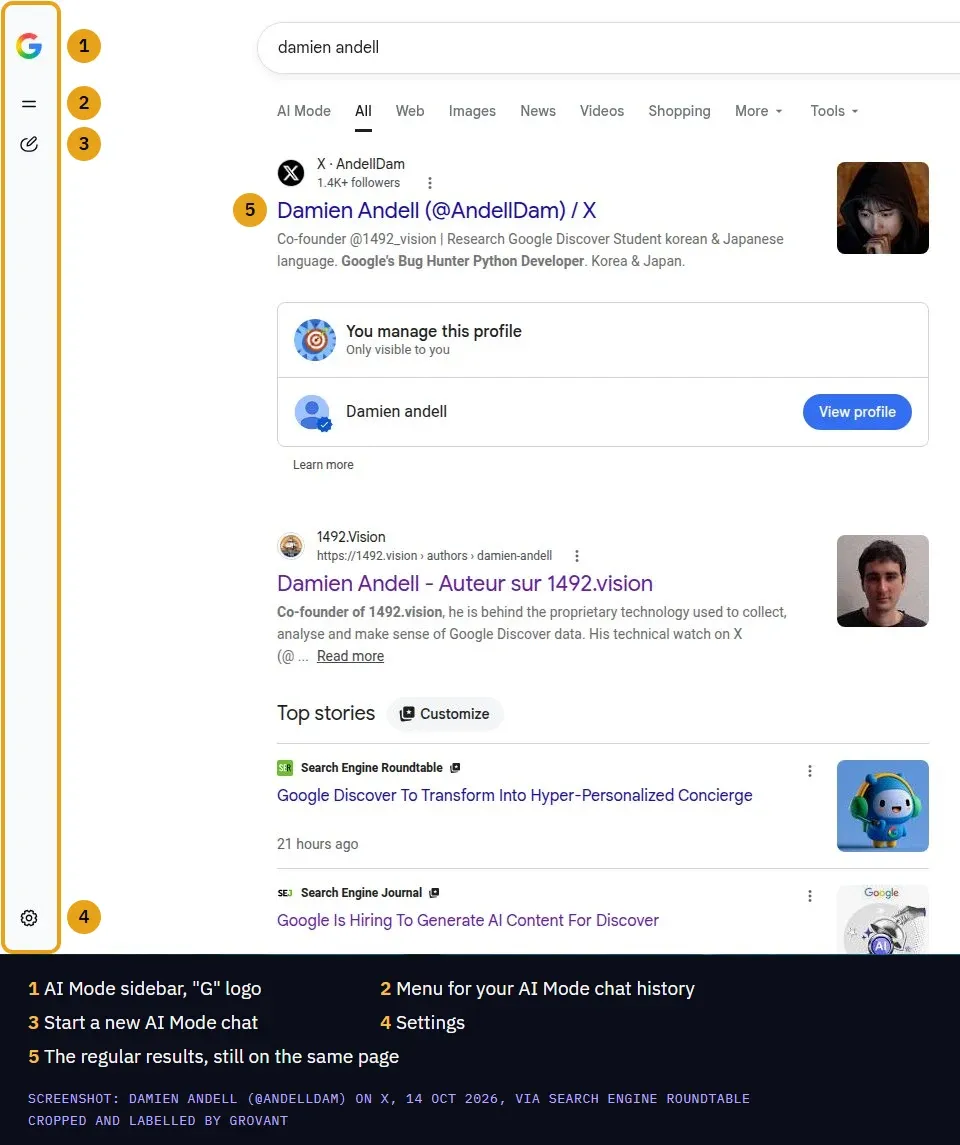
You can see Andell's original post on X here.
Andell believed it had rolled out to everyone. Schwartz couldn't reproduce it in any of his browsers, so treat it as a limited test. Marie Haynes first said she could see her Gemini app conversations in the sidebar, then corrected herself: they were chats from the Gemini overlay on her Android phone. Google has not commented.
On its own, a sidebar test is a footnote. Google runs experiments on the results page constantly. What makes this one worth your attention is where it sits in the sequence.
Google's official line
In June, a flag in Chrome Canary named "Fulfill Searchbox Queries in AI Mode" sent address-bar searches straight into AI Mode. Google's VP of Search Engineering, Rajan Patel, responded publicly that it appeared in error and that Google is not planning to make AI Mode the default for Chrome searches.
We take that at face value. It is also narrower than it sounds. It is a statement about the Chrome address bar. It says nothing about what the results page itself turns into.
Now line up the receipts
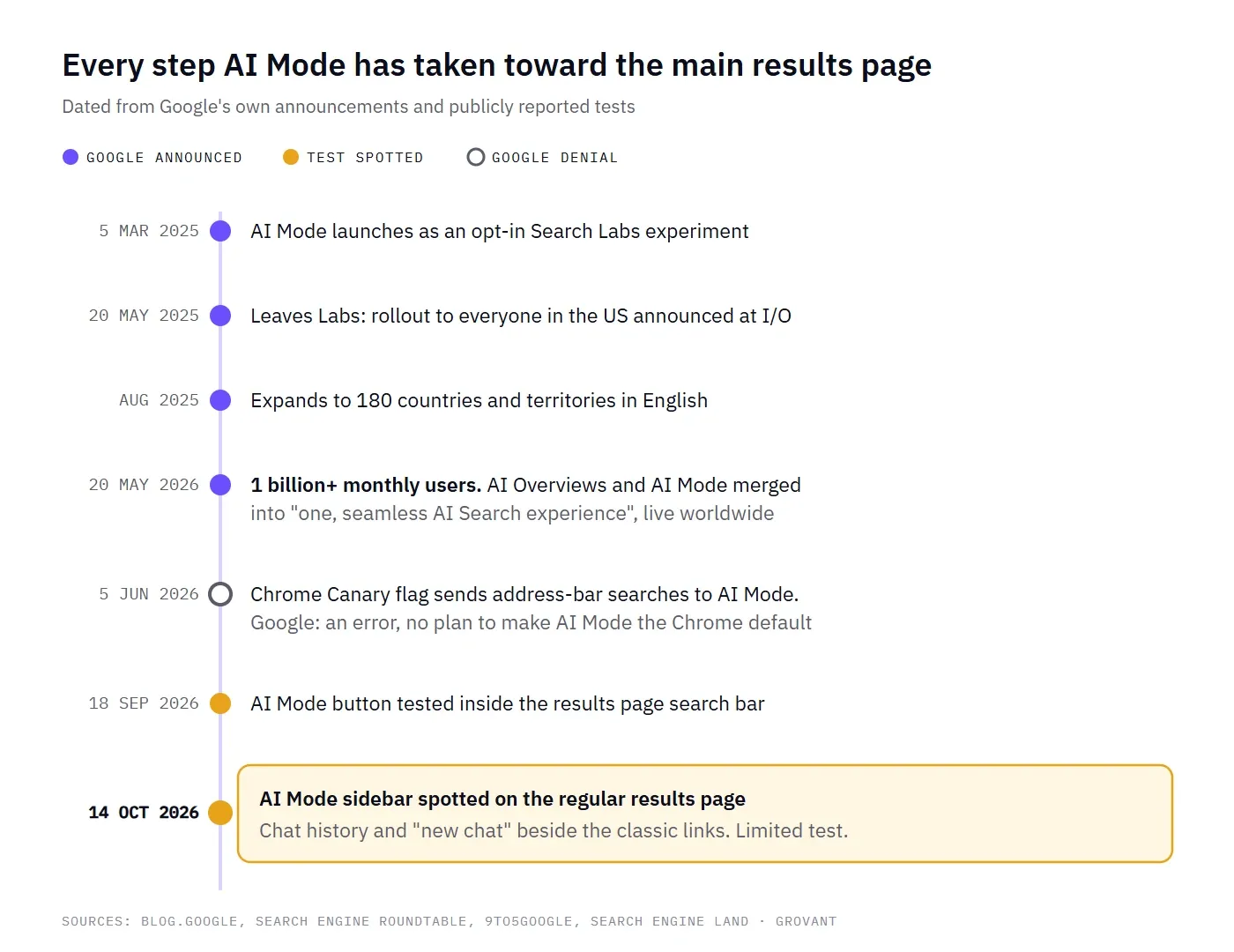
Put Google's own announcements and the reported tests in date order and the direction is hard to miss.
| Date | What happened | Source |
|---|---|---|
| 5 Mar 2025 | AI Mode launches as an opt-in Search Labs experiment | Google blog |
| 20 May 2025 | Google announces AI Mode is leaving Labs and rolling out to everyone in the US | TechCrunch |
| Aug 2025 | AI Mode expands to 180 countries and territories in English | Search Engine Land |
| 20 May 2026 | AI Mode passes 1 billion monthly users; AI Overviews and AI Mode become one AI Search experience | Google blog |
| 5 Jun 2026 | Chrome Canary flag routes searches to AI Mode; Google calls it an error | 9to5Google |
| 18 Sep 2026 | AI Mode button tested inside the search bar on the results page | Search Engine Roundtable |
| 14 Oct 2026 | AI Mode sidebar tested on the regular results page | Search Engine Roundtable |
The May 2026 step is the one most people skimmed past. At Google I/O, Google said it was "bringing AI Overviews and AI Mode into one, seamless AI Search experience", so a search can move from a results page with an AI Overview to a follow-up in AI Mode. It went live on desktop and mobile, worldwide. In the same announcement, Google said AI Mode queries were "more than doubling every quarter since launch."
So a road from the classic results page into AI Mode already runs through every search that shows an AI Overview. The button test puts AI Mode in the search bar on the results page. The sidebar test puts your AI Mode history beside the links. None of these makes AI Mode the default. Together, they make it the obvious next click.
Why it matters: follow the clicks
Every step deeper into an AI answer is a step away from a click to your site. The best independent data comes from Pew Research Center, which tracked the real Google searches of 900 US adults in March 2025:
- With an AI summary on the page, people clicked a regular result in 8% of visits. Without one, 15%.
- People clicked a link inside the AI summary itself in just 1% of visits.
- People ended their browsing session on 26% of pages with an AI summary, against 16% of pages without one.
Google disputes the doom reading. Liz Reid, Google's head of Search, wrote in August 2025 that total organic click volume has been "relatively stable year-over-year" and that Google is sending "slightly more quality clicks", meaning clicks where people don't quickly bounce back. The post did not include figures.
Both can be true at once: fewer clicks per search, more searches overall. Which side your site lands on depends on whether you are the source the AI answer leans on. And that is where it gets uncomfortable, because you can't easily check.
The blind spot almost nobody talks about
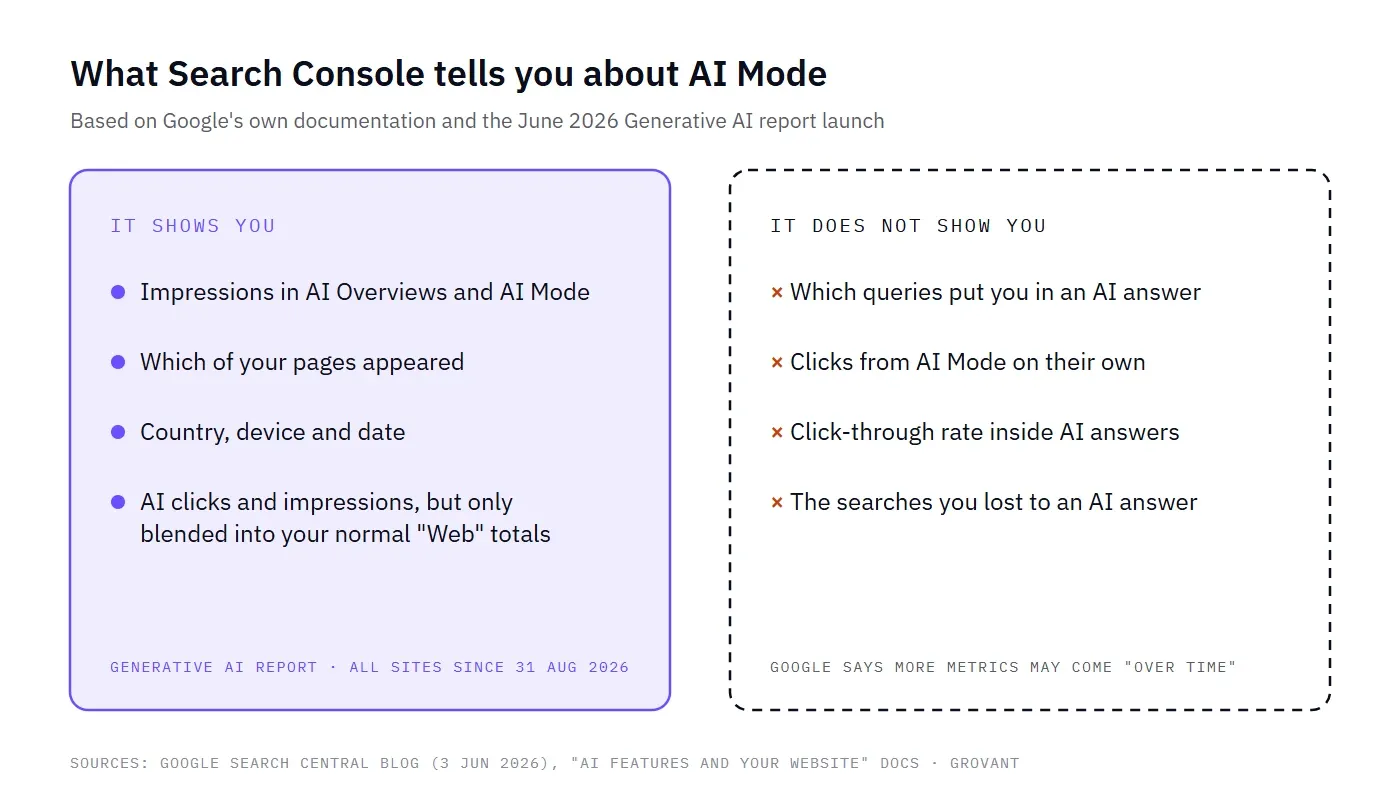
If AI Mode is taking clicks from you, Search Console will not show you directly. Here is what Google's own documentation says:
- AI Overviews and AI Mode traffic is included in your overall Search Console traffic, reported "within the 'Web' search type". It is blended in, with no filter to pull it out.
- In June 2026 Google launched Search Generative AI performance reports, rolled out to all websites on 31 August. They show impressions in AI Overviews and AI Mode, by page, country, device and date.
- They do not show clicks, click-through rate or the queries behind those impressions. Google says it may add "additional metrics over time".
So you can now see that your page appeared in an AI answer. You cannot see which question put it there, or whether anyone clicked. If your clicks drop while your rankings hold, there is no line in Search Console that says "AI Mode did this".
A workaround you can run today
- Open the Generative AI report and export the pages with AI impressions over the last three months.
- In the normal Performance report, filter to those pages and compare clicks and click-through rate with the same period a year earlier.
- Flag pages where AI impressions are rising, clicks are falling and average position is steady. Those are your best estimate of where AI answers are absorbing the click.
It is a proxy, not proof. But it turns "traffic feels down" into a list of pages you can do something about.
Meanwhile, Google is cleaning house
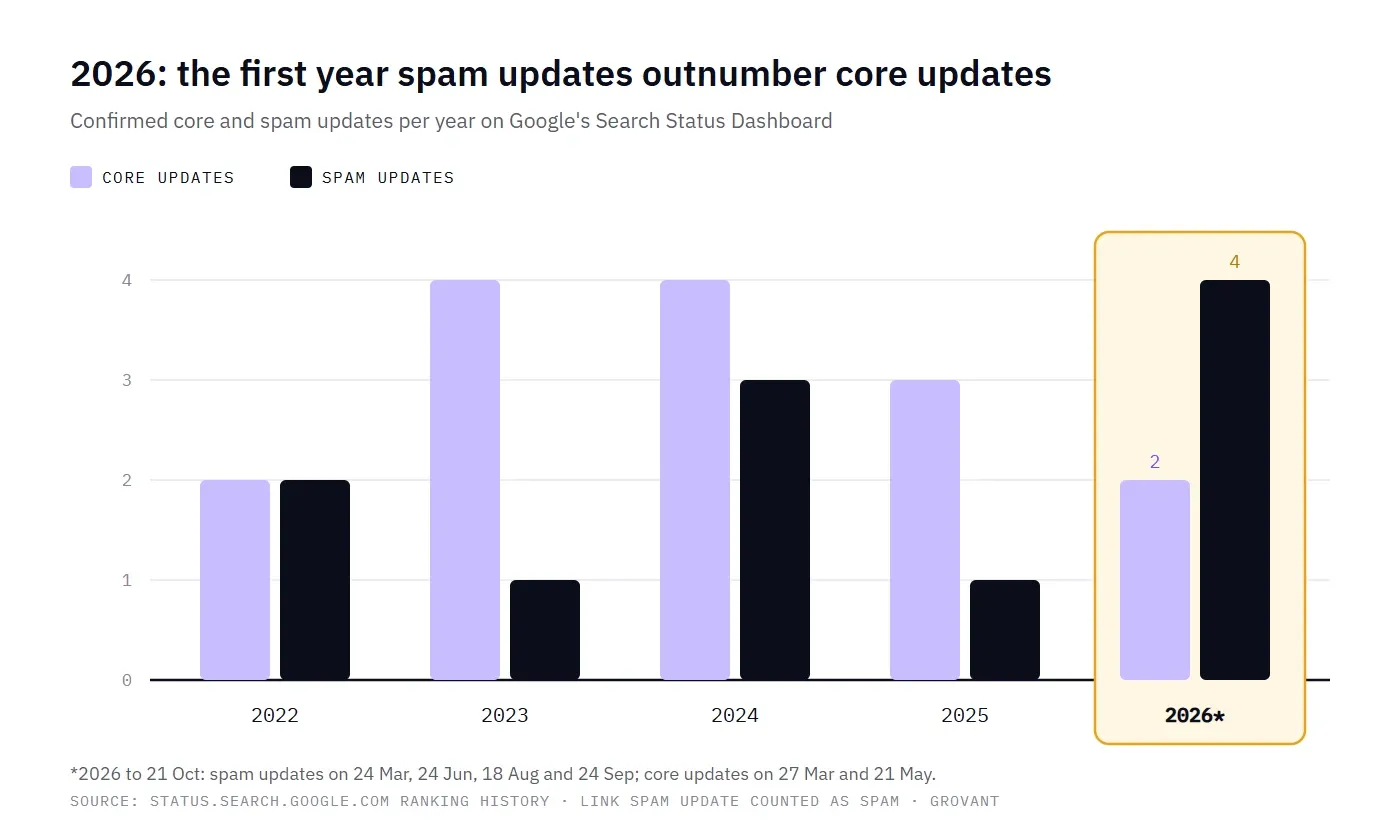
Here is a number we haven't seen anyone else point out. Count the confirmed updates on Google's own Search Status Dashboard and 2026 is the first year in its history, which goes back to late 2021, where spam updates outnumber core updates: four spam updates (24 March, 24 June, 18 August and 24 September) against two core updates (27 March and 21 May).
The September spam update was also the longest of the four, at 13 days and 16 hours, against under three days for the June and August updates. Google hasn't said which spam policies any of them targeted. For more on the August one, see our breakdown of the August 2026 spam update.
Two quieter documentation changes sit alongside the updates:
- Google's spam policies now define spam to include "attempting to manipulate generative AI responses in Google Search", a change reported in May 2026. Gaming AI answers is now, officially, spam.
- On 1 October, Google updated its guidance on AI-generated content: it is "critical to manually factcheck and review all AI-generated content" before publishing, and the review "also applies to metadata", naming titles, meta descriptions, structured data and image alt text.
What to do this week
None of this calls for panic, and none of it calls for a magic "AI SEO" product. Here is what the evidence actually supports.
- Ignore anyone selling "AI Mode schema". Google's AI features documentation is blunt: there are "no additional requirements to appear in AI Overviews or AI Mode", and "no special schema.org structured data" to add. Solid, indexable pages are the entry ticket.
- Write for the fan-out, not just the keyword. Google says AI features may use "query fan-out", issuing "multiple related searches across subtopics and data sources". A page that also answers the follow-up questions (costs, comparisons, edge cases) gives the answer more reasons to use it.
- Ask readers to make you a preferred source. Google's preferred sources documentation says that in AI Mode and AI Overviews, your content can be highlighted with a "preferred" badge for people who chose your site. The button takes two lines of HTML. Only domain or subdomain sites qualify, not subfolders.
- Run the impressions vs clicks check above every month, so you see the shift in Search Console before it shows up in revenue.
- Fact-check everything, including the parts nobody reads. Titles, meta descriptions, structured data and alt text are now explicitly part of Google's review advice.
- Don't try to game the answer. Planting self-serving lists or stuffing pages to get recommended by AI now sits inside the spam definition. Earn mentions instead: original data, clear company facts and coverage on sites AI tools already trust. Our GEO vs SEO vs AEO guide explains how those layers fit together.
- Know your off switch. If you want content kept out of AI features, Google's controls are nosnippet, data-nosnippet, max-snippet and noindex. Use them with care: they also limit how you appear in regular results.
One thing that won't fix this on its own: an llms.txt file. Here is what it does and doesn't do.
What we think happens next
To be clear, this section is opinion.
We don't expect a big announcement that "AI Mode is now the default". We expect more of what 2026 has already shown: AI Mode entry points in more places, the classic results still on the page, and more of the decision happening inside the AI layer. If the sidebar ships widely, every results page becomes a doorway into AI Mode with your history already loaded.
The sites that do well in that world are the ones AI answers cite by name: the clearest, best-sourced page on a question, from a brand other sites already talk about. Ranking still matters, because AI answers draw on pages Google already trusts. It just isn't the finish line anymore.
That is the work our SEO team does under the GEO label: making sure the pages that matter are the ones AI answers can find, trust and quote. Agencies can also offer it to their own clients under their own brand with white label GEO.
Sources
- Search Engine Roundtable: Google testing AI Mode left sidebar on main results page
- Damien Andell on X: the original AI Mode sidebar screenshot
- Search Engine Roundtable: AI Mode button inside the results page search bar
- 9to5Google: Chrome test sends searches to AI Mode
- Google: 100 things announced at I/O 2026
- Google: Expanding AI Overviews and introducing AI Mode
- TechCrunch: AI Mode rolls out to the US
- Search Engine Land: AI Mode in 180 countries
- Google Search Status Dashboard: ranking update history
- Search Engine Roundtable: September 2026 spam update done
- Google Search Central: Search Generative AI performance reports
- Google Search Central: AI features and your website
- Google Search Central: spam policies
- Gizmodo: Google's spam policies now apply to AI manipulation
- Google Search Central: using generative AI content
- Google Search Central: preferred sources
- Pew Research Center: Google users click less when an AI summary appears
- Google: AI in Search is driving more queries and higher quality clicks