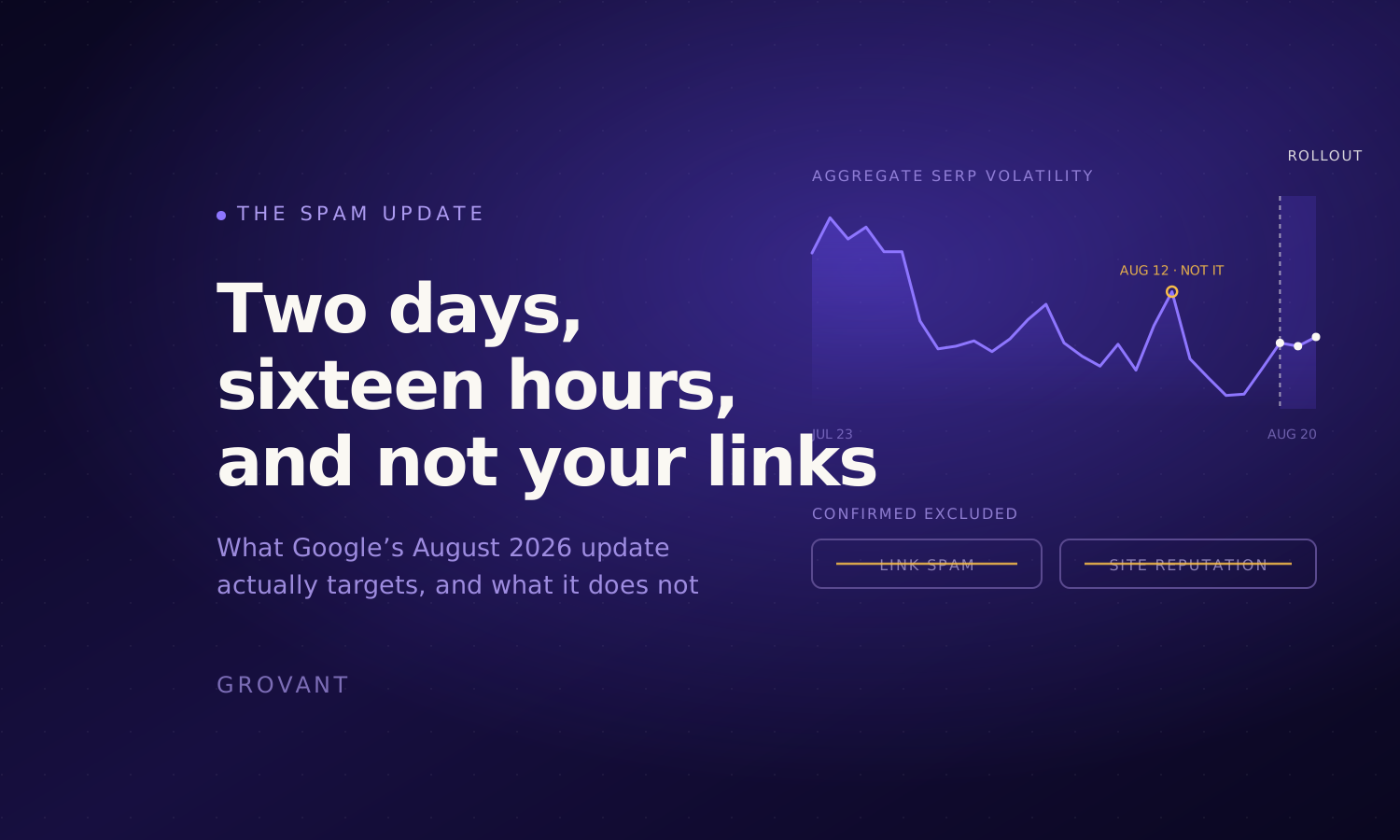
Google finished rolling out the August 2026 spam update this morning, August 21, at 4:50 am ET. It started on Tuesday, August 18 at around 12:30 pm ET, which puts the whole thing at two days and sixteen hours from launch to done.
That is the third spam update this year, after March 24 and June 24. Three in five months. Google normally spaces these out with a couple of core updates in between, so the current pace is unusually tight.
Here is the part most coverage buried. Google called it "a normal spam update," introduced zero new policies, and confirmed to Search Engine Roundtable that it does not target link spam and does not target the site reputation abuse policy.
So if you woke up to a traffic drop and your first instinct was to blame your backlinks, hold on. This update almost certainly was not that.
Let's break down what it actually does, and whether you need to care. Let's dive in.
2d 16h
Total rollout time
Aug 18, 12:30 pm ET to Aug 21, 4:50 am ET
3rd
Spam update of 2026
After March 24 and June 24
0
New spam policies introduced
Policy doc unchanged since May 15, 2026
What Google actually said
The entire announcement was two sentences on the Search Status Dashboard:
Released the August 2026 spam update, which applies globally and to all languages. The rollout may take a few days to complete.
No blog post. No new documentation. Google's spam policies page has not been touched since May 15, 2026.
That silence is the message. Spam updates are not Google changing the rules. They are Google getting better at enforcing rules that already exist. SpamBrain, Google's AI spam-detection system, got a tune-up. The 16 spam policies it enforces are the same ones that were on the books last month.
What it targets, and what it leaves alone
Google confirmed this update hits "some" of its spam policies, not all of them. The confirmed exclusions matter as much as the inclusions.
| Spam policy | Status for this update |
|---|---|
| Link spam | Confirmed excluded by Google |
| Site reputation abuse (parasite SEO) | Confirmed excluded by Google |
| Scaled content abuse | Not excluded, treat as in scope |
| Expired domain abuse | Not excluded, treat as in scope |
| Scraping and thin affiliation | Not excluded, treat as in scope |
| Doorway abuse | Not excluded, treat as in scope |
| Cloaking, sneaky redirects, hidden text, keyword stuffing | Not excluded, treat as in scope |
| Hacked content and user-generated spam | Not excluded, treat as in scope |
Notice the pattern? Almost everything left in scope is a content-production problem, not a links problem.
And one of those is the one that quietly catches honest businesses.
The one that catches people who are not trying to spam
Scaled content abuse.
Google's definition is blunt: generating many pages that add little value for users, in order to manipulate rankings. The policy explicitly names "using generative AI tools or other similar tools to generate many pages without adding value for users."
Read that again, because the trap is not the AI. It is the scale plus the emptiness.
If you published 200 near-identical location pages last quarter, or spun up 130 "ultimate guide" articles on topics nobody at your company actually knows anything about, you are in the blast radius. Not because a robot wrote them. Because nothing in them exists that a reader could not get somewhere better.
But wait, my rankings dropped two weeks ago
Then it probably was not this.
There were real volatility spikes on August 1 through 3, again on August 5 and 6, and again on August 12 and 13. A lot of people felt those and assumed the spam update had quietly started early.
Google's John Mueller said flatly that it had not.
And the tracker data backs him up. Across the aggregate of roughly fourteen third-party volatility tools, the rollout days were calmer than the days before them. Aggregate volatility sat around 29.9 on August 18, 29.4 on August 19, and 30.8 on August 20. Compare that to 37.6 on August 12, and to the low-to-mid 40s through late July.
The result? By the numbers, this was one of the quietest rollouts in recent memory. For scale, last year's August 2025 spam update ran for 26 days and 15 hours. This one wrapped in under three.
Which does not mean nobody got hit. It means the sites that got hit got hit hard, and everyone else barely felt a thing. That is how spam updates behave. Core updates move the whole board. Spam updates take specific sites off it.
How to check if this was you
Open Search Console and compare August 18 through 21 against the two weeks before. Then go one level deeper.
- Look page by page, not sitewide. Spam updates often gut a specific cluster while the rest of the site holds. If your service pages are flat and 40 programmatic pages fell off a cliff, that tells you exactly where to look.
- Check the date the drop started. If your decline began August 1, or August 12, this update is not your answer. Keep looking.
- Be honest about your thinnest content. Not your best pages. Your worst ones. The ones you would be a little embarrassed to show a client.
If you were hit, here is the uncomfortable part
There is no reconsideration request. That is only for manual actions, which show up in Search Console under Manual Actions. This is algorithmic, so nothing appears there and there is nothing to appeal.
Google's own wording: making changes may help "if our automated systems learn over a period of months that the site complies with our spam policies."
Months. Not days. And recovery is gated on Google's periodic refreshes of the spam systems, which happen on a schedule nobody outside Google knows.
So the play is: cut or genuinely rebuild the thin stuff now, do not wait for a refresh you cannot predict, and stop measuring recovery in weeks.
What this actually means for you
If you run a real business publishing content people read, this update was probably a non-event. Check your data, confirm it, move on.
If you have been scaling content faster than you have been adding value, August 18 was a warning shot, and there are more coming. Three spam updates in five months is not a coincidence. Google is refreshing SpamBrain more aggressively than it has in years, and the direction of travel is obvious.
The sites that keep winning are not the ones that publish the most. They are the ones where every page can answer a simple question: what does this give a reader that they could not get anywhere else?
If your pages cannot answer that, no update is going to be kind to you. This one just happened to be the one that noticed.
If you want a second pair of eyes on which pages are exposed before the next refresh lands, that is what our SEO team does every week, whether you run the site yourself or you are an agency running it for a client under your own brand.