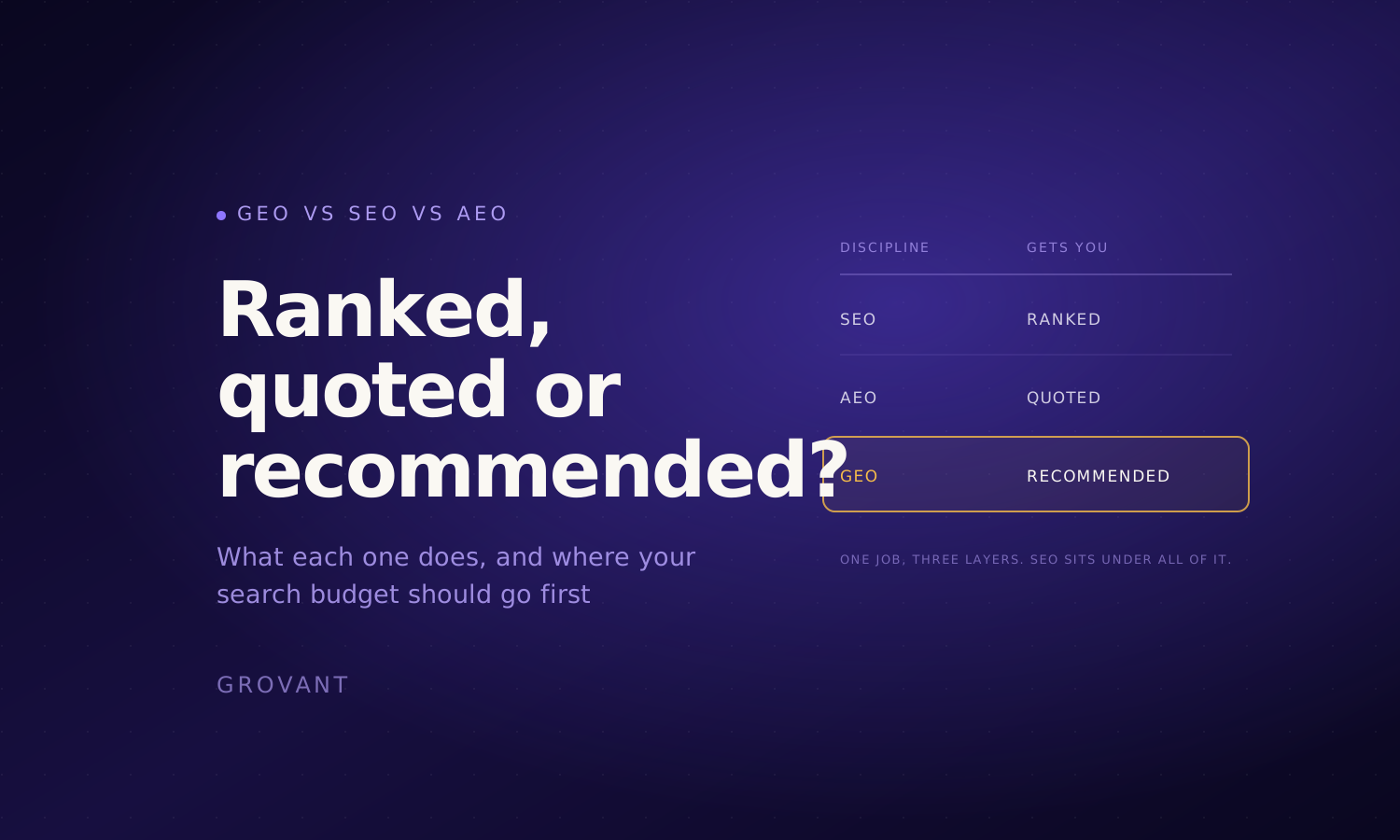
SEO gets your pages ranked, AEO gets your content used as the answer, and GEO gets your brand named inside AI-generated answers. They are three layers of the same job, not three competing strategies. AEO and GEO overlap so much that most people use the terms interchangeably, and both sit on top of SEO.
The confusion is understandable. Every few months a new acronym arrives, and plenty of providers have responded by renaming their SEO package rather than changing what they do. This guide cuts through it: plain definitions, a side-by-side comparison, what genuinely changes in day-to-day work, and how to decide where your budget should go.
The short version: three definitions
- SEO (search engine optimization) is the work of getting your pages to rank in search results, so people click through to your site.
- AEO (answer engine optimization) is the work of shaping your content so search engines and assistants can lift it as the direct answer to a question: featured snippets, voice answers and, more recently, AI answers.
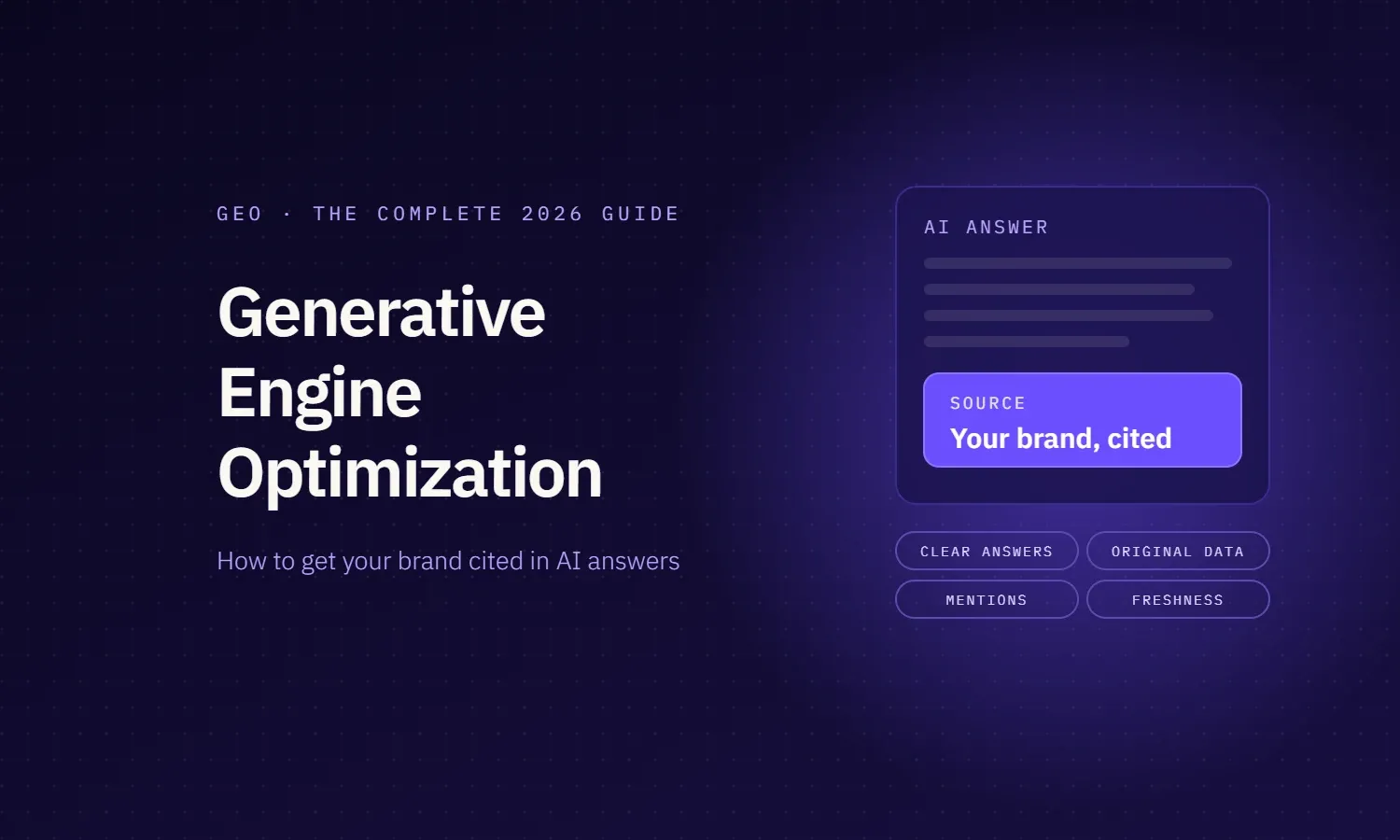
- GEO (generative engine optimization) is the work of getting your brand cited or recommended inside answers written by AI tools such as ChatGPT, Perplexity, Gemini and Google's AI Overviews and AI Mode.
AEO came first, in the days of featured snippets and voice assistants. GEO is the newer name for the same instinct applied to generative AI. Some people draw a cleaner line between them: AEO aims to be the single answer a search engine extracts, while GEO aims to be one of several sources an AI tool cites inside a longer answer. In practice the work overlaps heavily, which is why you will see agencies sell them as one service.
One note on naming: GEO here means generative engine optimization. It is not geotargeting, which some ad and analytics tools also shorten to GEO.
GEO vs SEO vs AEO, side by side
| Factor | SEO | AEO | GEO |
|---|---|---|---|
| The goal | Rank pages and earn the click | Be the answer that gets quoted | Be the brand an AI tool names or cites |
| Where it shows | Google and Bing results | Featured snippets, voice answers, AI Overviews | ChatGPT, Perplexity, Gemini, AI Overviews and AI Mode |
| What wins | Relevance, authority, technical health | A clear, direct answer in a clean structure | Trust: what other sites say about you, consistent facts, original data |
| Main tactics | Keyword research, content, technical fixes, links | Answer-first writing, short sections, tables, FAQs | Mentions on other sites, consistent company facts, answer-ready pages, freshness |
| How you measure | Rankings, organic clicks, leads | Snippet and AI Overview appearances for target questions | How often you are cited or mentioned on tracked prompts, AI referral visits |
| Typical timeline | 3 to 6 months for real movement | Weeks, once a page already ranks | First citations often in 1 to 2 months; steady visibility in 3 to 6 |
The table makes them look more separate than they are. Look at the "what wins" row: a page with a clear answer, on a site Google already trusts, from a company other sites talk about, tends to win in all three places at once.
What the search data shows
We pulled US search data from Ahrefs in October 2026 for ten keywords about AI search, from "geo vs seo" to "how to rank in chatgpt". Two things stood out.
| Keyword | US searches a month | AI Overview on the results page |
|---|---|---|
| generative engine optimization | 6,500 | Yes |
| aeo vs seo | 2,700 | Yes |
| geo vs seo | 2,600 | Yes |
| llms.txt | 2,500 | Yes |
| is seo dead | 1,300 | Yes |
| chatgpt seo | 1,000 | Yes |
- People are already searching for this in volume. A term most marketers had never heard of three years ago now draws thousands of searches a month, and the comparison questions ("aeo vs seo", "geo vs seo") are almost as popular as the term itself.
- Every one of the ten keywords shows a Google AI Overview. People asking how to get into AI answers are shown an AI answer first. If you want a single sign of where search visibility is heading, that is it.
How the three fit together
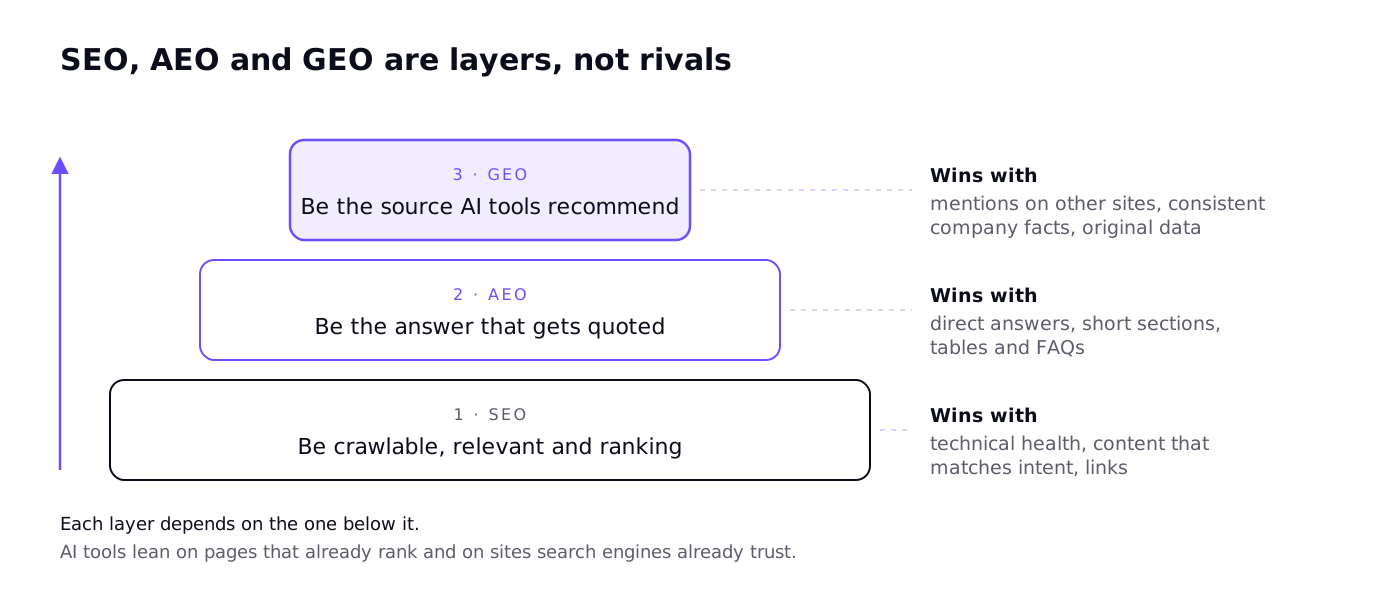
Think of it as layers. SEO is the foundation: if search engines can't crawl, understand and trust your pages, nothing above it works. AEO is the shape of the content on those pages. GEO adds the part you don't fully control, which is whether the rest of the web backs up what you say about yourself.
That last point is where GEO genuinely differs from SEO. In an Ahrefs study of roughly 75,000 brands, mentions of a brand on other websites tracked AI visibility far more closely than backlinks did (a correlation of about 0.66, against 0.22 for backlinks). A link passes authority. A mention in a trade article tells an AI tool what you are known for. That makes earned media part of search work in a way it never quite was before.
The term itself comes from research. In 2023, researchers from Princeton and IIT Delhi published GEO: Generative Engine Optimization, later presented at KDD 2024. They tested ways to make content more visible inside AI-generated answers and found that the strongest methods, such as citing sources, adding quotations and including statistics, raised visibility by up to 40%, with results varying by subject. That is the evidence behind the practical changes below.
What actually changes in day-to-day work
If you already do SEO well, most of GEO is a shift in emphasis rather than a new discipline. These are the changes we would make first.
- Answer first. Open each page, and each section, with a direct answer of 40 to 60 words, then explain. AI tools lift self-contained passages, so an answer buried in paragraph four rarely gets used.
- Write in short, self-contained sections. Keep each section on one question, and use a table for anything that can be compared. A table of prices or options is far easier to quote than three paragraphs saying the same thing.
- Make your company facts consistent. Your name, what you do, where you operate and who you serve should read the same on your site, LinkedIn, review profiles and directories. Conflicting facts make AI tools hedge or skip you.
- Earn mentions, not just links. Trade press, podcasts, review sites, analyst notes and genuine community answers all count. Our guide to B2B public relations covers the tactics that reach buyers.
- Keep important pages fresh. One review of 54 studies found that pages cited by AI tools were about 26% fresher than Google's organic top 10. Update prices, examples and dates on the pages that matter, and only change the "updated" date when the content really changes.
A few things matter less than the hype suggests. Studies so far show little measurable effect on AI citations from adding an llms.txt file or extra schema on their own. Both are cheap, so do them, but don't build a strategy on them.
Do you need all three?
Usually yes, but not in equal measure. Where to put the effort depends on where you are today.
| Your situation | Focus first | Why |
|---|---|---|
| New site with little search traffic | SEO, written answer-first from day one | AI tools lean on sites search engines already trust. Build that first. |
| Ranking well, but clicks are falling | AEO and GEO | AI answers are taking clicks on your queries. Be the source they cite. |
| Buyers ask AI which vendor to choose (B2B, SaaS, services) | GEO | Recommendation questions are answered from lists, reviews and comparisons on other sites. |
| Local business | SEO, plus your Google Business Profile and reviews | Local answers lean heavily on reviews and business listings. |
| Agency adding the service | SEO plus a GEO add-on | Most clients need both, sold as one retainer. |
If you're in that last group, our guide to white label GEO for agencies covers packaging, pricing and how to vet a delivery partner.
How to split your budget
There is no industry standard yet, so treat this as a starting point rather than a rule. For most companies with SEO already running, we would keep the bulk of the budget on the foundation (content, technical work, links) and move roughly a fifth to a third into GEO-specific work: earning mentions, tracking prompts and reworking key pages into an answer-first shape. Then let the tracking decide. If your tracked prompts start showing citations and AI referral visits turn into leads, shift more.
For a brand-new site, flip that thinking. Almost everything goes into the foundation, with every new page written answer-first so you don't have to redo it later. A sound SEO content strategy does most of the work for all three layers.
How to measure each one
- SEO: rankings for target keywords, organic clicks in Google Search Console, and the leads those clicks produce.
- AEO: whether your pages appear as the featured snippet or inside the AI Overview for the questions you target. Check by hand each month, or use a rank tracker that records these features.
- GEO: a fixed set of 10 to 30 buyer prompts, run monthly in ChatGPT, Perplexity, Gemini and Google, logging whether you are cited (linked), mentioned (named) or absent, and who appears instead. Add an "AI assistants" channel in Google Analytics that groups visits from chatgpt.com, perplexity.ai, gemini.google.com and copilot.microsoft.com.
That last channel is worth setting up now, even if the numbers are small. Our own site is young, and Google Analytics already shows visits arriving from AI assistants. It is the earliest sign that the work is turning into traffic.
Four myths worth ignoring
- "SEO is dead." AI answers draw heavily on pages that already rank. SEO is the price of entry for GEO, not its casualty.
- "GEO needs a separate team." It needs a few new habits and some PR effort. Most of the skills are SEO and content skills you already pay for.
- "You can buy your way into ChatGPT." You can't buy a place in organic AI answers. Paying for spots in "best of" lists to game them is risky, and Google treats paid links as spam. Here is what its latest spam update changed.
- "AEO and GEO are different disciplines." The goals differ slightly. The work barely does. Pick one name, use it consistently with clients and move on.
Where to start this month
- Write down 10 to 20 questions your buyers ask, worded the way they would type them into ChatGPT.
- Run them in ChatGPT, Perplexity and Google, and note who gets named.
- Rewrite the opening of your five most important pages so each one answers its main question in the first two sentences.
- Make your company description match across your site, LinkedIn and review profiles.
- Set up the AI assistants channel in Google Analytics, then rerun the same questions next month.
None of this replaces SEO. It makes the SEO you already do count in more places. If you would rather have a senior team handle all three layers, see how our SEO service covers AI search.