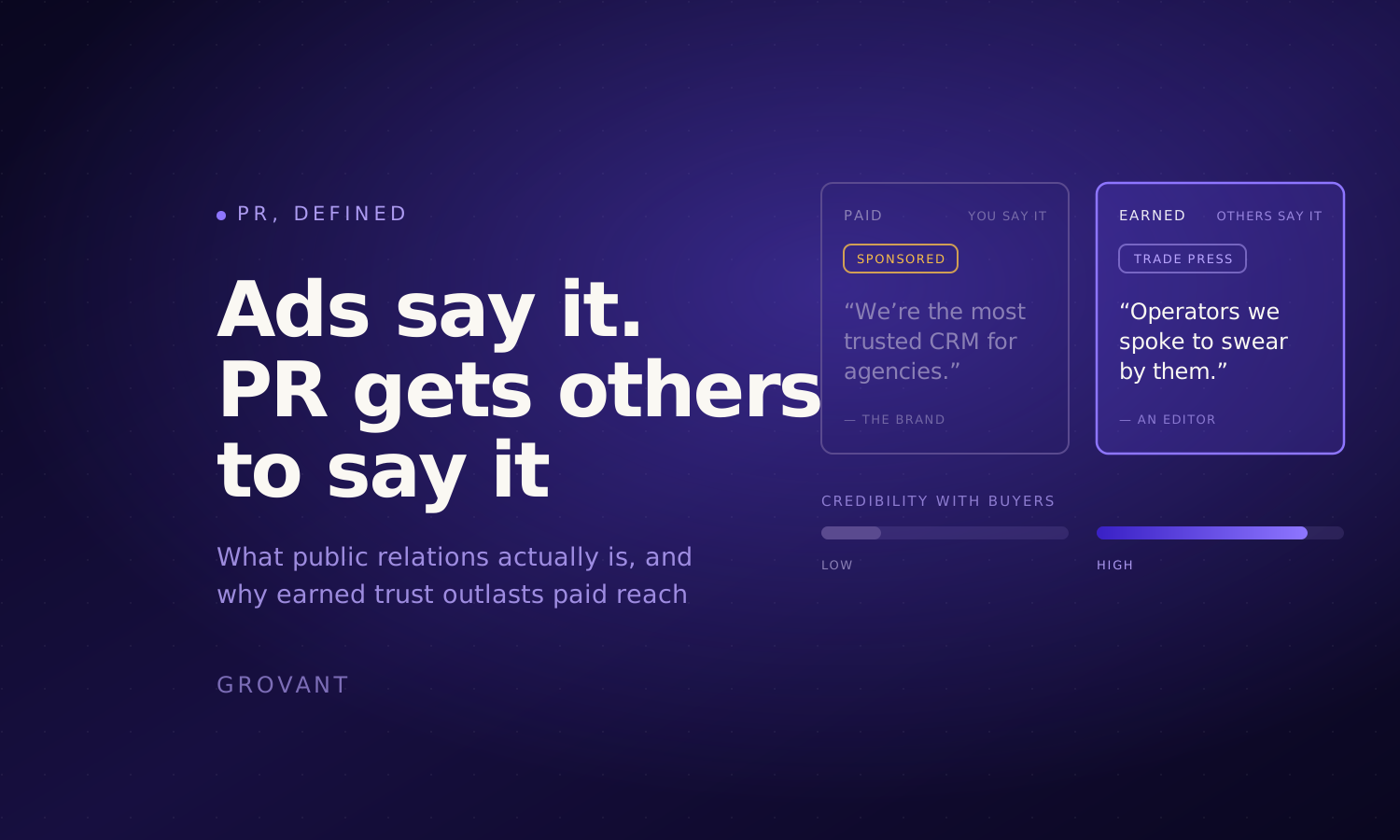
Public relations (PR) is the work of earning attention and trust for a company through other people's voices: journalists, podcasts, analysts, partners and customers. Advertising pays for space. PR earns it, by giving the media and the public a story, an expert view or data worth sharing.
The Public Relations Society of America describes PR as "a strategic communication process that builds mutually beneficial relationships between organizations and their publics." In plain terms, PR shapes what people hear and believe about your company when you are not the one talking.
This guide explains what public relations is, what PR teams do day to day, the main types of PR, how it differs from advertising and marketing, real public relations examples and how to measure its value.
What does public relations do?
The main goal of public relations is to build a good reputation, so that customers, investors, employees and partners already trust a company before they deal with it. PR teams reach that goal through a mix of daily tasks:
- Media relations: pitching stories to journalists, answering reporter requests and arranging interviews.
- Thought leadership: placing founder or expert articles, quotes and opinions in trade and business media.
- Content and press materials: writing press releases, media kits, company announcements and executive bios.
- Podcast and speaking placements: booking leaders as guests on podcasts, webinars and industry events.
- Social and community: managing executive LinkedIn presence and responding to public conversations about the brand.
- Crisis communication: preparing for and responding quickly when something goes wrong, to limit damage to trust.
- Measurement: tracking coverage, share of voice, brand searches and the business impact of each campaign.
A small company may have one PR person or an outside agency doing all of this. Large companies split it across media, internal, investor and crisis teams.
How public relations works
PR lives mainly in earned media: attention you get because someone else decided your story was worth telling. Modern PR also uses the other three channels of the PESO model (paid, earned, shared and owned media) to make every earned win go further.
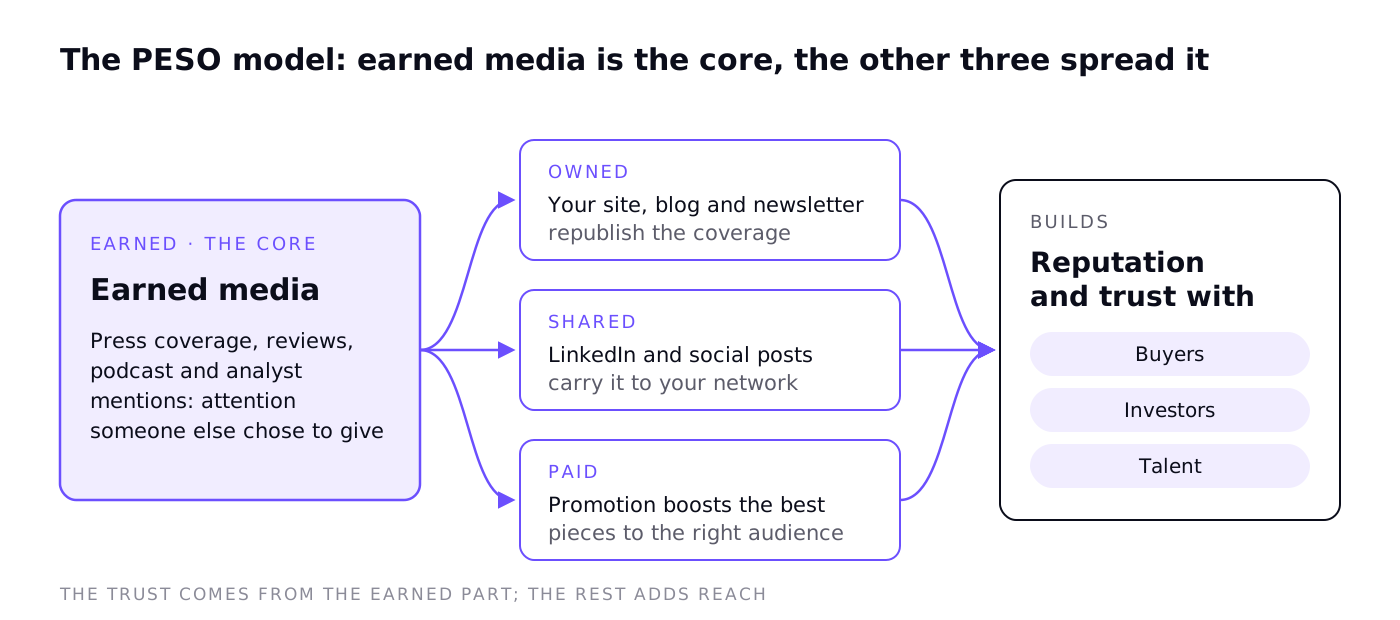
A typical cycle looks like this: the PR team finds a story worth telling, earns coverage for it, publishes it on the company's own channels, shares it on LinkedIn and social, and sometimes boosts the best pieces with paid promotion. Each step adds reach, but the trust comes from the earned part.
Types of public relations
PR is a family of disciplines. Most companies need two or three of them, not all.
| Type | Focus | Typical work |
|---|---|---|
| Media relations | Press coverage | Pitches, interviews, press releases |
| Corporate PR | Company reputation | Announcements, leadership profiles, awards |
| Thought leadership | Expert authority | Bylined articles, podcasts, speaking slots |
| Digital PR | Online coverage and links | Data stories, online media outreach, backlinks |
| B2B PR | Trust with business buyers | Trade media, analyst briefings, case studies |
| Crisis communication | Protecting trust | Response plans, holding statements, media handling |
| Internal communication | Employees | Company updates, change communication |
| Investor relations | Shareholders and investors | Results, investor updates, funding news |
| Community relations | Local reputation | Events, partnerships, social impact |
Digital PR also supports SEO, because coverage on respected sites often comes with links. If you buy that work from a partner, check which link building tactics are safe before you sign.
For technology and SaaS companies, B2B PR is often the most valuable of these, because business buyers research vendors for weeks before they talk to sales. Our guide to B2B public relations covers how it works in detail.
PR vs advertising vs marketing
PR is not the same as marketing, but it is part of it. Marketing is the full job of attracting and winning customers. Advertising and PR are two of its tools, and they work in opposite ways.
| Factor | Public relations | Advertising | Marketing |
|---|---|---|---|
| How attention is won | Earned through stories and expertise | Paid for | Mix of paid, earned and owned |
| Who controls the message | Partly the media and the audience | The company, fully | The company, mostly |
| Credibility | High: third parties vouch for you | Lower: people know it is an ad | Varies by channel |
| Main goal | Reputation and trust | Reach and direct response | Leads, sales and growth |
| Speed | Slower, builds over months | Fast, starts when spend starts | Varies |
| Cost model | Retainer or project fee | Media spend plus fees | Budget across channels |
The best results come when they work together. PR builds the trust that makes ads perform better, and ads put PR wins in front of more of the right people.
Public relations examples
PR is easier to understand through the everyday work it produces. These six examples show what typical PR activity looks like for a growing company:
- A data story. A software company surveys 500 of its users and publishes the findings. Trade media cover the numbers, and the company is quoted as the source in dozens of articles.
- An expert quote. A founder answers a journalist's request for comment on an industry trend. Her quote appears in a business publication with a link to the company.
- A podcast tour. A CEO appears on six niche podcasts in two months, each one reaching the exact buyers the sales team wants to meet.
- A product launch. A press release, briefings with three reporters and a launch post from the founder on LinkedIn turn a new feature into news on the day it ships.
- A customer story. A client agrees to a joint case study, which then gets pitched to a trade magazine as a feature on how their industry is changing.
- A crisis response. After a service outage, the company publishes a clear explanation within hours, updates customers directly and answers press questions openly, so the story is about the fix, not the failure.
None of these are ads. In most of them, someone else tells the story, which is why people believe it.
The value of PR and how to measure it
Good PR creates value that is hard to buy any other way:
- Trust before the first call. Buyers who have seen you in trusted media arrive warmer and close faster.
- Search and AI visibility. Coverage and mentions on respected sites help your search rankings, and AI assistants often draw on the same sources when they recommend companies.
- Easier hiring and fundraising. A known name attracts better candidates and makes investor conversations easier.
- Protection in a crisis. A company with a good reputation gets more benefit of the doubt when things go wrong.
PR is often called hard to measure, but it can be tracked if you agree on the numbers before the campaign starts:
| Metric | What it shows | How to track it |
|---|---|---|
| Coverage | How often and where you appear | Media monitoring or a simple coverage log |
| Share of voice | Your mentions compared with competitors | Media monitoring tools |
| Branded search | Whether more people look you up by name | Google Search Console |
| Referral traffic | Visits from articles and podcasts | Google Analytics 4 |
| Backlinks | Links earned from coverage | SEO tools such as Semrush or Ahrefs |
| Sales mentions | Whether buyers say they saw you | A "how did you hear about us" field in your CRM |
Avoid judging PR on advertising value equivalency (what the same space would cost as an ad). It says little about trust or business impact.
Get PR that builds real trust
Grovant's Brand and PR practice is run by one senior PR operator: reporter outreach, podcast tours, newsletter placements and founder ghostwriting. If you also want the LinkedIn posts and long-form articles that keep your name visible between press wins, our content and social team can run them to the same plan. Every engagement is priced by custom quote, month to month.