Ask five providers what social media management costs and you will get five confident answers that disagree by a factor of ten.
A freelancer on Upwork quotes $400 a month. A boutique agency quotes $3,000. A big-name agency quotes $12,000. All three proposals use the same words: strategy, content, engagement, reporting. The words match. The work does not.
We quote this work every week, so we see what the market charges, what each package actually contains and what the invoice looks like six months in. Below are the real price bands, what each package tier includes, the costs that never appear in the proposal and how to pick the right package for your stage.
Last updated: October 2026. Prices reviewed every quarter.
How much does social media management cost per month?
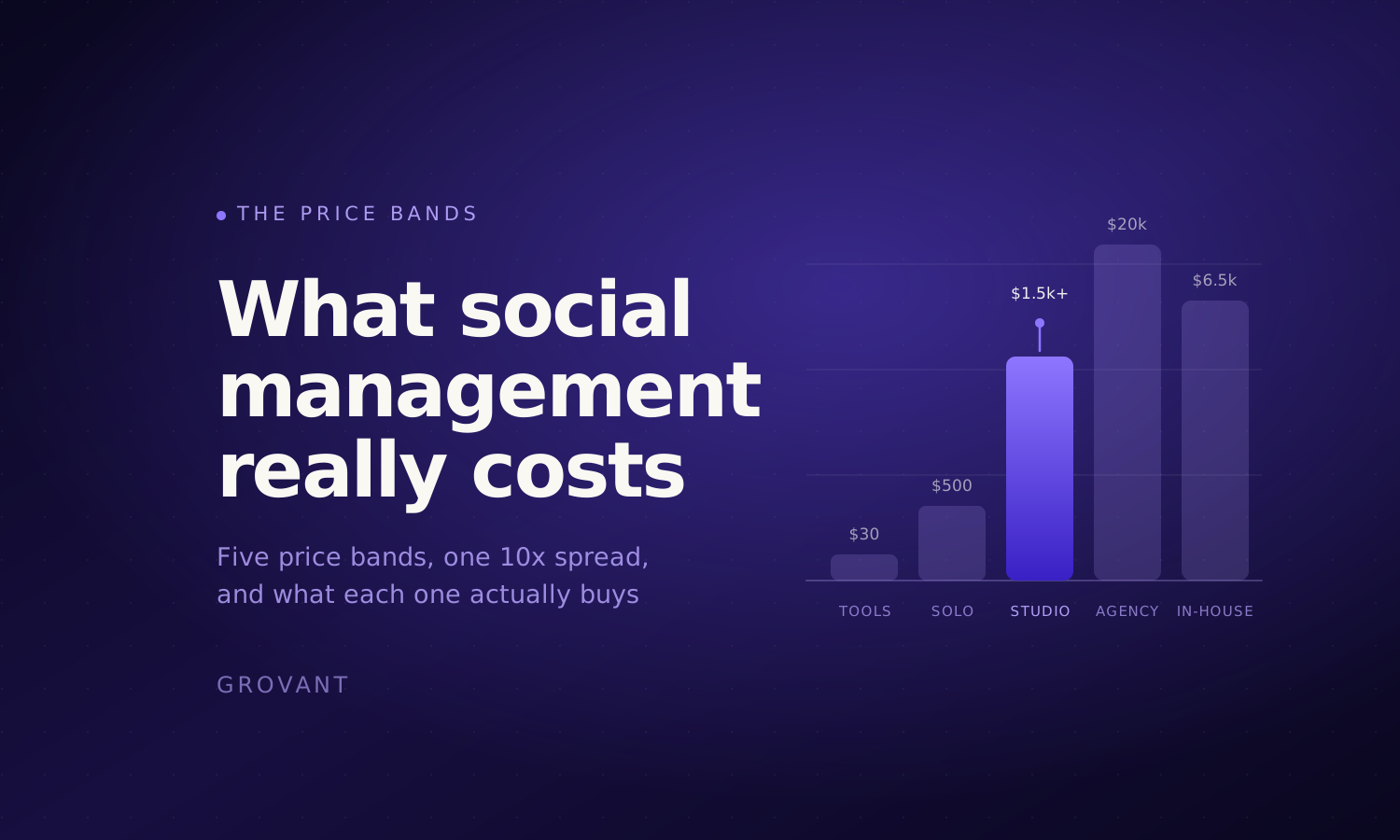
The honest 2026 range is $500 to $20,000+ a month, and the type of provider explains most of the spread.
| Option | Typical monthly cost (USD) | What it really is |
|---|---|---|
| DIY with scheduling tools | $30 to $300 + your time | Software, not a service. You are still the strategist, writer and designer |
| Freelancer | $500 to $2,500 | One person's hours. Quality tracks that one person exactly |
| Boutique agency or studio | $1,500 to $6,000 | A small team, 2 to 4 platforms, strategy plus production |
| Full-service agency | $5,000 to $20,000+ | Strategy, creative team, paid social management, reporting layer |
| In-house hire | $5,500 to $8,000 fully loaded | A $55k to $70k salary plus benefits, tools and management time |
Social media management packages: Starter, Growth and Scale
Most providers sell social media management packages in three tiers. The prices below are typical market ranges for a boutique or mid-size agency in the US.
| Package | Typical price per month | Platforms | Content volume | Best for |
|---|---|---|---|---|
| Starter | $800 to $1,500 | 1 to 2 | 8 to 12 posts | Local or early-stage businesses that need a credible, live presence |
| Growth | $2,000 to $5,000 | 2 to 4 | 12 to 20 posts + 2 to 4 short videos | Businesses using social as a real lead channel |
| Scale | $6,000 to $15,000+ | 4+ | Daily posting, video series, founder content | Brands where social drives revenue, often with paid social on top |
These are market ranges to help you benchmark proposals, not Grovant's price list. We price every engagement as a written custom quote, because the honest cost depends on your platforms, volume and how much production the calendar needs.
What is included in each social media management package?
The proposal words are identical across tiers, so compare the line items, not the adjectives.
| Included | Starter | Growth | Scale |
|---|---|---|---|
| Strategy and content pillars | Template-based | Custom, reviewed quarterly | Custom, reviewed monthly |
| Voice and messaging system | No | Yes | Yes, with founder voice |
| Original creative (not templates) | Mostly templates | Yes | Yes, plus video production |
| Short-form video | No | 2 to 4 a month | Weekly series |
| Community management (comments, DMs) | No | Business hours | Daily coverage |
| Paid social management | No | Optional add-on | Included (ad spend extra) |
| Reporting | Monthly PDF | Monthly report + call | Pipeline-linked dashboard |
| Named senior owner | Rarely | Should be | Yes |
Under $1,000: you are buying scheduling, not strategy
At this level the economics only work one way: templates. The provider keeps a library of generic post formats, swaps in your logo and colors, and schedules a month in one sitting. Ten clients get variations of the same calendar.
That is not a scam. It is an honest service at an honest price for what it is. The problem is what it cannot do: sound like you. On social, sounding like everyone else is the same as being invisible.
$1,500 to $6,000: where real work becomes possible
This is where someone can actually study your business: a real voice and messaging system, content made from your own material, and a human noticing what performed and adjusting. Most businesses that treat social as a real channel end up in this band.
It is also the band with the widest quality gap, because the proposal language matches the templated tier. Two agencies can both promise "12 posts, 4 platforms, monthly reporting" while one assigns a senior strategist and the other assigns whoever is free.
Above $6,000: you are paying for a bench
Strategy lead, copywriter, designer, community manager, paid-social buyer, account manager. For brands where social is a primary revenue channel, that bench earns its cost. For everyone else, part of the fee pays for the account manager who briefs the person who does the work.
Agency vs freelancer vs in-house: which is cheaper?
A freelancer is cheapest on the invoice. An agency is usually cheapest per result once you count your own time and the gaps one person leaves.
| Factor | Freelancer | Agency | In-house hire |
|---|---|---|---|
| Monthly cost | $500 to $2,500 | $1,500 to $20,000+ | $5,500 to $8,000 fully loaded |
| Skills covered | One person's skills | Strategy, writing, design, video | One person, plus tools you buy |
| Holiday and sick cover | None | Built in | None |
| Speed to start | Days | 1 to 2 weeks | 2 to 3 months to hire |
| Your management time | High | Low to medium | High |
| Best when | Budget is tight and scope is small | Social is a real lead channel | Volume is high and stable for years |
The in-house figure is our own arithmetic, not a published statistic: a typical mid-range social media manager salary, plus about 30 percent for benefits and payroll, plus the tool stack, before any design support.
What affects the cost of social media management?
Five factors move a quote more than anything else:
- Number of platforms. Each platform needs its own format and rhythm. LinkedIn and TikTok are not the same job.
- Content volume and format. Video costs more to produce than static posts, and original shoots cost more than repurposed material.
- Strategy depth. A voice system and regular strategy reviews cost more than a templated calendar, and are worth more.
- Community management hours. Replying to comments and DMs is billed by coverage, not by post.
- Seniority of the person doing the work. A senior writer costs more per hour and usually less per result.
The costs that never appear in the proposal
- Ad spend. "Social media management" almost always means organic. Paid budget sits on top, and managing it usually adds a fee of roughly 10 to 20 percent of spend on smaller accounts.
- Creative production beyond the calendar. Product photography, video shoots and motion graphics are often billed at day rates.
- Community management. Many packages include none of it, which surprises clients the first time a customer complaint sits unanswered for three days.
- Your own review time. Every draft you rewrite is you paying twice: once in the retainer, once in your hours. It is the number one reason cheap providers end up expensive.
Why it is worth pricing seriously
More than five billion people use social media, and the average user spends over two hours a day there, according to DataReportal's global tracking. Your buyers are on these platforms daily whether you show up or not. The question is whether what you publish is worth their time.
How to choose the right social media management package
Decide what social is for first, then buy the smallest package that serves it. If social exists so prospects who check you out find a live, credible presence, a Starter package covers it. If it is a real acquisition channel, buy strategy and original creative, not post volume.
Five red flags in cheap packages
- Price per post, with no strategy line. Nobody is accountable for whether the posts do anything.
- No questions about your business. A provider who quotes without asking who your customers are is planning to publish templates.
- "We post daily" as the headline promise. Frequency is the cheapest thing to promise and the least linked to results.
- Follower growth as the main KPI. Followers can be manufactured. Ask about profile visits, link clicks and inbound conversations instead.
- No named human. If you cannot name the person writing your content, your voice resets every time the roster changes.
Five questions to ask on the sales call
- Who exactly writes our content, and can we meet them?
- Can you show me two clients whose voices sound nothing alike?
- What would you stop posting if the data said it was not working?
- What do you need from us each month, and what happens if we are slow?
- Which platform would you tell us to skip?
How Grovant prices social media management
We do not sell fixed packages. A senior writer first studies how you talk, how you write and what your customers hear on calls, then drafts sample content in your voice, free, before any engagement. If it does not sound like you, you have lost nothing. After that you get a written custom quote within one business day, based on your platforms, volume and production needs.
Budgeting the bigger picture? Our guides on what a design audit catches and where AI automation actually pays off cover the two other line items most 2026 marketing budgets are wrestling with.