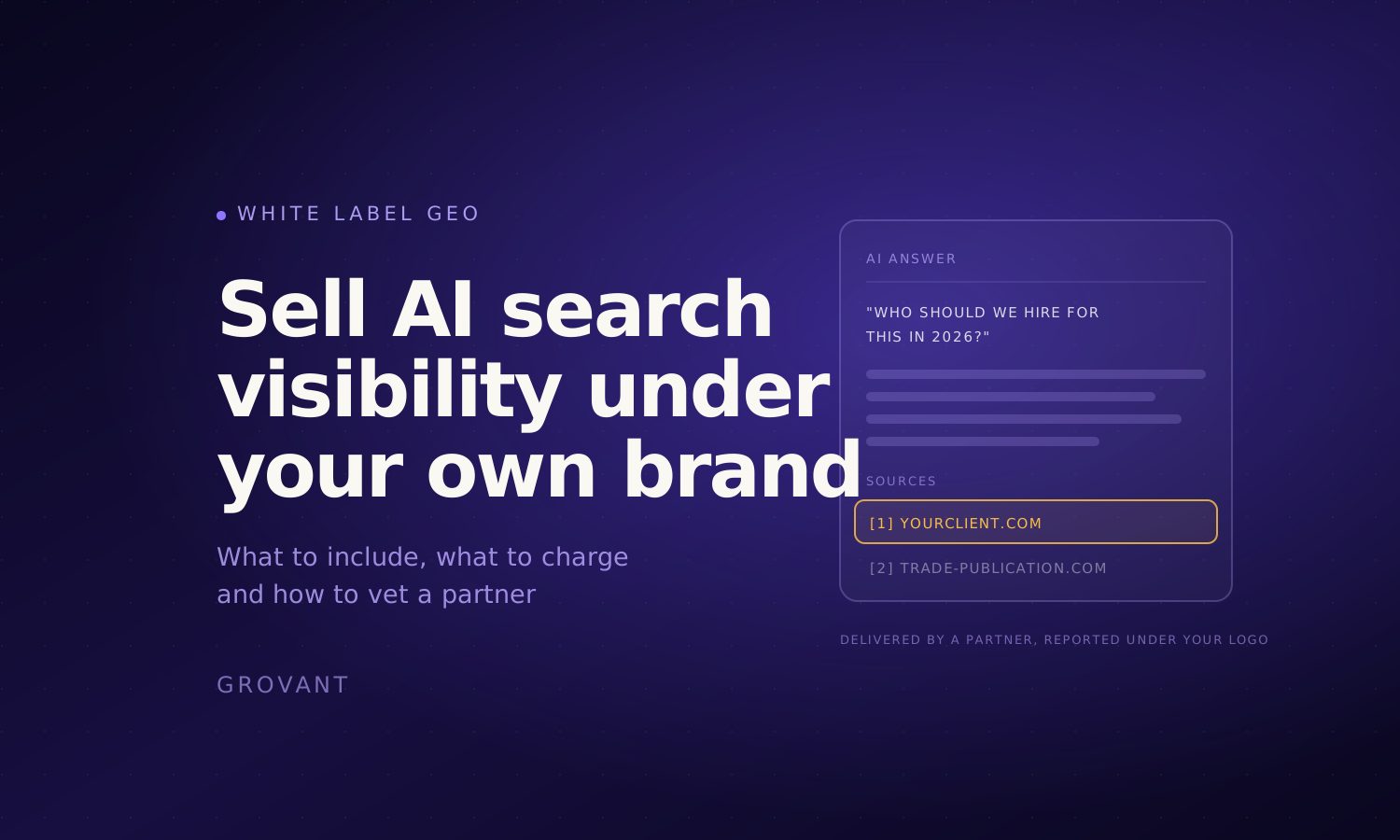
White label GEO is generative engine optimization that a specialist partner delivers for your clients under your agency's brand. The partner does the audits, fixes, content and outreach that get a client named in ChatGPT, Perplexity and Google's AI answers. You set the price, own the client and send every report with your logo.
A new question keeps coming up on client calls: "Why does ChatGPT recommend our competitor and not us?" Most agencies don't have anyone who can answer it with confidence, and hiring a GEO specialist for a discipline this young is a gamble. Reselling the service is the faster way to say yes.
We run SEO under other agencies' brands, so we see this question from the delivery side. This guide covers what we would tell an agency owner adding GEO today: what a package should include, what to charge, how to sell it to clients you already have, and how to spot a partner that has simply renamed its SEO package.
What white label GEO means (and how it differs from white label SEO)
GEO stands for generative engine optimization: the work of getting a brand cited or recommended inside answers written by AI tools. You will also see it called AEO (answer engine optimization) or AI SEO. The labels differ. The work is largely the same.
The white label part works exactly like white label SEO. The partner stays in the background and your agency is the only name the client ever sees. What changes is the goal, the levers and what you report.
| Factor | White label SEO | White label GEO |
|---|---|---|
| The goal | Rank the client's pages on Google | Get the client named or cited in AI answers |
| Where results show | Google's organic results | ChatGPT, Perplexity, Gemini, Google AI Overviews and AI Mode |
| Main levers | Technical fixes, content, links | Clear answers, consistent company facts, content, mentions on other sites |
| What you report | Rankings, traffic, leads | Citations and mentions on tracked prompts, AI referral visits, leads |
| First signs of progress | Usually 3 to 6 months | Often 1 to 2 months for first citations |
| How they relate | The foundation | Builds on it: AI tools lean on pages that already rank |
That last row is the one to remember. GEO is not a replacement for SEO, whatever some sales decks say. AI answers draw heavily on pages that already rank and on sources search engines already trust, so GEO works best for clients with solid SEO underneath. It is also why most agencies sell GEO as an add-on to an existing SEO retainer, not as a separate service.
What a white label GEO package should include
A real GEO package covers five workstreams. If a provider's offer stops at the first one (an audit) or covers only the last one (a tracking dashboard), you are buying a report, not the service.
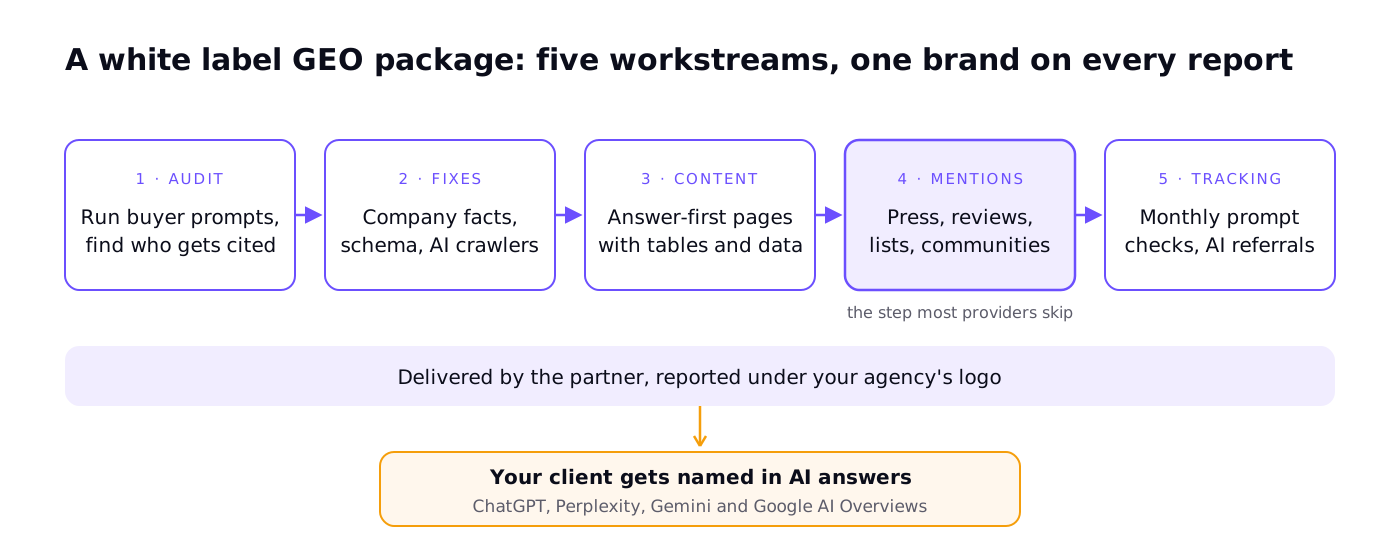
| Workstream | What the partner does | What your client sees |
|---|---|---|
| 1. AI visibility audit | Runs the questions buyers ask AI tools, records which brands get cited and finds the gaps | A branded audit showing the prompts that matter and who wins them today |
| 2. Entity and technical fixes | Makes company facts consistent across the site and key profiles, adds schema and checks that AI crawlers can reach the site | Fixes listed in your monthly report |
| 3. Answer-first content | Rewrites key pages and writes new ones that answer buyer questions directly, with tables and specific numbers | New and updated pages on the client's site |
| 4. Mentions on other sites | Earns coverage, reviews and list placements on the sites AI tools read | Mentions and coverage listed in the report |
| 5. Tracking and reporting | Re-runs the tracked prompts every month and reads AI referral traffic | A monthly report under your brand |
The fourth workstream is the one most providers underweight, and it is the one the evidence points to. In an Ahrefs study of roughly 75,000 brands, mentions of a brand on other websites tracked AI visibility far more closely than backlinks did (a correlation of about 0.66, against 0.22 for backlinks). It makes sense once you think about how these tools work. A claim on the client's own site is an assertion. The same claim in a trade publication or on a review site is evidence.
In practice, this is ordinary earned media work aimed at the sources AI tools read. For B2B clients that usually means trade press, analyst and review sites, podcasts and "best of" lists written by third parties. Our guide to B2B public relations covers the tactics.
How to price white label GEO
GEO pricing hasn't settled yet, and the rate cards agencies and providers published this year vary a lot. These are the retail ranges that come up most often in 2026:
| What you sell | Typical retail price | Who it suits |
|---|---|---|
| One-off AI visibility audit | $500 to $2,000 (more for large brands) | Every client. It is also your best sales tool |
| Add-on to an SEO retainer | $1,000 to $2,500 a month | Small and mid-sized clients already on SEO |
| Standalone GEO retainer | $2,000 to $8,000 a month | Clients who want content and outreach, not just tracking |
| Enterprise program | $10,000+ a month | Several products, brands or markets |
On the buying side, agencies usually mark partner costs up two to three times, the same range as white label SEO. Before you price anything, get three things from the partner in writing: the wholesale rate card, the minimum term and notice period, and the exact monthly deliverables (prompts tracked, pages written, mentions pursued).
One piece of advice from our side: price on things the client can see, such as the number of prompts tracked and the pages and placements delivered. Pricing on hours invites the question "what did you do this month?", and with GEO the honest answer is sometimes "waited for the AI answers to change".
How to sell GEO to the clients you already have
Your easiest buyers are clients already paying you for SEO. They trust you, they know search takes time, and plenty of them have already typed their own company name into ChatGPT to see what comes back. This sequence works well:
- Start with a short audit. Run 10 to 20 buyer prompts for the client and their top three competitors, such as "best [service] for [industry]" or "[product] alternatives". Seeing a competitor recommended by name does more selling than any slide.
- Agree on the prompts that matter. Pick 10 to 30 questions the client's buyers really ask. These become the tracked set you report on every month.
- Set honest expectations. First citations often show within one to two months. Steady visibility usually takes three to six. AI answers also vary from one run to the next, so promise trends, not screenshots.
- Bundle it with SEO. Position GEO as the layer that turns rankings into recommendations, not a separate project fighting for the same budget.
- Report monthly. Show the prompts tracked, how often the client is cited or mentioned, which competitors appear instead, and the visits and leads that come from AI tools.
If a client isn't on SEO with you yet, sell the audit on its own. It is quick to deliver, it shows the gap in a way clients understand, and it often opens the door to an SEO retainer. If you don't deliver SEO in-house, here is how agencies sell SEO without hiring a team.
How to vet a white label GEO partner
GEO is new enough that plenty of providers have relabelled an SEO package and called it GEO. Ask these six questions before you put your name on anyone's work.
- "Show me a client you got cited in AI answers, and how." Ask for the prompts, the dates and before and after screenshots. A partner without one real example is learning on your clients.
- "Which AI platforms do you track, and with which tools?" Expect named platforms (ChatGPT, Perplexity, Gemini, Google AI Overviews) and named tools. If the GEO report is only Google Search Console data, it is SEO with a new label.
- "How do you earn mentions on other sites?" Look for digital PR, review profiles and genuine community participation. Walk away from anyone selling paid spots in "best of" lists.
- "Is the reporting fully white label?" Check the PDF, its file properties, the dashboard domain and the sender address for the partner's name.
- "Can your specialists join client calls under our brand?" Useful when a client asks detailed questions about AI search. This is the private label version of the model.
- "What is the minimum term?" Three months is common. Avoid long lock-ins while the service is this new.
The usual rules for choosing a fulfillment partner apply too: check how they communicate, who actually does the work and what happens when something goes wrong.
How to report GEO results to clients
Clients want three answers every month. Are we being mentioned? Is it improving? Is it bringing in business? A useful report pulls from three sources.
- Prompt tracking. For each tracked prompt, whether the client was cited (linked as a source), mentioned (named without a link) or absent, and which competitors appeared instead.
- Google's own data. Google has been adding reporting on its AI features to Search Console. Where the client's property has it, put it next to your prompt checks.
- AI referral traffic. In Google Analytics, group visits from chatgpt.com, perplexity.ai, gemini.google.com and copilot.microsoft.com into one "AI assistants" channel, then report sessions and leads from it.
Give it at least three months before drawing conclusions. The same prompt can return a different answer an hour later, so one screenshot proves very little either way.
Mistakes that make GEO harder to sell
- Selling GEO without SEO underneath. AI answers lean on pages that already rank. If the foundations are weak, fix them first, starting with a content strategy that ranks.
- Publishing "best of" lists that rank the client first. Tempting, and increasingly risky. One analysis of Google's AI Overviews found that the brand ranking itself first was left out of the actual recommendation most of the time.
- Promising a specific answer. Nobody controls what ChatGPT says. Promise the work and the tracking, not a guaranteed placement.
- Treating llms.txt or schema as the whole service. Both are cheap and worth doing, but studies so far show little measurable effect on citations on their own.
- Buying links instead of earning mentions. Paid links carry the same risks they always have. Here is what still works in white label link building.
Where Grovant fits
We have run SEO under agency brands since 2018, and AI search visibility is now part of that work: audits, answer-first content and the outreach that earns mentions, all reported under your logo. If you want to add GEO without hiring for it, tell us about your clients and we will show you what a first audit looks like.