Private label SEO is a reseller model where a specialist SEO team does the work for your clients under your agency's brand, and acts as part of your team. You set the price, own the client relationship and send every report with your logo. The partner stays invisible, but its people can join calls or send emails as members of your agency when you need them to.
For agencies, that means you can sell SEO without hiring a full in-house team. It also means you are putting your name on work someone else delivers. This guide explains how private label SEO programs work, what is included, how pricing is usually structured and how to pick a partner you can trust with your clients.
What is private label SEO?
Private label SEO (sometimes written "SEO private label") means buying SEO services from a provider and reselling them as your own. The provider handles strategy, audits, content and link building. Your agency handles the brand, the price and the client.
The word "private" matters. In a private label SEO program, the partner works as a hidden extension of your team, not as a separate vendor. Depending on the setup, its specialists may:
- Use an email address on your domain
- Join client calls introduced as your SEO lead
- Work inside your project tools and reporting templates
- Follow your processes, tone of voice and approval steps
The client sees one agency: yours.
Who private label SEO services are for
- Marketing and web design agencies that get SEO requests but do not have a dedicated SEO team.
- Growing SEO agencies that have more clients than their in-house team can handle.
- Consultants and freelancers who want to sell larger retainers without hiring.
- Agencies entering a new market where they need specialists, such as local SEO or ecommerce SEO.
If your clients already ask for SEO and you keep saying no, or doing it half-way, a private label SEO reseller program is usually the fastest fix.
How a private label SEO program works
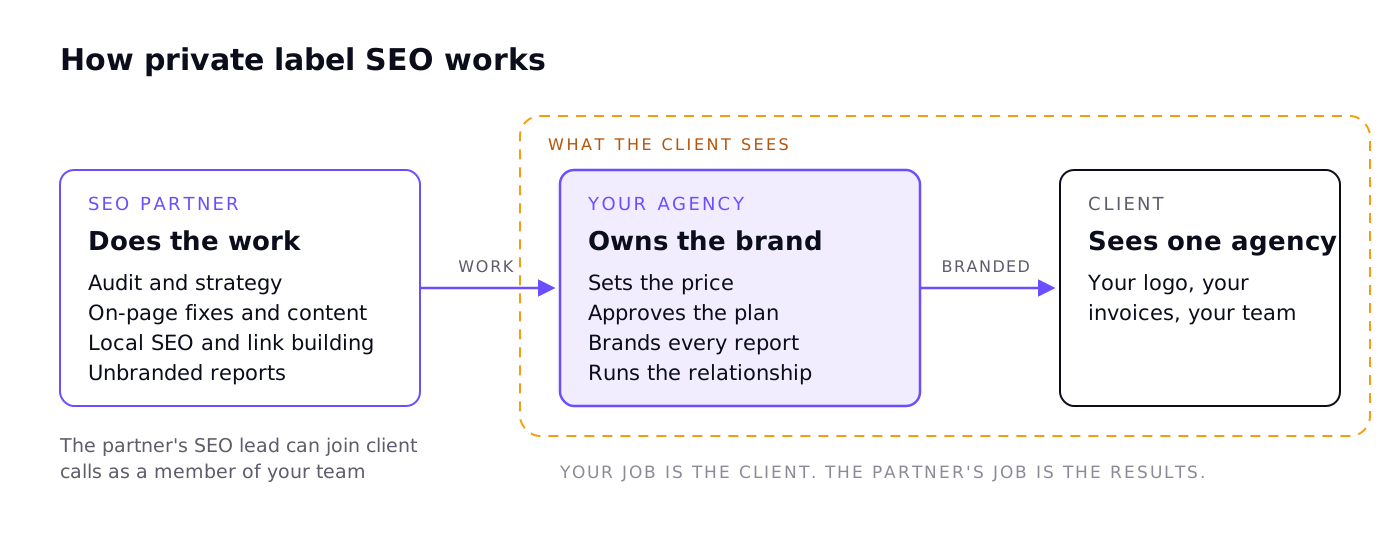
Most private label SEO reseller programs follow the same six steps:
- Sales and scoping. You find the client and agree on goals. Many partners help with a free audit or proposal you can send under your brand.
- Onboarding. You share the client's website access, Google Search Console, Analytics and brand details with the partner.
- Audit and strategy. The partner runs a technical audit, keyword research and competitor review, then builds a plan you approve.
- Delivery. The partner does the monthly work: on-page fixes, content, local SEO and link building, based on the plan.
- Reporting. Reports arrive with your logo and colours. You send them, or the partner sends them from your domain.
- Client contact. You run the relationship. In a private label setup, the partner's SEO lead can join calls as a member of your team when the client needs deeper answers.
Your job is the client. The partner's job is the results.
Private label vs white label SEO
Many providers use the two terms as if they mean the same thing. In practice, they usually differ in one way: how close the partner gets to your client. In white label SEO, the partner delivers unbranded work and stays fully in the background. In private label SEO, the partner works as part of your team and can speak to clients under your brand.
| Factor | White label SEO | Private label SEO |
|---|---|---|
| Brand on reports | Yours | Yours |
| Who talks to the client | Only your agency | Your agency, plus partner staff introduced as your team |
| Partner's role | Back-office supplier | Extension of your team |
| Your workload | Higher: you explain all the work | Lower: experts can join calls |
| Best for | Agencies with SEO knowledge in-house | Agencies without a senior SEO person |
If you want the full background on the white label model, read our guide to white label SEO for agencies. Many agencies start with white label and move to private label once they have more SEO clients than they can personally manage.
What is included in private label SEO services
A good private label SEO program covers the full SEO job, not only links. Use this table to check what a partner actually delivers.
| Service | What it covers | How often |
|---|---|---|
| SEO audit | Technical issues, site speed, indexing, on-page gaps | At the start, then every 6 to 12 months |
| Keyword research and strategy | Target keywords, content gaps, competitor review, roadmap | At the start, reviewed each quarter |
| On-page SEO | Titles, meta descriptions, headings, internal links, schema | Monthly |
| Content | Blog posts, service pages, location pages written for search | Monthly, by plan |
| Link building | Outreach and digital PR links from relevant sites | Monthly |
| Local SEO | Google Business Profile, citations, reviews, local pages | Monthly, for local clients |
| Reporting | Rankings, traffic, leads and work done, in your branding | Monthly |
| Account support | A named SEO lead who can join client calls as your team | As needed |
Ask every partner which of these are included in the base price and which cost extra. Content and link building are the two items most often billed separately.
How private label SEO pricing works
There is no standard price for private label SEO. The cost depends on the client's competition, the size of the site and how much content and link building the plan needs. Most programs use one of four pricing models:
| Model | How it works | Works best when |
|---|---|---|
| Monthly retainer per client | A fixed monthly fee for an agreed scope | Clients on ongoing SEO |
| Tiered packages | Set bundles by size, such as local, growth and national | You want simple offers to resell |
| Per deliverable | You pay per audit, article or link | You only need parts of the work |
| Custom quote | Scope and price set per client after an audit | Clients with different goals and markets |
How agencies make a margin
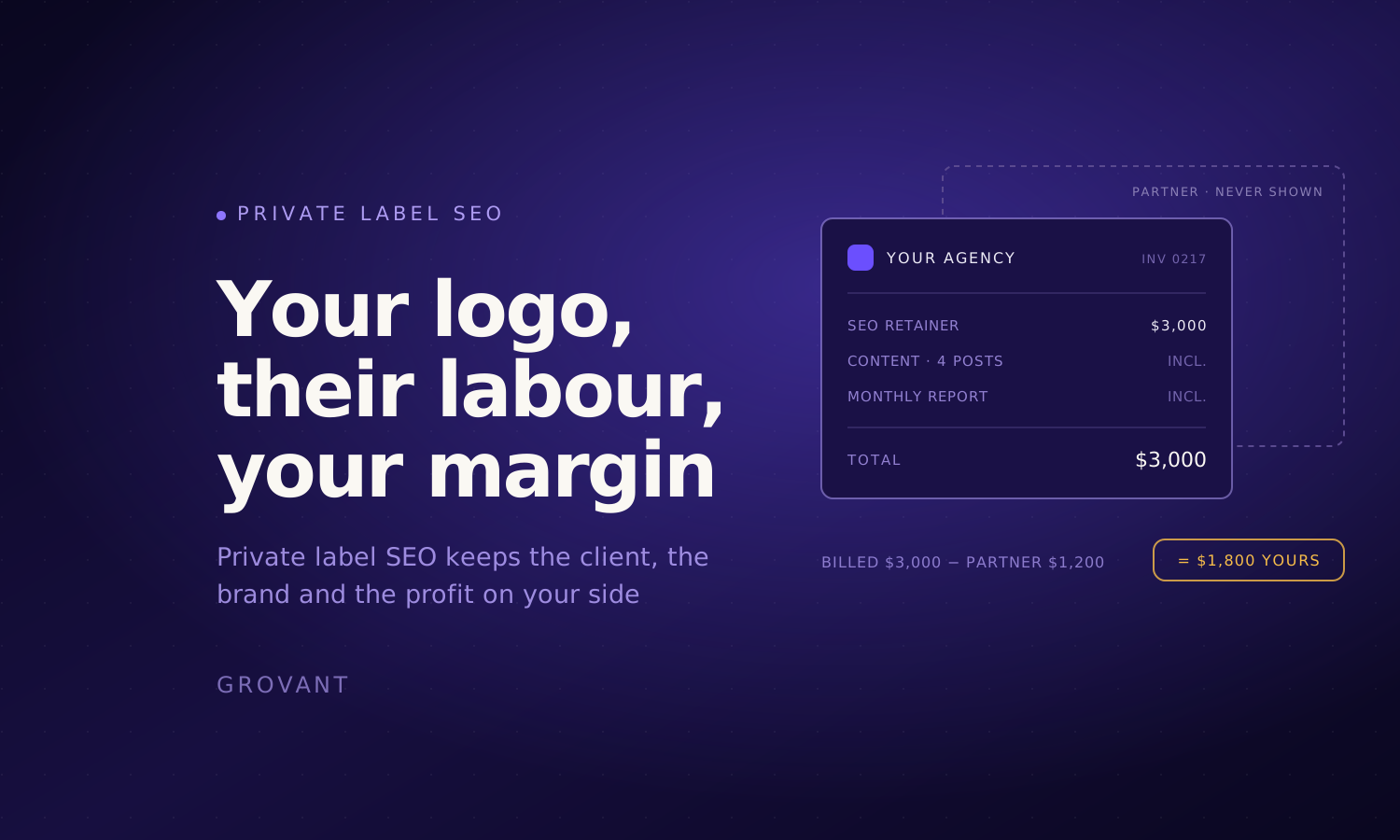
Your profit is the gap between what you charge the client and what you pay the partner. Here is a simple example with round numbers:
- The partner charges your agency $1,000 a month for a client's SEO.
- You sell the same service to the client for $1,800 a month.
- Your gross margin is $800 a month, before your own account management time.
Set your price based on the value to the client and your local market, not only on the partner's cost. Leave room for the time you spend on sales calls and reporting.
At Grovant, we price each partnership by custom quote after a free audit, so the scope fits the client instead of a fixed package.
Benefits and risks of private label SEO
Private label SEO lets you grow faster, but it only works if the partner is reliable. Weigh both sides before you sign.
Benefits
- Sell SEO without hiring. You skip the cost and time of recruiting and training an in-house SEO team.
- Scale up or down. Add clients without adding staff, and reduce scope when a client leaves.
- Access to specialists. You get technical SEO, content and link building skills under one partner.
- Keep the client relationship. The client signs with you, pays you and stays loyal to your brand.
- Experts on calls. Unlike pure white label, a private label partner can explain the work to clients directly as your team.
Risks
- Your reputation is on the line. Poor work or spammy links hurt your brand, not the partner's.
- Less control. You depend on the partner's process, speed and quality checks.
- Communication gaps. If the partner joins calls, they must follow your tone and promises exactly.
- Lock-in. Some partners keep the content, reports or accounts in their own systems.
Most of these risks can be managed with a clear contract, access to all work in your own accounts and a short trial before you resell at scale.
How to choose a private label SEO partner
The right partner is one whose work you would be proud to put your name on. Use this checklist before you sign with any private label SEO provider.
- Ask for real results. Request anonymised case studies with traffic or lead numbers and the timeframe.
- Review their link building. Ask for sample links. Avoid partners who sell links in bulk or will not show where links come from, since Google's spam updates keep targeting low-quality links.
- Check the reports. Ask for a sample white-labelled report. It should show leads and traffic, not only rankings.
- Confirm who talks to clients. Agree whether partner staff can join calls, which email they use and how they introduce themselves.
- Own the accounts. Search Console, Analytics, Google Business Profile and content should sit in your or your client's accounts.
- Read the contract. Look for a non-solicit clause so the partner cannot approach your clients, plus clear notice periods.
- Test response times. Send a few questions before you sign. Slow replies now mean slow replies when a client is waiting.
- Start with one or two clients. Run a 60 to 90 day trial before you move your whole SEO book.
If a partner passes all eight, you can resell with confidence.
Resell SEO under your brand with Grovant
Grovant works with agencies as a private label and white label SEO partner. Our team handles audits, content, link building and branded reporting, and our SEO leads can join your client calls as part of your team. Every partnership is priced by custom quote after a free audit.