An SEO content strategy is a plan for what content to publish, which keywords each page targets and how those pages link together, so that your site ranks for the searches your buyers make. It turns keyword research into a publishing list with a clear order, owner and goal for every piece.
Without one, teams write whatever feels useful that week. Posts compete with each other for the same keyword, important topics get skipped, and traffic stays flat. With one, every article has a job, and each new page makes the pages around it stronger. This guide shows you how to build an SEO content strategy in seven steps, how to prioritise topics and how to measure what works.
What is an SEO content strategy?
An SEO content strategy (also called a content strategy for SEO) decides three things:
- What to write: the topics and keywords your audience searches for at each stage of buying.
- Where it goes: which page targets which keyword, so no two pages compete.
- How it connects: the internal links that group related pages into topic clusters.
SEO content strategy vs content marketing strategy
The two overlap, but they start from different places. A content marketing strategy starts from your brand story and channels, such as email, social and video. An SEO content strategy starts from search demand: what people type into Google and AI assistants, and what it takes to rank for it.
| Factor | SEO content strategy | Content marketing strategy |
|---|---|---|
| Starts from | Search demand and keywords | Audience, brand and channels |
| Main channel | Organic search and AI answers | Email, social, video, events, search |
| Success measure | Rankings, organic traffic, leads from search | Reach, engagement, pipeline across channels |
| Time to results | 3 to 12 months, then compounds | Varies by channel |
The best results come when both work together. Your SEO content strategy brings people in from search, and your wider content marketing turns them into subscribers and buyers.
How to build an SEO content strategy in 7 steps
- Define the goal and the audience. Write down who you want to reach and what they should do after reading, such as booking a call or signing up. A strategy for leads looks very different from one built for raw traffic.
- Audit what you already have. List every page with its traffic, rankings and target keyword. Mark each one keep, update, merge or remove. Updating a page that already ranks on page two is often the fastest win.
- Research keywords by topic. Start from your services and your customers' questions. For each keyword, note search volume, keyword difficulty (KD) and intent: is the searcher learning, comparing or ready to buy?
- Group keywords into topic clusters. Put related keywords under one topic. Each cluster gets one pillar page for the broad term and several supporting posts for the narrower questions.
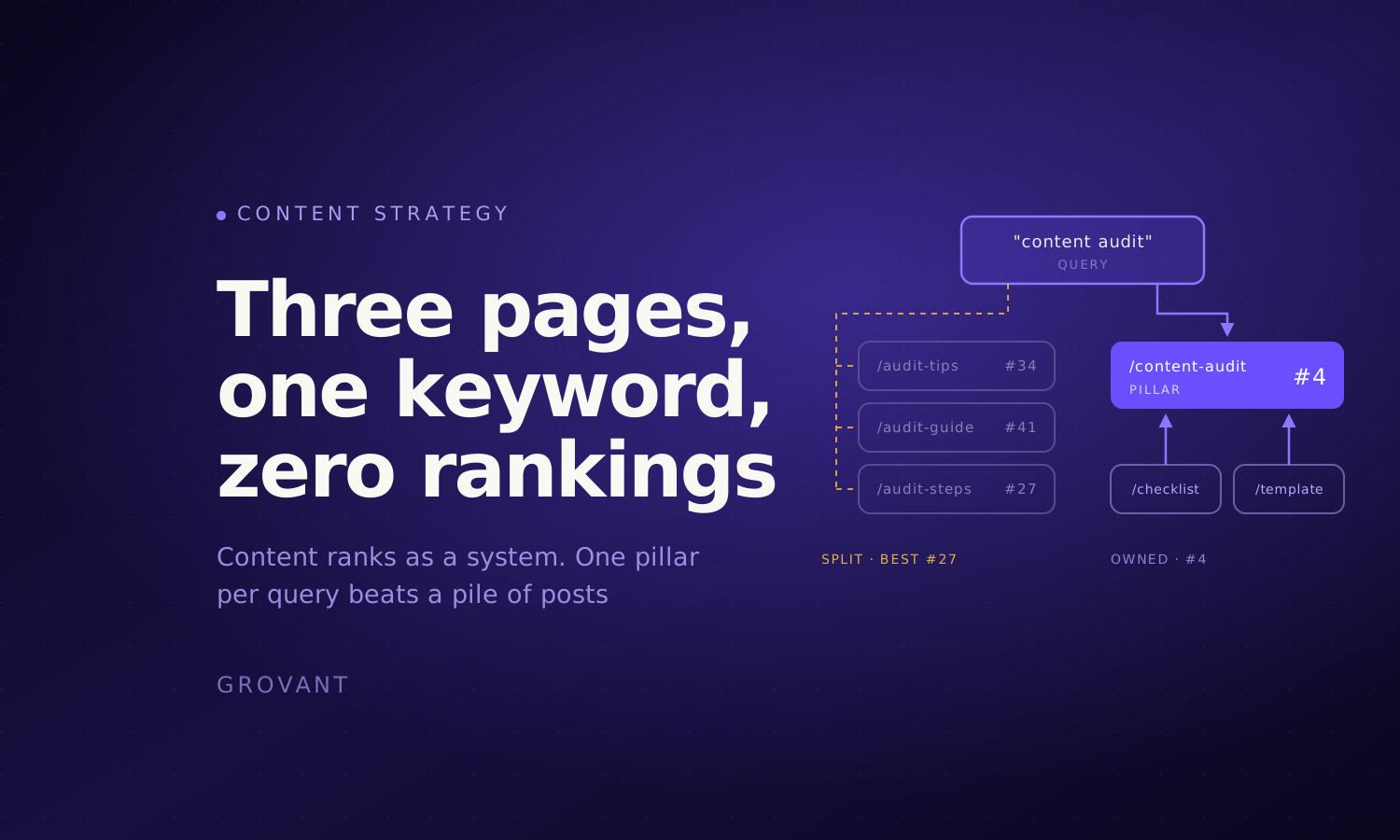
- Map one primary keyword to one page. Give every page a single primary keyword and a few secondary ones. Never target the same primary keyword on two pages, or they will compete and both rank lower.
- Write briefs, then content. A brief sets the search intent, H1, meta title, headings, questions to answer, internal links and word count. Good briefs keep quality steady when several writers are involved.
- Publish on a steady cadence and refresh. Pick a rhythm you can keep, such as four to eight posts a month. Review older posts every three to six months and update facts, dates and links.
Steps 4 and 5 are where most strategies succeed or fail, so the next section looks at topic clusters in more detail.
How topic clusters work
A topic cluster is a group of pages about one subject. One pillar page covers the broad topic and targets the main, harder keyword. Several cluster posts each answer one narrower question and target an easier, long-tail keyword.
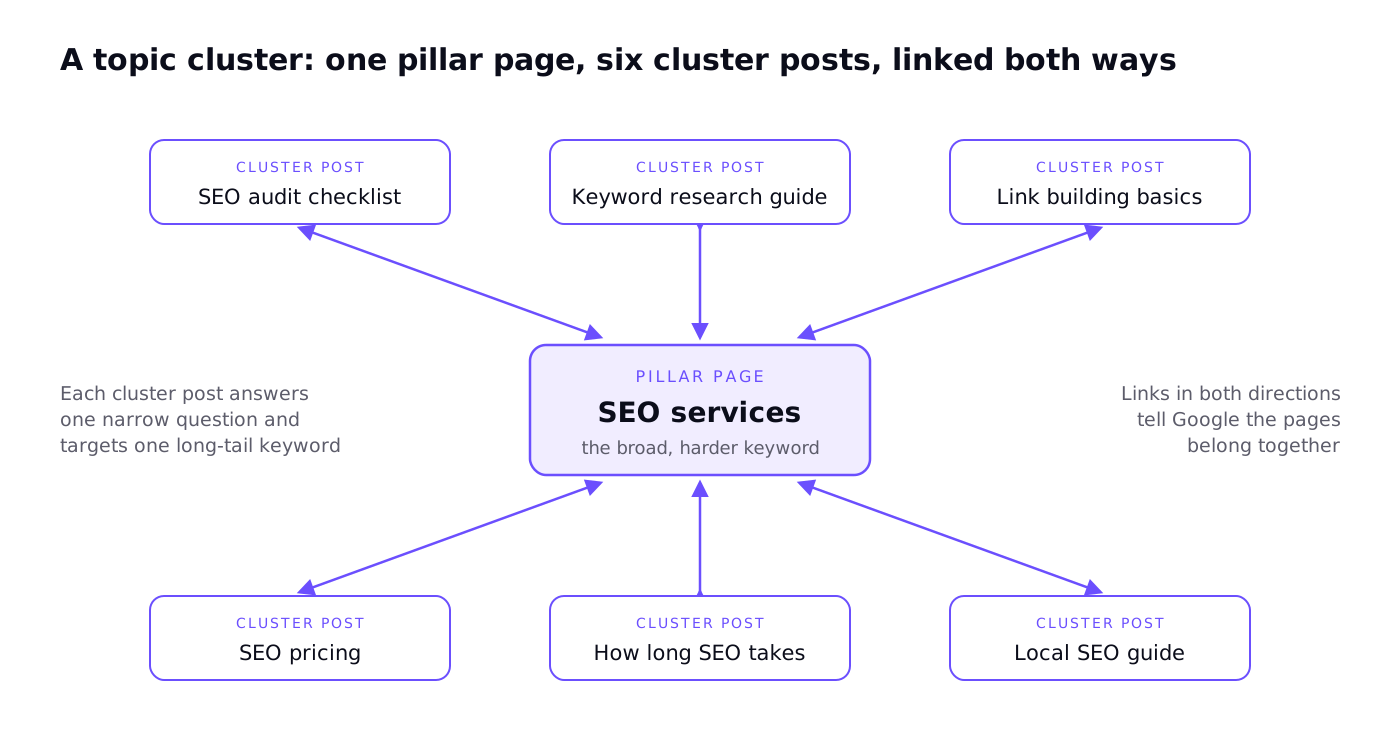
The links are what make it work. Every cluster post links to the pillar, and the pillar links back to every post. This tells Google the pages belong together and that your site covers the topic in depth. It also helps AI assistants, which favour sites that answer a full set of related questions clearly.
Three rules keep clusters clean:
- One primary keyword per page, with no repeats across the cluster.
- Link with descriptive anchor text, such as "SEO audit checklist", not "click here".
- Use each internal link once or twice per page at most, so every link still carries weight.
How to prioritise topics
You will always have more topics than time. Score each topic on four factors from 1 to 3, add them up and write the highest scores first.
| Factor | Score 3 | Score 2 | Score 1 |
|---|---|---|---|
| Business value | Close to a service you sell | Related to your service | General interest only |
| Ranking chance | KD under 30, or you already rank on page 2 | KD 30 to 50 | KD over 50 on a newer site |
| Search demand | High volume for your niche | Medium volume | Low volume, but still asked by buyers |
| Cluster fit | Fills a gap in an existing cluster | Starts a new cluster you plan to build | Stands alone |
A practical rule: in the first few months, favour low-KD topics that sit close to your services. They rank sooner, bring leads sooner and give the site the authority it needs to compete for harder keywords later.
Two more quick wins to put near the top of the list:
- Pages already ranking in positions 8 to 20. A focused update can push them onto page one.
- Questions your sales team hears every week. These match real buyer intent, even when tools show low volume.
How to measure an SEO content strategy
Rankings are a signal, not the goal. Track the numbers that show whether content brings the right people and turns them into leads.
| Metric | What it tells you | Where to find it | Check |
|---|---|---|---|
| Impressions and clicks | Whether Google shows and people choose your pages | Google Search Console | Weekly |
| Keyword positions | Progress on each page's primary keyword | Search Console or a rank tracker | Weekly |
| Organic sessions | How much traffic the content brings | Google Analytics 4 | Monthly |
| Leads from organic | Whether content drives business | GA4 conversions or your CRM | Monthly |
| Pages with traffic | How much of your library is working | Search Console pages report | Quarterly |
| AI mentions | Whether AI assistants cite your pages | Manual checks of target prompts | Monthly |
Give new content time. Most posts need three to six months to settle in search results. Judge a cluster as a whole, because supporting posts often lift the pillar page more than they rank on their own.
Common SEO content strategy mistakes
- Chasing volume over intent. A high-volume keyword that brings students instead of buyers fills reports, not pipelines.
- Keyword cannibalisation. Two pages on the same primary keyword split their strength. Merge them or give each a distinct target.
- Publishing without internal links. A post with no links from related pages is hard for Google to find and rank. Link every new post into its cluster.
- Thin, AI-padded content. Pages that repeat what already ranks, without real examples or expertise, rarely hold their positions after Google's spam updates.
- Never updating old posts. Dates, prices and screenshots go stale. A regular refresh keeps rankings and earns trust.
- Measuring too early. Judging a post after two weeks leads to cutting content right before it would have started to rank.
Get an SEO content strategy built for your site
Grovant's SEO team builds content strategies from real keyword data: topic clusters, a keyword map with no overlaps, briefs and a publishing plan your team can follow. If you also need the writing done, our content team can produce the articles to the same plan. Every engagement is priced by custom quote after a free audit.