Most companies do not set out to build an offshore development center. They get there after the third hiring round that took four months, or the second agency project that shipped late and left nobody behind who understood the code.
An ODC is the answer to a specific problem: you need a stable engineering team, you need it faster and cheaper than local hiring allows, and you do not want to rent a different team for every project. We build software under other companies' brands, so we see both sides of this decision every week.
Below is what an offshore development center actually is, how it differs from outsourcing, the three ways to set one up, what it costs in 2026 and when it is the wrong choice.
What is an offshore development center?
An offshore development center is a team of engineers, testers and designers based in a lower-cost country, assigned full time to one client. The vendor hires the people, provides the office, equipment, payroll and HR. The client sets the priorities, runs the backlog and treats the team as an extension of its own engineering department.
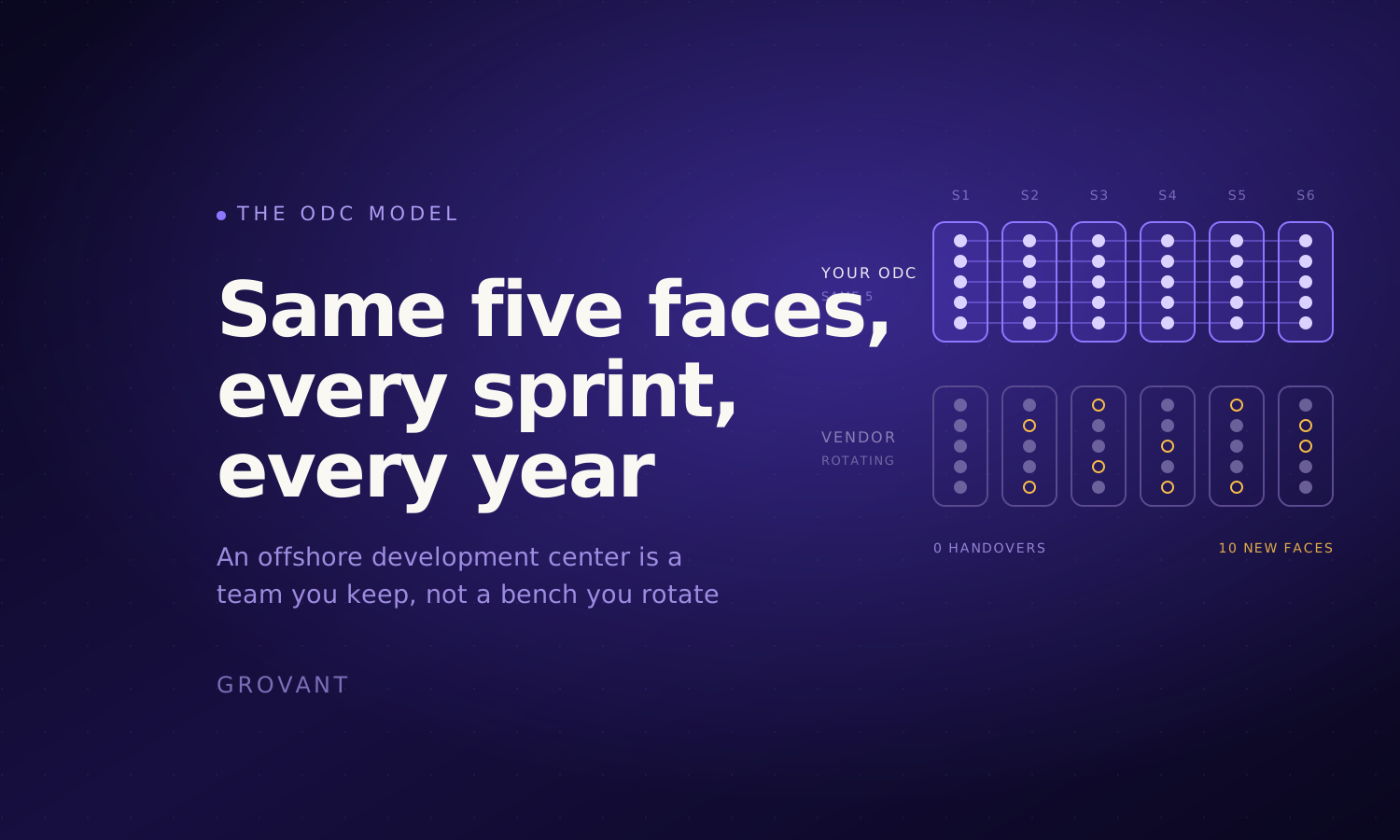
The offshore development center meaning comes down to one word: dedicated. The same people work on your product every day, learn your codebase and stay with it. That is the difference from a vendor that assigns whoever is free to each new project.
What a dedicated offshore development center includes
- A dedicated team: developers, QA, and often a tech lead or project manager, working only on your product.
- Infrastructure: office space, hardware, secure network, software licences and backups, provided by the vendor.
- People operations: recruitment, payroll, benefits, retention and replacements, handled by the vendor.
- Your process: your sprint rituals, tools (Jira, GitHub, Slack) and code standards, not the vendor's.
- IP and access controls: contracts that assign all code and IP to you, plus NDA and data-protection terms.
In short, the vendor runs the building and the payroll; you run the work.
Offshore development center vs outsourcing vs in-house
An ODC sits between project outsourcing and an in-house team: you get the control of in-house with most of the cost advantage of outsourcing.
| Factor | Offshore development center | Project outsourcing | Freelancers | In-house team |
|---|---|---|---|---|
| Who directs the work | You | The vendor | You | You |
| Team continuity | Same people long term | Changes per project | Low | High |
| Typical commitment | 12 months or more | Per project | Per task or month | Permanent |
| Pricing | Monthly fee per team member | Fixed price or time and materials | Hourly | Salary plus about 30% benefits |
| Time to start | 4 to 10 weeks | 2 to 4 weeks | Days | 3 to 6 months per hire |
| Best for | Ongoing product development | One-off builds with a clear scope | Small, short tasks | Core IP and leadership roles |
The main difference from outsourcing is accountability. With project outsourcing the vendor owns delivery against a scope. With an ODC you own delivery and the vendor owns the team. That suits companies with a product to evolve, not a project to finish.
For a deeper look at the project model, see our guide to outsourcing software development.
The three offshore development center models
There are three ways to run an ODC, and they differ mainly in who owns the entity and the people.
| Model | How it works | Who employs the team | Setup effort | Best for |
|---|---|---|---|---|
| Vendor-managed ODC | A vendor hires and hosts a dedicated team for you | The vendor | Low | Startups and SMBs that want speed and low risk |
| Build-operate-transfer (BOT) | The vendor builds and runs the center, then transfers it to you after an agreed period | The vendor first, then you | Medium | Companies that want their own entity in 2 to 3 years |
| Captive center | You set up your own legal entity abroad and hire directly | You | High | Large companies planning a big long-term team, with legal and HR capacity |
Vendor-managed is where most companies start. You pay a monthly fee per person, the vendor handles everything local, and you can scale up or down with notice.
Build-operate-transfer is a staged path to ownership. The vendor carries the setup risk; you agree up front on the transfer date, price and which people move over.
Captive centers give the most control and the lowest long-run cost per head, but you take on local law, payroll, tax and office leases yourself.
How much does an offshore development center cost?
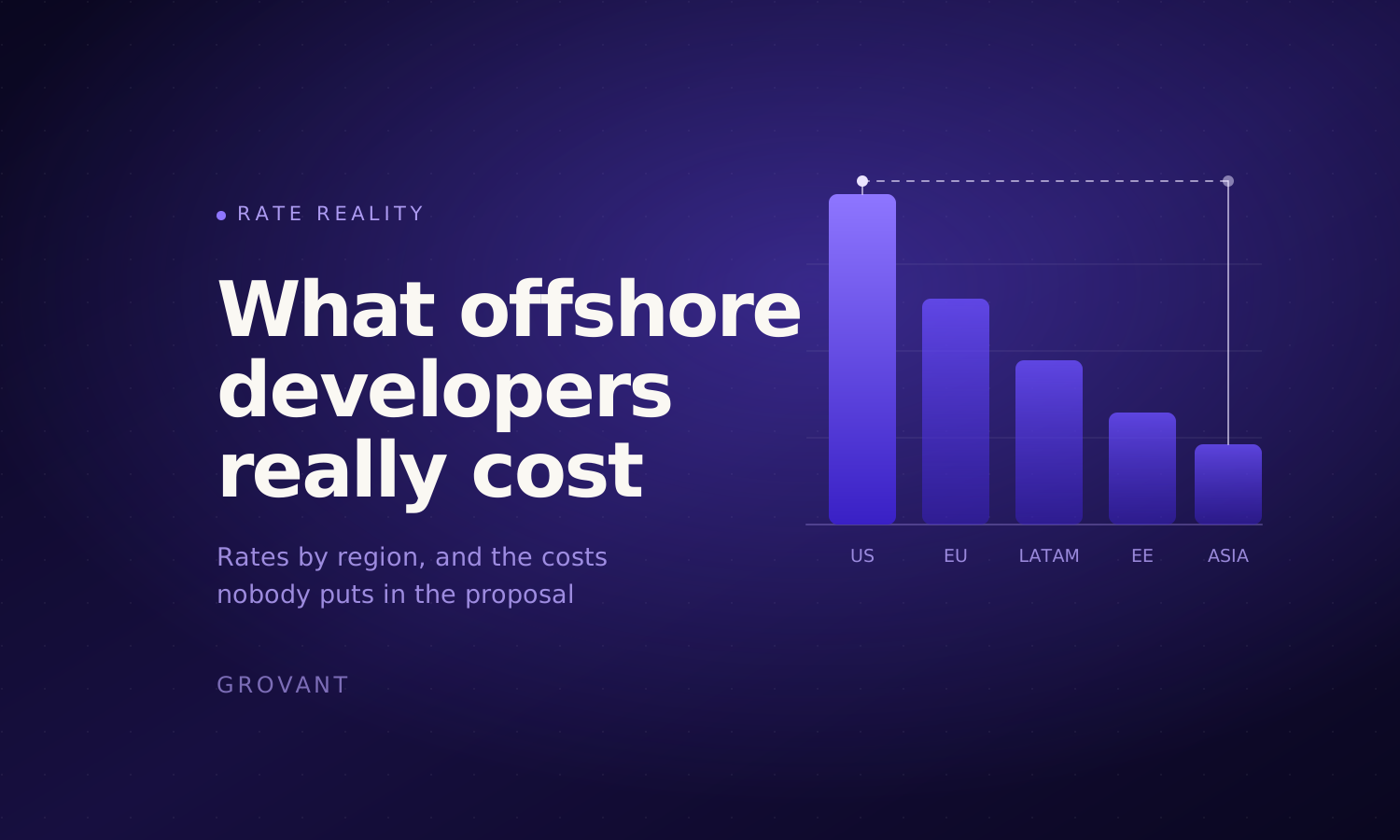
A five-person vendor-managed ODC in Asia costs roughly $19,000 to $33,000 a month in 2026, against about $72,000 a month for the same headcount in the US.
Most vendors charge a blended monthly rate per team member that already includes office, equipment and HR. Hourly billing rates by region in 2026:
| Region | Junior (per hour) | Senior (per hour) | Change on 2025 |
|---|---|---|---|
| Asia | $24 to $31 | $31 to $41 | down about 8% |
| Central and Eastern Europe | $31 to $39 | $64 to $76 | down 4.4% |
| Latin America | $33 to $45 | $60 to $75 | down 7.1% |
See the full breakdown in our offshore developer rates guide.
A worked example: five developers for one month
- ODC in Asia: 5 people × 160 hours × $24 to $41 = $19,200 to $32,800 a month.
- In-house in the US: median developer wage of $133,080 a year plus about 30% benefits = about $173,000 a year, or about $14,400 a month per person, $72,000 for five.
US wage and benefits share: US Bureau of Labor Statistics, as cited in our rates guide.
Costs that do not appear in the monthly rate
- Ramp-up time: a new team needs weeks to learn your codebase before it is fully productive.
- Your management time: someone on your side must own the backlog, reviews and priorities.
- Travel and onboarding: at least one in-person visit early on pays for itself in alignment.
- Transfer or exit fees: in a BOT model, agree the transfer price in the contract on day one.
The rate is never the whole story. A cheaper team that needs twice the rework costs more than a senior team that ships it right.
When does a dedicated offshore development center make sense?
A dedicated offshore development center fits when the work is ongoing and you can lead it. Use this quick check:
| An ODC is a good fit when... | Choose something else when... |
|---|---|
| You need 5 or more engineers for 12 months or longer | You have one project with a fixed scope: use project outsourcing |
| You have a product owner or CTO who can run the backlog | Nobody on your side can lead engineering day to day |
| Local hiring is too slow or too expensive | You need 1 or 2 specialists for a few weeks: use freelancers |
| You want the team to build long-term product knowledge | The work is core IP you must keep fully in-house |
How to set up an offshore development center in 6 steps
- Define the team and the work. Roles, seniority, tech stack and the first 90 days of backlog.
- Pick the country and model. Weigh rates, time-zone overlap and English; choose vendor-managed, BOT or captive.
- Vet the vendor. Meet the actual engineers, check retention and references, and review a sample contract. Our vendor vetting checklist covers the questions.
- Lock down IP and security. Code ownership, NDA, data protection, access rules and an exit clause.
- Onboard like a new hire. Documentation, a first small release, shared rituals and at least one in-person visit.
- Measure and adjust. Track cycle time, defect rate and retention monthly, and fix issues before you scale the team.
If you would rather not run the setup yourself, Grovant can provide a dedicated senior team under your process. See our development services for how a custom quote works.