A startup can get press without an agency by doing five things in order: pick one goal, find a story only you can tell, pitch trade press before the big outlets, give journalists something they cannot get elsewhere, and reuse every piece of coverage you earn. Funding news is not the only way in. When we read every startup story TechCrunch published in October 2026, two out of three had no funding round in the headline.
Key takeaways
- Journalists still need you. 66% rely on PR content for story ideas (Cision, 2026), and 86% say at least some of their stories start with a pitch (Muck Rack, 2026).
- Most pitches miss. 72% of journalists say fewer than a quarter of the pitches they get are relevant, and 88% delete pitches outside their beat.
- Funding is one hook, not the only one. In our October 2026 sample, 33% of TechCrunch startup stories led with a funding round; 38% were product or company stories with no funding hook.
- Data and experts win. Journalists rank original research and access to sources among the most valuable parts of a pitch.
- An agency is optional early on. Typical retainers run $5,000 to $15,000 a month; most early startups get better value doing the first round themselves.
What works, and what burns budget
| Area | What works | What burns budget |
|---|---|---|
| Who you pitch | 10 to 20 reporters who have covered your space in the last 3 months | Mass lists of hundreds of contacts |
| The story | A clear hook: new data, a real customer result, a contrarian view, a launch with numbers | "We are excited to announce" with nothing new |
| The outlet | Trade press, newsletters and podcasts your buyers read | Only chasing TechCrunch, Forbes or the Wall Street Journal |
| The pitch | Under 200 words, one idea, why it matters to their readers now | Long pitches with attachments and no point |
| Press releases | A wire release for funding or legal news, as a record | Paying for wire releases as your main tactic |
| Founder voice | Sharing expert views on news your space cares about | Waiting for a big announcement before talking to anyone |
| Follow-up | One polite follow-up after 3 to 5 days | Chasing three or four times |
| After coverage | Sharing it on LinkedIn, in sales decks and on your site | Letting it sit as a one-day spike |
What actually got covered: we read a month of startup news
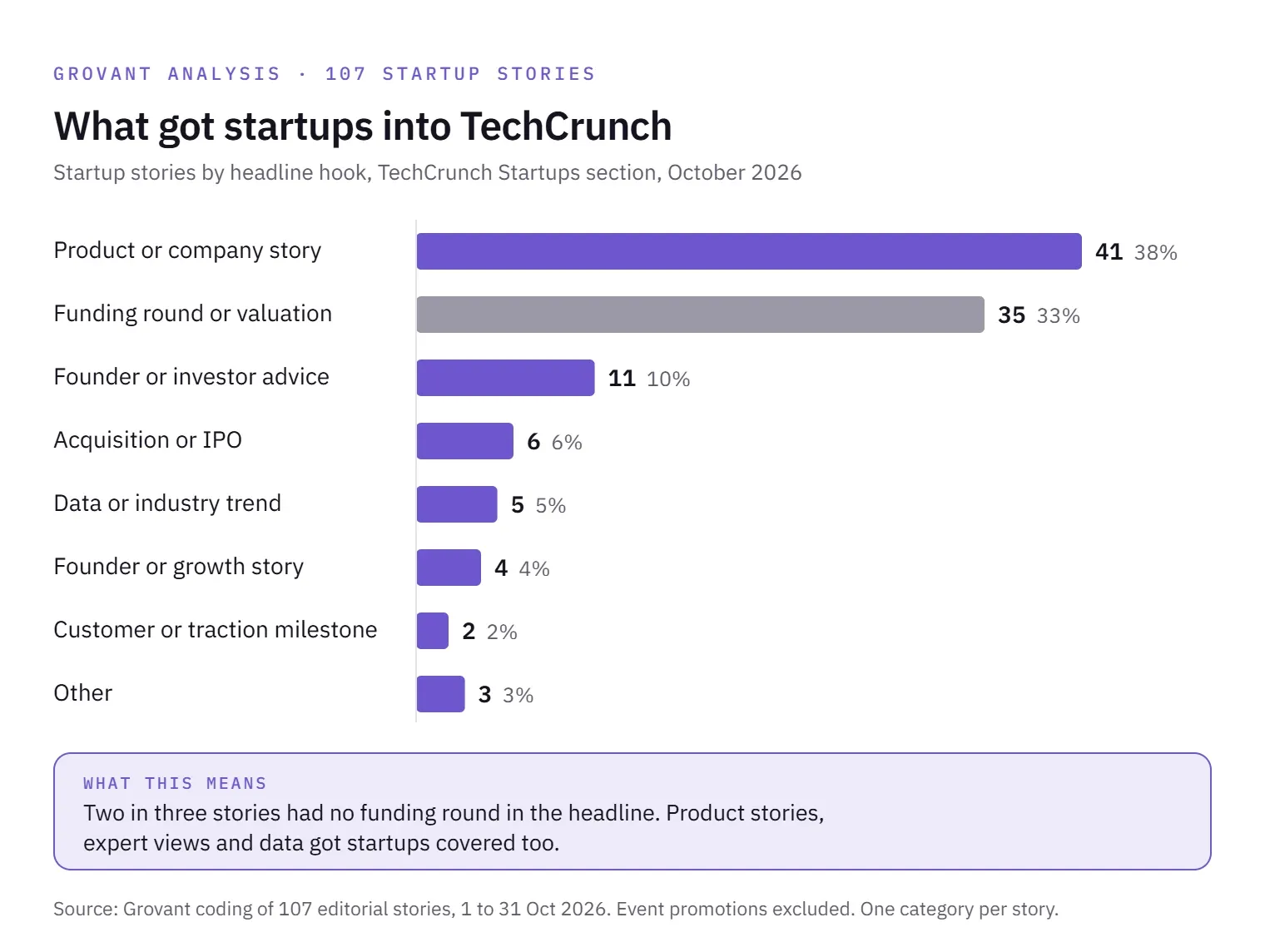
Most advice says "wait until you raise". We wanted to check that, so we read every story in TechCrunch's Startups section for October 2026 and sorted each one by the hook in its headline. TechCrunch published 154 stories there that month; we set aside 47 that promoted TechCrunch's own events, which left 107 editorial stories.
| Story type | Stories | Share | Typical hook |
|---|---|---|---|
| Product or company story, no funding in the headline | 41 | 38% | What the product does and the problem it solves |
| Funding round or valuation | 35 | 33% | Amount raised, lead investor, new valuation |
| Founder, investor or expert advice and views | 11 | 10% | A clear opinion or lesson from someone who has done it |
| Acquisition, acqui-hire or IPO | 6 | 6% | A deal or exit |
| Data, analysis or industry trend | 5 | 5% | Numbers or a pattern across the market |
| Founder or growth story | 4 | 4% | How someone built or grew something unusual |
| Customer or traction milestone | 2 | 2% | A big contract or usage number |
| Other (shutdown, partnership, roundup) | 3 | 3% | Mixed |
What this shows:
- Two thirds of the stories had no funding hook. A clear product story, a strong opinion or useful data got startups in too.
- Programs and competitions open doors. 14 of the 107 stories mentioned TechCrunch's own Startup Battlefield 200 program, and 12 of those were product stories. Accelerator demo days, awards and competitions are a real route to coverage.
- Expert views are the cheapest way in. One story in ten was built around a founder's or investor's advice. That needs no announcement, just a clear point of view and a reporter who knows you exist.
Limits: this is one month of one outlet, coded from headlines by one team. TechCrunch leans towards venture-backed tech, so trade press in your industry will look different. Treat it as a direction, not a law.
The startup PR playbook, step by step
- Pick one goal. Decide what press is for: trust with buyers, hiring, investors or search visibility. The goal decides which outlets matter.
- Find your story. List what only you can say: a customer result with numbers, data from your product, a contrarian view, or a launch that changes something for a clear group of people. If a competitor could send the same pitch, it is not a story.
- Build a short list. Find 10 to 20 reporters, newsletter writers and podcast hosts who covered your space in the last three months, and read what they wrote. Relevance beats reach.
- Start with trade press. Industry publications, niche newsletters and podcasts your buyers read are easier to reach and often send better leads than a big-name mention. Earn small wins first, then use them to open bigger doors.
- Write a short pitch. A subject line with the news, two or three sentences on why it matters to their readers, and one line on what you can offer: data, a customer, the founder. Make it easy to say yes.
- Offer something exclusive. Give one reporter first access or an embargo for your biggest news. Exclusives get read.
- Become a source. Answer journalist requests in your field and comment on news fast with a clear view. Reporters remember people who helped them on deadline.
- Apply where startups get picked. Accelerator demo days, startup competitions and industry awards come with built-in press. Let someone else's stage do the pitching.
- Reuse every hit. Share coverage on LinkedIn, add it to your site and sales decks, and link to it from your own content. One article can work for a year.
When an agency is worth it, and what startup PR costs
Doing PR yourself costs time, not cash. An agency costs both, and only pays off when you have more news than you can pitch.
| Option | Typical cost | Best for |
|---|---|---|
| Do it yourself | Founder time, plus optional tools | Pre-seed and seed startups with one or two stories a year |
| Freelance or project PR | One-off fee for a launch or funding announcement | A single big moment you want handled well |
| PR agency retainer | About $5,000 to $15,000 a month | Startups with a steady flow of news and several markets |
| In-house PR hire | About $150,000 to $250,000 a year with overhead | Later-stage companies where comms is a full-time job |
Hire help when:
- You have news at least every month or two, and no one has time to pitch it.
- You are entering a new market where you do not know the reporters.
- You face a crisis, a sensitive announcement or a regulated industry.
Keep it in-house when:
- You have one or two stories a year.
- The founder is the story and can talk to reporters directly.
- You have not yet found a story that gets a reply from trade press. An agency cannot fix a weak story.
How Grovant helps
We do not sell guaranteed placements, because no honest team can. What we do is help you find the story, build a target list that fits your market, write pitches that get read, and turn coverage into links, trust signals and search visibility. For B2B companies, our guide to B2B public relations goes deeper.
Our brand and PR service is a custom quote, month to month, with no long lock-in.
Sources
- Cision 2026 State of the Media Report (1,899 journalists, Jan to Feb 2026)
- Muck Rack State of Journalism 2026 (897 journalists, Jan to Mar 2026)
- DesignRush: How much does PR cost in 2026
- TechCrunch Startups section, October 2026 (our own coding of 107 editorial stories)
Want us to deliver this for you?
One senior specialist, start to finish. Free proposal, no pressure.