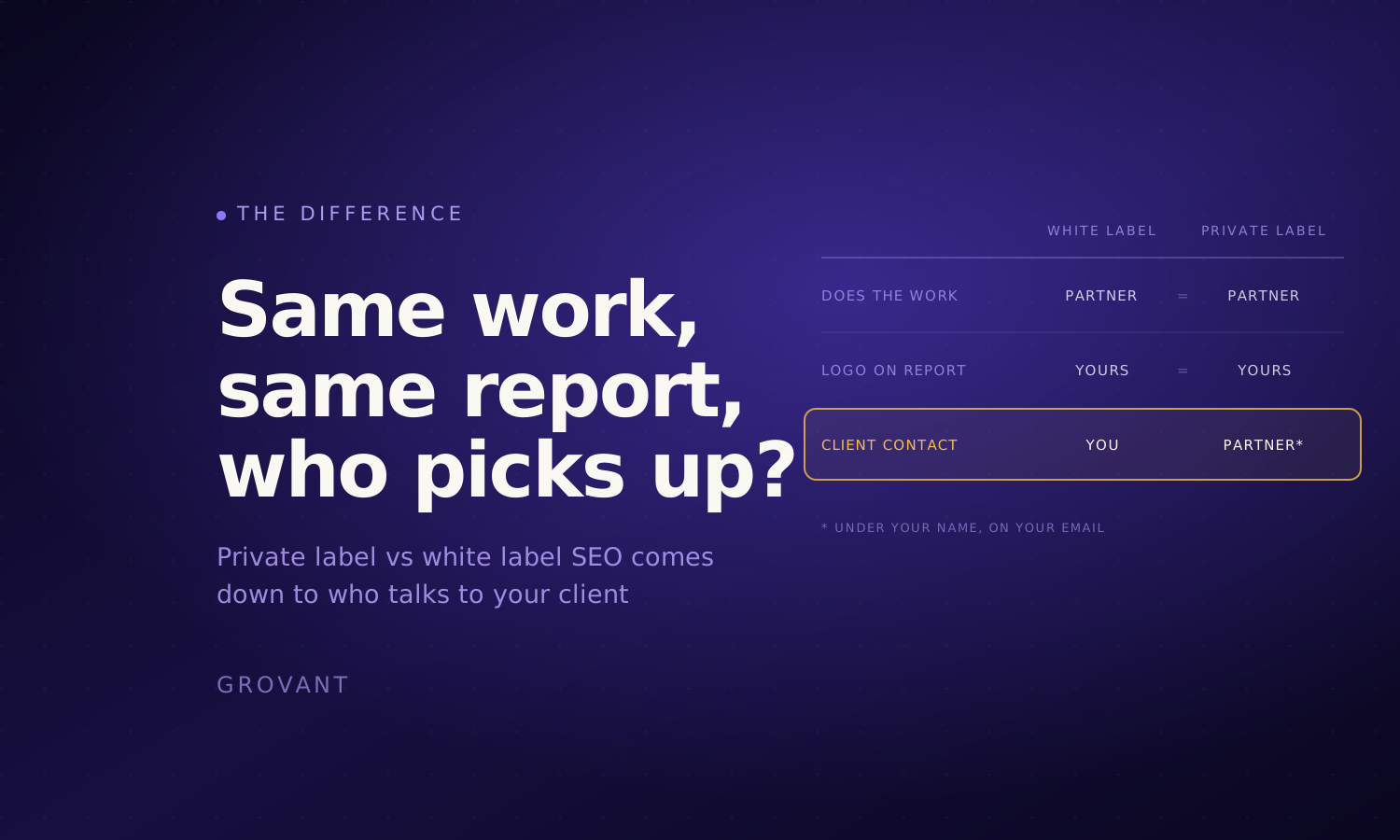
The short answer: in white label SEO the partner stays fully in the background and your agency handles every client conversation. In private label SEO the partner works as part of your team and can speak to clients under your brand. In both models you set the price, own the client and send reports with your logo.
Many providers use the two terms as if they mean the same thing, which is why agency owners often end up confused. The real difference is not the branding, which is yours in both cases. It is how close the partner gets to your client, and how much SEO knowledge your own team needs.
This guide compares private label vs white label SEO side by side: who does what, how pricing and margins work in each model, and which one fits your agency today.
Private label vs white label SEO: side by side
| Factor | White label SEO | Private label SEO |
|---|---|---|
| Brand on reports and deliverables | Yours | Yours |
| Who talks to the client | Only your agency | Your agency, plus partner specialists introduced as your team |
| Partner's role | Back-office supplier | Extension of your team |
| SEO knowledge you need in-house | Enough to explain strategy and results yourself | Less: the partner's experts can join calls |
| Your time per client | Higher | Lower |
| Partner email and tools | Partner's own, never seen by the client | Often your domain and your tools |
| Typical cost to you | Lower | Higher, because the partner does more |
| Control over messaging | Full | Shared, so set clear rules |
| Best for | Agencies with an SEO lead in-house | Agencies without a senior SEO person, or at full capacity |
The pattern is simple: the more of the client relationship you hand to the partner, the less time you spend per client, and the more you pay for the service.
How each model works
In both models the work flows the same way: the partner delivers the SEO, your agency brands it and sells it, and the client pays you. The only change is the line between the partner and the client.
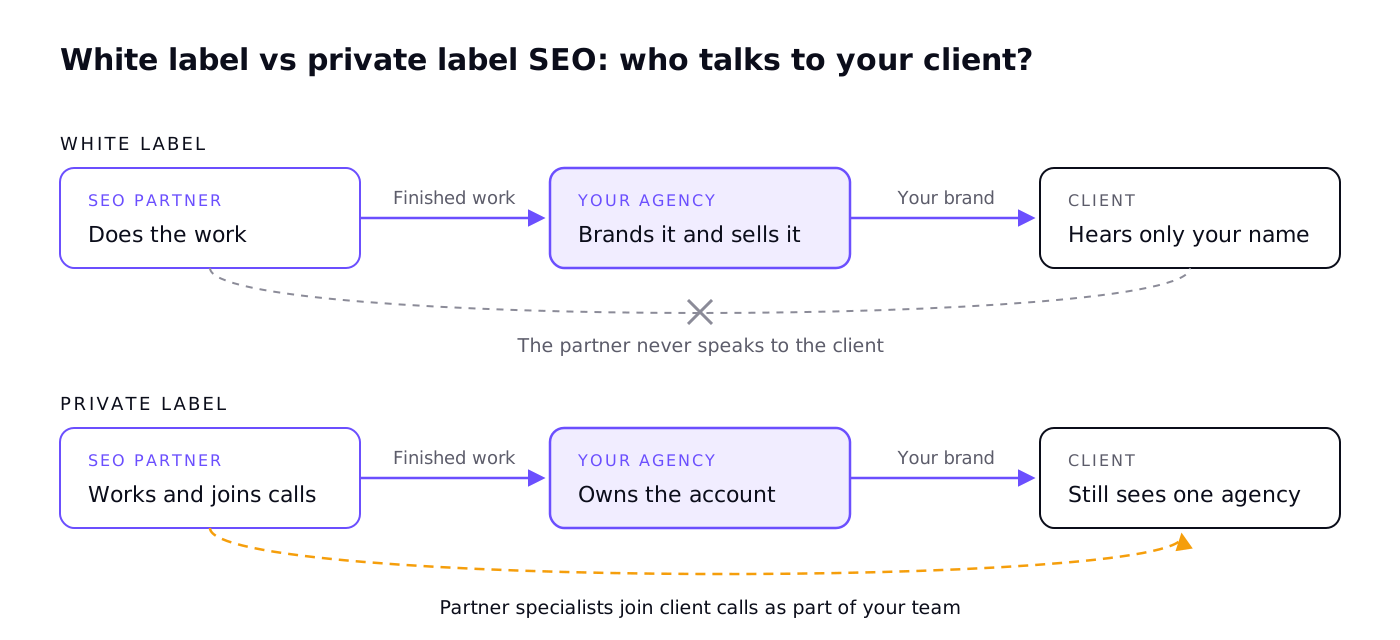
White label: the partner sends finished work and unbranded reports to you. You review them, add your branding and handle all client calls and emails. The client never hears the partner's name.
Private label: the partner does the same work, but its specialists can also use an email on your domain, join client calls as "your SEO lead" and answer technical questions directly. The client still sees one agency: yours.
Pricing and margins in each model
Both models are usually priced as a monthly retainer per client, a tiered package or a custom quote. The difference is what the fee covers. A private label partner also covers part of the account management, so the same SEO scope usually costs a little more than white label.
That does not always mean a lower margin. What matters is your margin after your own team's time. Here is a simple example with round numbers for one client paying you $1,800 a month:
| Item | White label | Private label |
|---|---|---|
| Partner fee (example) | $1,000 | $1,200 |
| Your gross margin | $800 | $600 |
| Your team's time per month | About 8 hours on calls, reports and questions | About 2 hours, mostly approvals |
| Margin per hour of your time | About $100 | About $300 |
These numbers are only an illustration, not real prices. Run the same sum with your partner's actual quote and your own hourly cost. For many small agencies, private label wins on margin per hour even when the fee is higher, because the founder's time is the scarcest resource.
Whichever model you choose, ask what is included in the base fee. Content and link building are the two items most often billed separately.
Which model fits your agency?
Choose white label SEO if:
- You already have someone in-house who understands SEO and can explain it to clients.
- You want full control over every client message.
- You want the lowest possible cost per client.
- Your clients expect to deal with the same one or two people at your agency.
Our guide to white label SEO for agencies covers this model in depth.
Choose private label SEO if:
- Nobody on your team is a senior SEO specialist, but you still want to sell SEO without hiring.
- Clients ask technical questions you would rather an expert answered.
- Your team is at full capacity and you need to win back hours.
- You want to sell larger SEO retainers that need strategy calls.
For a full breakdown of how reseller programs run, read our guide to private label SEO.
A quick test: if a client asked tomorrow why their rankings dropped, could someone at your agency answer confidently in a call? If yes, white label is enough. If no, private label will protect the relationship.
Can an agency offer both?
Yes, and many do. The two models are not a one-time choice for the whole agency. You can pick per client:
- White label for smaller clients who rarely ask questions and are happy with a monthly report.
- Private label for larger or more demanding clients who want regular strategy calls.
The same logic works beyond SEO. Agencies often use white label marketing for PPC and design, and private label where a client expects to talk to a specialist. Our guide to white label PPC shows how the model works for paid search.
Switching from white label to private label
Many agencies start with white label and move to private label as they grow. To switch smoothly:
- Agree with your partner how their specialists will introduce themselves, which email they use and who joins which calls.
- Introduce the specialist to the client as "our SEO lead" on a regular review call, not in the middle of a problem.
- Keep one person at your agency as the main contact for billing and big decisions.
- Write down what the partner can and cannot promise, such as timelines, results and extra work.
One partner, both models
Grovant works with agencies as both a white label and a private label SEO partner, so you can choose per client and switch as you grow. A senior specialist handles audits, content, links and branded reports, and can join your client calls as part of your team when you need it. Every partnership is priced by custom quote after a free audit.