Most small businesses pay for SEO software long before they need it. The truth is that the best SEO tools and software for a small business are mostly free. Google Search Console, Google Analytics 4 and a free crawler cover indexing, technical fixes and on-page work. You only need a paid tool, such as Semrush, Ahrefs, SE Ranking or Moz Pro, when you want competitor research and keyword data the free tools can't give you.
This guide covers 18 tools: what each one is for, what it really costs, and the order to add them in. Every tool in this list has been used by our SEO team in day-to-day work, and every price comes from the tool's own pricing page, checked on 24 November 2026. Day to day, Semrush and Ahrefs are the two our team opens most, so you will see them come up more than once.
What SEO tools actually do (and which jobs you need covered)
Before you compare brands, it helps to know what job you're hiring a tool for. SEO software does seven jobs. Free tools cover most of them; paid tools mostly win on competitor data and scale.
| Job | What it answers | Free tool | Paid upgrade |
|---|---|---|---|
| Measure results | Which searches bring clicks, and what visitors do next | Google Search Console, GA4 | Not needed |
| Technical health | Broken links, redirects, missing titles, slow pages | Screaming Frog (500 URLs), PageSpeed Insights | Screaming Frog licence, Sitebulb |
| On-page SEO | Titles, meta descriptions, sitemaps, schema | Yoast, Rank Math or AIOSEO free | Plugin premium tiers |
| Keyword research | What people search for and how often | Keyword Planner, Google Trends, Search Console | Semrush, Ahrefs, SE Ranking, Moz Pro |
| Competitors and backlinks | Who outranks you and who links to them | Ahrefs Webmaster Tools (your own site only) | Ahrefs, Semrush |
| Local SEO | How you show up in Maps and "near me" searches | Google Business Profile | BrightLocal |
| AI visibility | Whether ChatGPT, Gemini and AI Overviews mention you | Asking the assistants yourself | Semrush, Ahrefs Brand Radar, Surfer |
Notice the pattern? The first three jobs are fully covered for free. The money only starts when you want to see what your competitors are doing, or when you outgrow the free limits.
Best SEO tools for small business compared
| Tool | Best for | Free option | Paid from |
|---|---|---|---|
| Google Search Console | Rankings, clicks and indexing from Google itself | Free | n/a |
| Google Analytics 4 | What visitors do after they land | Free | n/a |
| Google Business Profile | Showing up in Maps and local results | Free | n/a |
| PageSpeed Insights / Lighthouse | Page speed and Core Web Vitals | Free | n/a |
| Google Keyword Planner and Trends | Keyword ideas and seasonality | Free (Keyword Planner needs a Google Ads account) | n/a |
| Bing Webmaster Tools | Bing indexing and a free site scan | Free | n/a |
| Screaming Frog SEO Spider | Technical crawl of your site | Free up to 500 URLs | £199/year (about $279) |
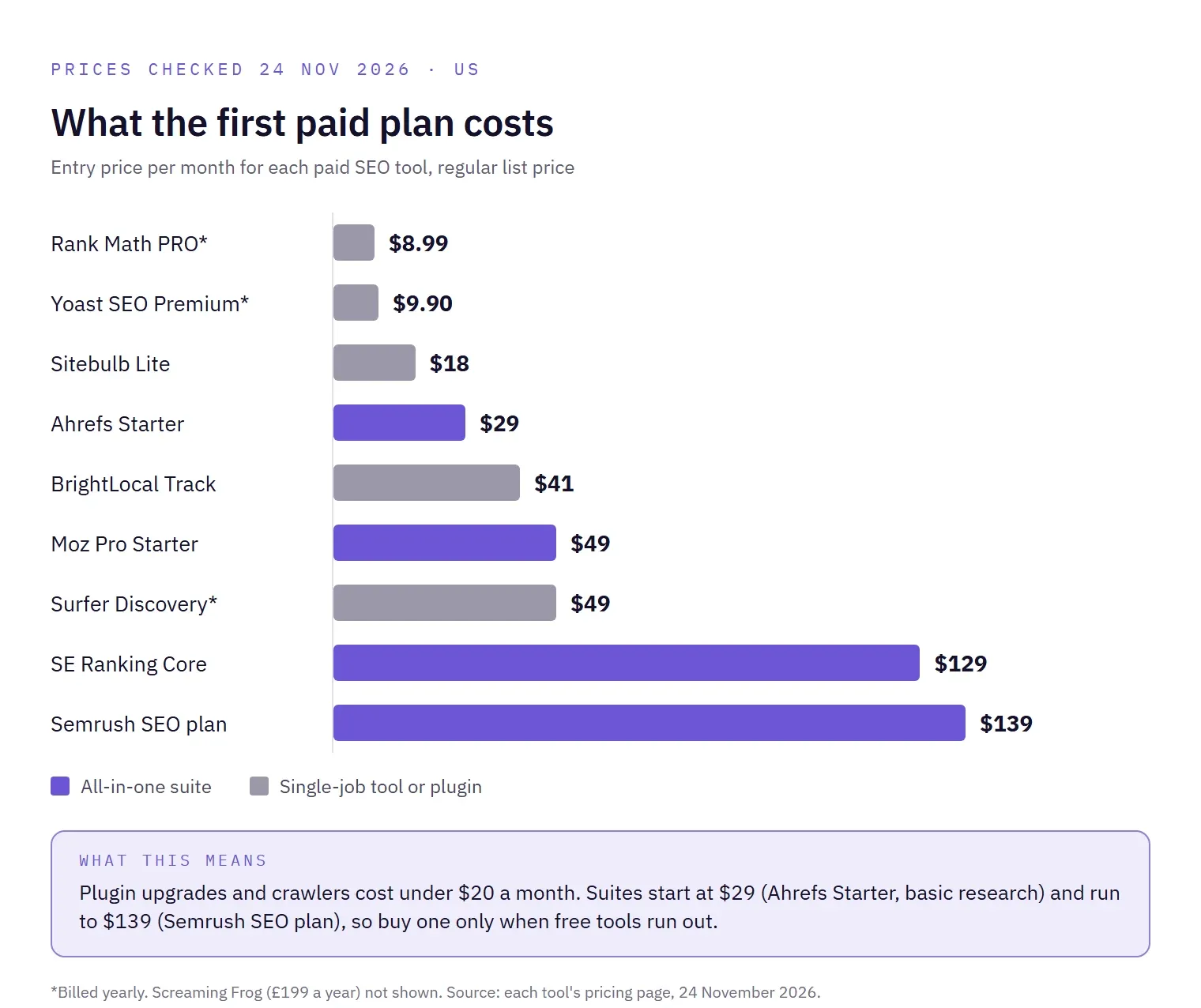
| Sitebulb | Visual technical audits with prioritised fixes | 14-day trial | $18/month (Lite) |
| Yoast SEO | WordPress on-page basics | Free plugin | $118.80/year (Premium) |
| Rank Math | WordPress SEO with more built in for free | Free plugin | $8.99/month billed yearly (PRO) |
| All in One SEO (AIOSEO) | WordPress SEO with local and schema add-ons | Free plugin | $99/year (Basic) |
| Semrush | All-in-one keyword, competitor and audit suite | Free plan (10 reports a day) | $139/month (SEO plan) |
| Ahrefs | Backlinks and competitor research | Free Webmaster Tools | $29/month (Starter), $129 (Lite) |
| SE Ranking | All-in-one suite with generous rank tracking | 14-day trial | $129/month (Core) |
| Moz Pro | Beginner-friendly research and tracking | Free trial | $49/month (Starter) |
| Surfer | Content optimisation and AI search tracking | None listed | $49/month billed yearly (Discovery) |
| BrightLocal | Local rankings, citations and reviews | 14-day trial | $41/month (Track) |
| ChatGPT / Claude | Briefs, outlines and first drafts | Free plans | $8/month (ChatGPT Go), $20 (Plus or Claude Pro) |
Best free SEO tools for small business: start here
- Google Search Console. The only place to see which queries bring you clicks from Google, which pages are indexed and what errors Google found. Set it up before anything else.
- Google Analytics 4. Shows what visitors do after they land: which pages lead to calls, forms or sales.
- Google Business Profile. For any business with a location or service area, this is the profile that shows in Maps and the local pack.
- PageSpeed Insights and Lighthouse. Free speed and Core Web Vitals checks for any page.
- Google Keyword Planner and Google Trends. Keyword ideas and rough volumes (Keyword Planner needs a free Google Ads account), plus seasonality from Trends.
- Bing Webmaster Tools. Bing's version of Search Console, with a free site scan. Bing data also feeds some AI assistants, so it is worth five minutes to set up.
- Screaming Frog SEO Spider. Crawls your site like a search engine and lists broken links, redirects, missing titles and duplicate pages. Free up to 500 URLs, which covers most small business sites.
- Yoast SEO, Rank Math or AIOSEO. On WordPress, one of these handles titles, meta descriptions, sitemaps and basic schema. Pick one, never two.
- Ahrefs Webmaster Tools. Free backlink and site audit data for sites you verify.
What the free stack can't do well: competitor research, large keyword lists with difficulty scores, and backlink analysis of other sites. That is when a paid suite earns its price. Whatever you use, give it time: here is how long SEO takes for different kinds of sites.
How to set up the free SEO stack in one afternoon
Got a site but never set any of this up? Do it in this order. Each step feeds the next, and none of it costs anything.
- Verify your site in Google Search Console. Use a domain property so every version of your site (www, non-www, http and https) is covered, then submit your XML sitemap.
- Install Google Analytics 4 and mark your key events. A form submission, a click on your phone number or a purchase. Then link GA4 to Search Console so you can see search queries next to what those visitors did.
- Add Bing Webmaster Tools. It can import your sites straight from Search Console, so this takes minutes.
- Claim and complete your Google Business Profile if you serve customers locally: primary category, address or service area, hours, services and real photos.
- Install one SEO plugin if you're on WordPress. Set your title format, turn on the XML sitemap and add basic organisation schema.
- Run a Screaming Frog crawl. Fix 404 errors, redirect chains, missing or duplicate titles, and pages blocked by mistake.
- Test your five most important pages in PageSpeed Insights. Usually your homepage and main service or product pages. Fix the biggest issues it flags, such as oversized images, first.
Search Console needs a few days to collect data after you verify it, so don't worry if the reports look empty on day one.
A 30-minute weekly SEO routine using only free tools
Tools are useless if nobody opens them. Here's a simple weekly check that catches most problems and opportunities:
- Search Console, Performance report: sort queries by impressions and look for ones where you rank around positions 8 to 20. Those pages are close to page one, and improving them usually pays off faster than writing something new.
- Search Console, low click-through pages: pages with plenty of impressions but few clicks often need a better title and meta description.
- Search Console, Pages report: check for new "not indexed" pages or errors since last week.
- GA4: see which organic landing pages lead to key events, and which get traffic but no enquiries.
- Google Business Profile: reply to new reviews and answer any new questions.
- Once a month: re-crawl the site with Screaming Frog and recheck your top pages in PageSpeed Insights.
Do this every week for three months and you'll understand your site better than most paid dashboards could tell you.
Best paid SEO tools for small business, by job
All-in-one suites
These four do the same core jobs: keyword research, competitor analysis, site audits and rank tracking. The real differences are price, data depth and limits. Our team works in Semrush and Ahrefs every day; SE Ranking and Moz Pro cover the same ground for less.
- Semrush: best all-round suite. The SEO plan ($139 a month) puts keyword and competitor research, site audits, rank tracking and AI search tracking in one dashboard. If you want the full keyword toolset and daily AI prompt tracking, Semrush One Starter is $199 and Pro+ is $299. A free plan with 10 reports a day lets you look around before you pay. Pick it if you want one tool for SEO, competitor research and AI visibility. Skip it if you only need rank tracking or backlinks.
- Ahrefs: best for backlinks and competitor research. Its link data is the reason many SEOs keep it. Starter ($29 a month) is the cheapest way into any of the big suites and handles occasional keyword and competitor lookups. Lite ($129) adds rank tracking and audits for your own projects; Standard is $249 and Advanced $449. Ahrefs says it never runs discounts, and Ahrefs Webmaster Tools is free for sites you own. Pick it if links and competitor research drive your strategy. Skip it if you need several seats on a small budget.
- SE Ranking: best value suite. Core ($129 a month) tracks four times as many keywords as Semrush's SEO plan, across twice as many sites. Growth ($279) adds more projects and three seats. There's a 14-day free trial. Pick it if you track lots of keywords or several sites. Skip it if backlink depth matters most to you.
- Moz Pro: easiest for beginners. Starter ($49 a month) covers a single website, which is all many small businesses need. Standard ($99) steps up to three sites; Medium is $179 and Large $299. Pick it if you want a gentle learning curve. Skip it if you research keywords every day, because Standard allows 150 keyword queries a month.
| Plan | Price per month | Sites or projects | Keywords tracked | Extra users |
|---|---|---|---|---|
| Moz Pro Standard | $99 ($79 billed yearly) | 3 | 300 | $49/month |
| Ahrefs Lite | $129 (up to 17% off yearly) | 5, plus unlimited verified | 750 | $40/month |
| SE Ranking Core | $129 ($103.20 billed yearly) | 10 | 2,000 | 1 seat; Growth includes 3 |
| Semrush SEO plan | $139 ($117.33 billed yearly) | 5 | 500 | From $45/month |
On paper, SE Ranking gives you the most tracked keywords per dollar. Semrush and Ahrefs cost more, but most SEOs pay the premium for their data and extra tools, especially Ahrefs' backlink index.
Technical audits
Screaming Frog is the best desktop crawler. The free version stops at 500 URLs; a licence costs £199 a year (about $279) and unlocks unlimited crawling, saved crawls, JavaScript rendering, custom extraction and API integrations. Sitebulb is better if you want clear, prioritised audit reports rather than raw data. Lite is $18 a month for up to 10,000 URLs per audit, Pro is $42 for up to 500,000, and cloud plans start at $125, with a 14-day free trial.
For a typical small business site with a few hundred pages, the free version of Screaming Frog is enough. Pay only when you pass 500 URLs or need JavaScript rendering.
WordPress plugins
- Yoast SEO Premium: $118.80 a year ($9.90 a month) for one site.
- Rank Math PRO: $8.99 a month billed yearly for unlimited personal websites; Business is $27.99 and Agency $64.99 a month. It was running a Black Friday sale at about half price when we checked.
- AIOSEO: Basic $99 (1 site), Plus $199 (3 sites), Pro $399 (10 sites) and Elite $599 (100 sites) a year. First-year discounts of around 50% are common.
The free versions of all three handle the basics well. Pay for premium only when you need a specific feature you can't get free.
Content
- Surfer: best for content optimisation. Discovery is $49 a month billed yearly and covers 120 documents, but no AI prompt tracking. For AI search tracking, the AI Search Analytics plan is $82 a month billed yearly; Standard is $99.
- ChatGPT or Claude: best for briefs and first drafts. Both have free plans. ChatGPT Go is $8 a month and Plus is $20; Claude Pro is $20 a month, or $17 billed yearly. Use them to speed up research and outlines, then edit with real expertise. For more options, see our guide to the best AI SEO tools.
Rank tracking and AI visibility
Rank tracking comes with every suite above, so don't buy a separate tracker. We use the position tracking built into Semrush and Ahrefs; if tracking lots of keywords is your main need, SE Ranking Core is the most generous of the four entry plans.
AI visibility is the newer job. Semrush and Ahrefs both now track how often a brand is mentioned in AI answers. Semrush's SEO plan includes AI search tracking and custom prompt monitoring, Ahrefs Lite includes 150 AI prompt checks, and BrightLocal's plans include a local AI visibility tracker. If you already pay for one of these, start there before buying a dedicated AI visibility tool such as Ahrefs Brand Radar (from $199 a month).
Best local SEO tools for small business
If customers find you through Maps or searches like “plumber near me”, local rankings matter more than national ones. Three tools cover most of it.
- Google Business Profile (free): your listing in Maps and the local pack. Keep categories, hours, photos and services current, and reply to reviews.
- Google Search Console (free): filter queries by your town or “near me” to see which local searches already send you clicks.
- BrightLocal: best for local rankings, citations and reviews. Track is $41 a month for one location and monitors local rankings for up to 100 keywords and four competitors, with a geo-grid map for five keywords, citation checks and a Google Business Profile audit. Manage ($54) adds listing sync and scheduled Google Business Profile posts. Grow ($65) adds review monitoring and review requests by email and SMS. Paying yearly saves 25%, and there's a 14-day free trial with no card needed.
Start with the two free tools. Add BrightLocal once you need to see how you rank across your service area, track several locations or manage citations at scale.
Signs you've outgrown the free tools
So how do you know it's time to pay? The clearest sign is wanting to see a competitor's keywords, because Search Console only shows your own. Others: you're planning content and need volumes and difficulty scores for hundreds of ideas, you want to build links and need to see who links to your competitors, or your site has grown past the 500 URLs the free Screaming Frog crawl covers. Serving several locations, where one national ranking tells you little, is another. So is spending hours each month copying data into spreadsheets.
If none of those apply yet, keep your money. A paid tool won't fix a problem you don't have.
Which SEO tool should a small business buy first?
| Your situation | Start with | Monthly cost |
|---|---|---|
| Brand new site, no budget | Search Console, GA4, Screaming Frog free, Yoast or Rank Math free | $0 |
| Local business with one location | Google Business Profile plus BrightLocal Track | From $41 |
| WordPress site, small budget | Rank Math PRO or Yoast Premium, plus Sitebulb Lite | About $27 to $28 |
| Need basic keyword and competitor lookups | Ahrefs Starter or Moz Pro Starter | $29 to $49 |
| Tracking many keywords or several sites | SE Ranking Core | $129 |
| Growing fast, publishing weekly | Semrush SEO plan or Ahrefs Lite | $129 to $139 |
Our advice: buy one paid tool at a time, and only when a free tool has clearly run out. The suites overlap heavily, so two of them rarely give you twice the value.
Tools only help if the plan behind them is sound. Our guide to building an SEO content strategy covers what to do with the data once you have it.
What SEO tools really cost: the extras to watch
The sticker price is rarely the whole bill. Before you sign up, check these:
- Extra users. Most suites charge per seat: $40 a month on Ahrefs Lite, from $45 on Semrush and $49 on Moz Pro. One extra person adds roughly $480 to $590 a year.
- Yearly billing. Paying yearly saves 17% to 25% depending on the tool, but locks you in. Stay monthly until you're sure the tool earns its place.
- Black Friday pricing. Deals like Rank Math's and AIOSEO's discount the first year. Rank Math's offer page says plans renew at the regular price, so budget for that.
- Add-ons. Deeper AI visibility tracking often costs more: Ahrefs Brand Radar starts at $199 a month, and Semrush's daily prompt tracking starts with the $199 Semrush One Starter plan.
- Currency. Screaming Frog prices in pounds, so your card's exchange rate and fees apply.
Mistakes small businesses make with SEO tools
- Paying for two suites. Semrush, Ahrefs, SE Ranking and Moz Pro overlap heavily. Pick one.
- Buying a yearly plan before testing. Run the trial or free plan on your own site first, and check the data looks right for your market.
- Chasing tool scores. Plugin traffic lights and third-party authority scores are estimates made by tool vendors, not numbers Google uses. A green light doesn't mean a page will rank.
- Treating keyword volumes as exact. Every tool estimates search volume differently. Search Console impressions are the closest you'll get to real numbers for your own site.
- Tracking hundreds of keywords you never act on. Track the terms tied to your services and money pages, and review them monthly.
- Skipping Search Console. It's free, it's Google's own data, and it often catches the problems paid tools charge to find.
How Grovant helps
Tools give you data; someone still has to decide what to fix first. Our SEO team runs the audits, keyword research and tracking for small businesses, using the same tools listed here (mainly Semrush and Ahrefs), so you don't have to pay for them yourself.
Pricing is a custom quote, month to month.
Sources
Pricing pages, all checked 24 November 2026: Semrush, Ahrefs, SE Ranking, Moz Pro, Screaming Frog, Sitebulb, Yoast, Rank Math, AIOSEO, Surfer, BrightLocal, ChatGPT, Claude.
Want us to deliver this for you?
One senior specialist, start to finish. Free proposal, no pressure.