SEO usually takes 3 to 6 months to show early movement and 6 to 12 months to bring meaningful traffic. New sites and competitive keywords take longer; established sites fixing technical problems or targeting easy keywords can see results in weeks. Google's own 2017 guidance on hiring an SEO put it at "four months to a year", and that range still holds for most businesses.
At a glance
- Weeks 1 to 4: pages get crawled and indexed. Google says crawling "can take anywhere from a few days to a few weeks".
- Months 1 to 3: impressions rise in Search Console and some long-tail keywords appear, usually beyond page one.
- Months 3 to 6: the first page-one rankings for easier keywords, and the first steady clicks.
- Months 6 to 12: meaningful traffic and leads, if the content and links keep coming.
- 12 months and beyond: competitive keywords. Ahrefs found the average #1 page is 5 years old.
On a new travel site we work with, impressions jumped in month 3, clicks passed 200 a month in month 6 and 1,000 a month in month 9. Full numbers below.
How long SEO takes, by site type
| Site type | First movement | Meaningful traffic | Why |
|---|---|---|---|
| New site (under a year old) | 4 to 6 months | 9 to 18 months | No history or links yet; Google says rankings for new sites can fluctuate for up to a year |
| Established site, fixing technical problems | 2 to 8 weeks | 2 to 4 months | Google only needs to recrawl, which takes days to weeks |
| Established site, new content | 1 to 3 months | 4 to 9 months | Pages that reach the top 10 often do it fast, but few new pages get there |
| Local business | 2 to 8 weeks | 3 to 6 months | Business Profile edits can take up to 30 days to review; local competition is smaller |
| Ecommerce store | 3 to 6 months | 6 to 12 months | Many pages to index and strong marketplace competitors |
| SaaS or B2B in a crowded market | 4 to 6 months | 9 to 18 months | Competitors have years of content and links |
| Site migration or redesign | A dip for a few weeks | 2 to 6 months to settle | Google says most pages move within weeks; rankings settle over time |
| Recovering from a core update | Weeks to months | Often the next core update | Google says recovery may mean waiting for the next one |
The pattern: the more history your site has, the faster SEO moves. A new site has to earn trust from zero. An established site often has rankings sitting just off page one, waiting for a fix.
What the data says
| Finding | Source and date |
|---|---|
| "SEOs need four months to a year to help your business first implement improvements and then see potential benefit" | Google, "How to hire an SEO" video (Maile Ohye), 2017 |
| Only 1.74% of newly published pages reach the top 10 within a year (6.11% in a second, cleaner sample) | Ahrefs, 1M and 2M URLs, May 2025 |
| 40.82% of pages that reach the top 10 do so within one month | Ahrefs, May 2025 |
| The average #1 ranking page is 5 years old; 72.9% of top-10 pages are over 3 years old | Ahrefs, 1.3M keywords, May 2025 |
| Most SEOs say results take three to six months | Ahrefs poll, 3,680 responses, 2022 |
| "Crawling can take anywhere from a few days to a few weeks" | Google Search Central, Dec 2025 |
| New sites' rankings can fluctuate; "over the course of a year, things settle down" | Google's John Mueller, Jun 2020 |
| Site-wide quality changes "often take several months to be reprocessed" | John Mueller, Jun 2021 |
| Core updates in 2025 and 2026 took 12 to 18 days to roll out; recovery can mean "waiting until the next core update" | Google Search Status Dashboard and core updates guide |
Two things stand out. First, most pages never reach page one, so "how long" really depends on picking keywords you can win. Second, the pages that do win often win fast: when a page is the right fit, a month can be enough. When it is not, a year of waiting rarely fixes it.
AI search has not changed the timeline much. AI Overviews and AI Mode draw on pages Google has already crawled and indexed, so the same clock applies. What has changed is that a page-one ranking now brings fewer clicks when an AI Overview appears, which we cover in Is SEO dead?
Case study: a new travel site, month by month
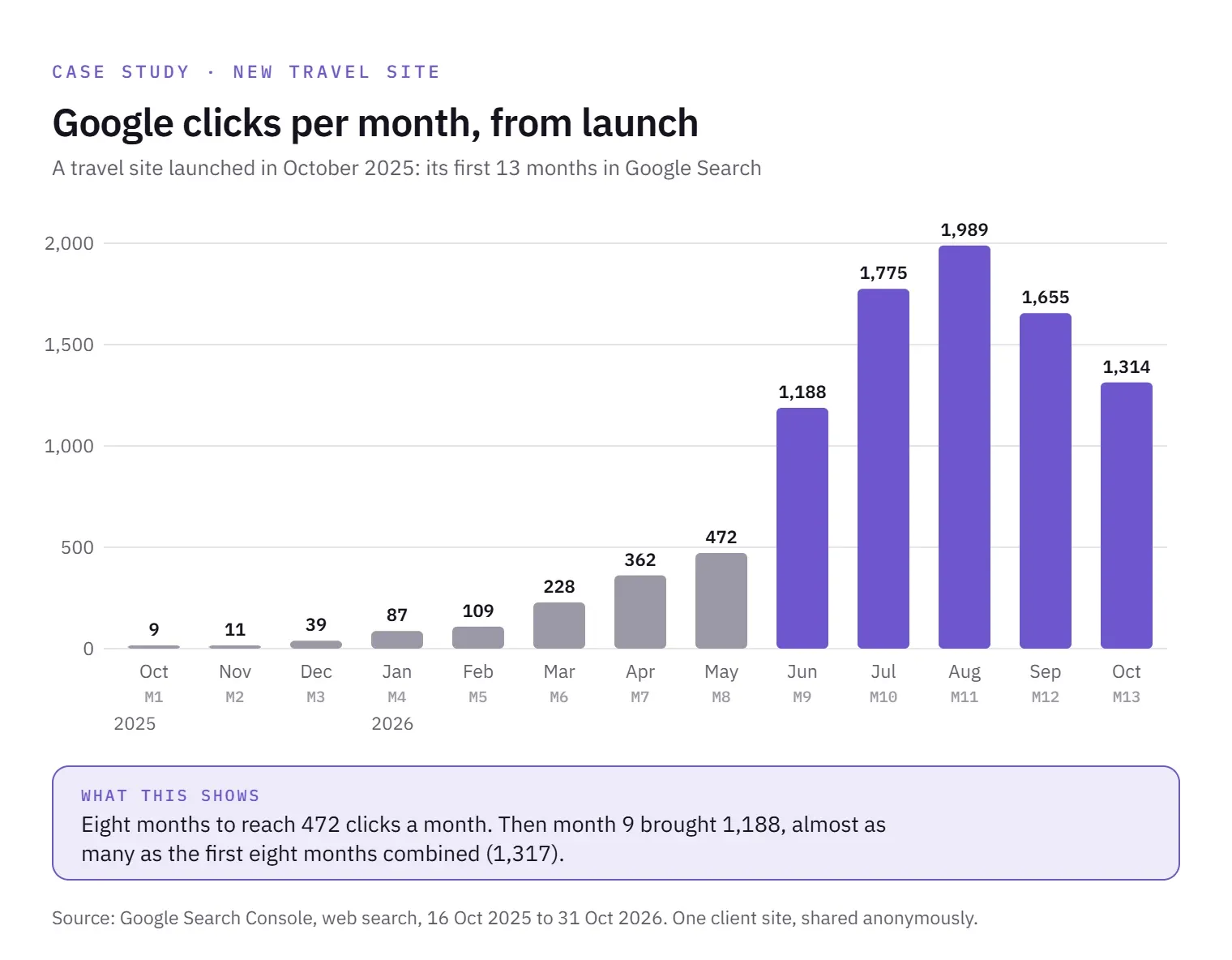
Studies give averages. Here is one real site. It is a travel guide site we work with that launched in October 2025, so these Google Search numbers cover its first 13 months, from launch day. It is one site, not an average, but it shows the shape most new sites follow.
| Period | Clicks per month | Impressions per month | What happened |
|---|---|---|---|
| Months 1 to 2 (Oct to Nov 2025) | 9 to 11 | 75 to 544 | Google found the site; almost no traffic |
| Month 3 (Dec 2025) | 39 | 13,666 | Impressions jumped about 25 times |
| Months 4 to 6 (Jan to Mar 2026) | 87 to 228 | 57,630 to 113,054 | Clicks roughly doubled every month or two |
| Months 7 to 8 (Apr to May 2026) | 362 to 472 | 101,363 to 143,148 | Steady growth |
| Month 9 (Jun 2026) | 1,188 | 333,622 | Clicks rose 2.5 times in one month |
| Months 10 to 11 (Jul to Aug 2026) | 1,775 to 1,989 | 451,412 to 536,308 | Peak so far |
| Months 12 to 13 (Sep to Oct 2026) | 1,655 to 1,314 | 312,282 to 323,540 | Down from the peak |
What this shows:
- Nothing visible for two months. Google crawled and indexed pages, but traffic was close to zero. This is the stage where most people think SEO is not working.
- Impressions come months before clicks. Impressions jumped in month 3; clicks did not pass 200 a month until month 6. Rising impressions are the first sign the work is landing.
- Growth is not a straight line. Month 9 alone brought almost as many clicks as the first eight months combined (1,188 against 1,317). That matches the Ahrefs finding that pages which win often win in a burst.
- It lines up with the new site row in our table. First movement around months 3 to 6, meaningful traffic around month 9.
In 13 months the site earned 9,343 clicks from 2.5 million impressions.
What speeds SEO up, and what slows it down
| Factor | Speeds it up | Slows it down |
|---|---|---|
| Site history | Years of content and links | A brand new domain |
| Competition | Long-tail, specific keywords | Head terms owned by big brands |
| Technical health | Fast pages, clean crawl, correct indexing | Blocked pages, broken redirects, slow templates |
| Content fit | Pages that match what searchers want | Pages written for the keyword, not the reader |
| Links and mentions | Steady earned links and brand mentions | No one referencing the site |
| Consistency | Publishing and fixing every month | Starting and stopping |
| Starting point | Pages already ranking on page two | Pages Google has never indexed |
The quickest wins are usually already on your site. Pages sitting in positions 8 to 20 need a better title, a clearer answer and a few internal links, not a new strategy. Search Console shows them in a minute: filter Performance by position.
The slowest part is trust. Content and fixes can be done in weeks. Links, mentions and a track record build over months, and there is no way to rush them without risk.
A realistic month-by-month SEO plan
- Weeks 1 to 4: fix what blocks Google. Run an audit, fix indexing and crawl errors, set up Search Console and analytics, and request recrawls. Expect: pages indexed, no traffic change yet.
- Months 1 to 3: optimise what already ranks. Rewrite titles and intros on pages in positions 8 to 20, add internal links, and publish the first pages for low-competition keywords. Expect: impressions rise first, then a few rankings move.
- Months 3 to 6: build topic depth. Publish supporting pages around your main services, following a clear SEO content strategy, refresh older posts, and start earning links and mentions. Expect: the first steady clicks from new pages.
- Months 6 to 12: compound. Keep publishing, update winners, and go after harder keywords now that the site has more authority. Expect: clear growth in organic traffic and leads.
- Month 12 onward: defend and expand. Refresh pages before they decay, watch core updates, and add new topics. Expect: SEO becomes a stable channel, not a project.
Common mistakes that make SEO look slower
- Measuring traffic too early. Impressions and average position move weeks before clicks do.
- Chasing head terms on a new site. The data above shows most new pages never reach the top 10.
- Changing everything at once. If titles, templates and URLs all change in one month, you cannot tell what worked.
- Stopping at month three. Most of the gains in the plan above arrive after month six.
- Ignoring AI search. Pages that answer clearly are more likely to be cited in AI Overviews, which matters as clicks shift. Our guide to generative engine optimization covers how.
How Grovant sets SEO timelines
We do not promise rankings by a date, because no honest agency can. What we do promise is a plan with milestones you can check: an audit and fixes in the first month, measurable impression growth by month three, and a monthly report that shows what moved and why.
Our SEO service is priced as a custom quote, month to month, with no long lock-in. If you want to see where your site stands before you commit, start with a free review of your Search Console data.
Sources
- Ahrefs: How long does it take to rank in Google? (May 2025)
- Ahrefs: How long does SEO take? (poll of 3,680 SEOs)
- Google Search Central: Ask Google to recrawl your URLs
- Google Search Central: Core updates
- Google Search Status Dashboard: ranking update history
- Google, "How to hire an SEO" video by Maile Ohye (2017)
Want us to deliver this for you?
One senior specialist, start to finish. Free proposal, no pressure.