SaaS SEO is getting your software found by people who are actively choosing a tool, not just reading about a topic. For a B2B SaaS company, the strategy that drives pipeline is to build four page types before anything else: comparison pages (you vs a competitor), alternatives pages, integration pages and use-case pages. Then make those pages easy for AI tools to quote, because that's where a growing share of buyers now start.
That's the short answer. Here's why we're confident in it.
We pulled Ahrefs data on three well-known SaaS companies, Pipedrive, ClickUp and Zapier, and split their organic traffic by site section. Then we looked at what each visit is worth, using traffic value (what those same clicks would cost as Google Ads).
The result?
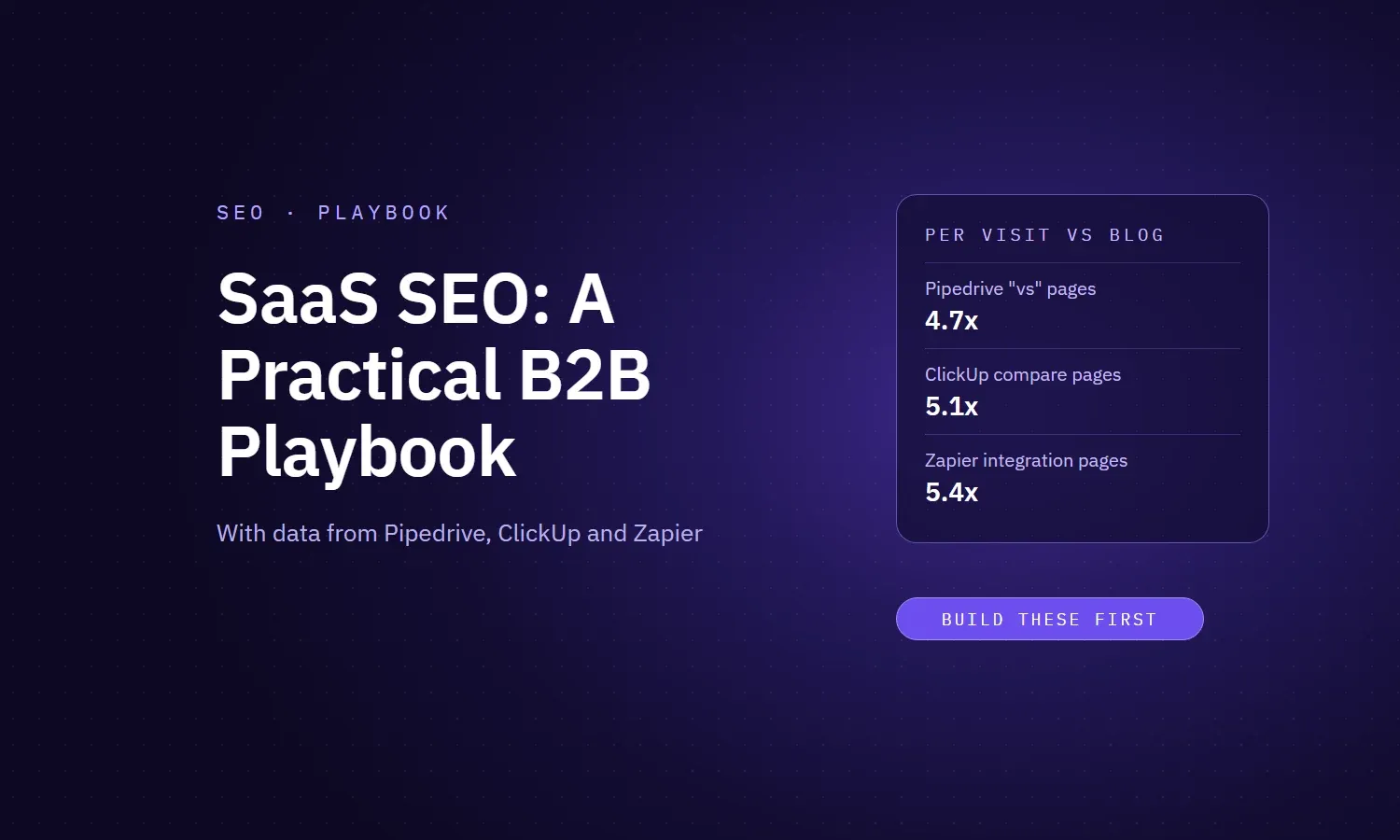
4.7x
Value of a Pipedrive "vs" page visit
$11.99 per visit vs $2.56 for its blog
5.1x
Value of a ClickUp compare page visit
$8.83 per visit vs $1.72 for its blog
5.4x
Value of a Zapier integration page visit
$2.07 per visit vs $0.38 for its blog
Every company, same pattern. The pages built for people who are choosing software are worth several times more per visitor than the blog, even at companies famous for their blogs.
So in this playbook we'll walk through the data, the four page types, the order to build them in, what burns budget, and how to get those pages into ChatGPT and Google's AI answers. Let's dive in!
Why SaaS SEO is different from "regular" SEO
Most SEO advice is written for publishers, where traffic is the product. In SaaS, traffic is only useful if some of it turns into demos and trials. And B2B software buyers behave in a very specific way.
They do the research alone, and they do most of it before talking to you. 6sense's 2025 Buyer Experience Report, based on nearly 4,000 buyers, found that first contact with a vendor now happens around 61% of the way through the buying journey.
And more of that research now starts somewhere other than Google. In G2's April 2026 survey of 1,076 B2B software buyers, 51% said they start research with an AI chatbot more often than with Google, up from 29% a year earlier. 69% picked a different vendor than they planned because of a chatbot recommendation.
Put those two facts together. By the time a buyer fills in your demo form, they've already compared you against two or three competitors, read about your integrations and checked whether you fit their use case. The only question is whether they did that research on your pages or on someone else's.
That's why the page types matter so much.
The data: what each page type is worth per visit
Here's the full breakdown from our Ahrefs pull (US organic traffic, November 2026 snapshot).
| Section (page type) | US visits / month | Value per visit | vs own blog |
|---|---|---|---|
| Pipedrive: "vs" pages (/crm-comparison/) | 720 | $11.99 | 4.7x |
| Pipedrive: alternatives hub (/crm/compare) | 1,472 | $7.32 | 2.9x |
| Pipedrive: integrations (/marketplace/) | 3,137 | $6.15 | 2.4x |
| Pipedrive: blog | 47,916 | $2.56 | 1x |
| ClickUp: comparisons (/compare/) | 148 | $8.83 | 5.1x |
| ClickUp: use cases (/teams/) | 1,430 | $5.98 | 3.5x |
| ClickUp: integrations | 552 | $2.97 | 1.7x |
| ClickUp: blog | 34,427 | $1.72 | 1x |
| Zapier: integrations (/apps/) | 48,294 | $2.07 | 5.4x |
| Zapier: blog | 9,165,878 | $0.38 | 1x |
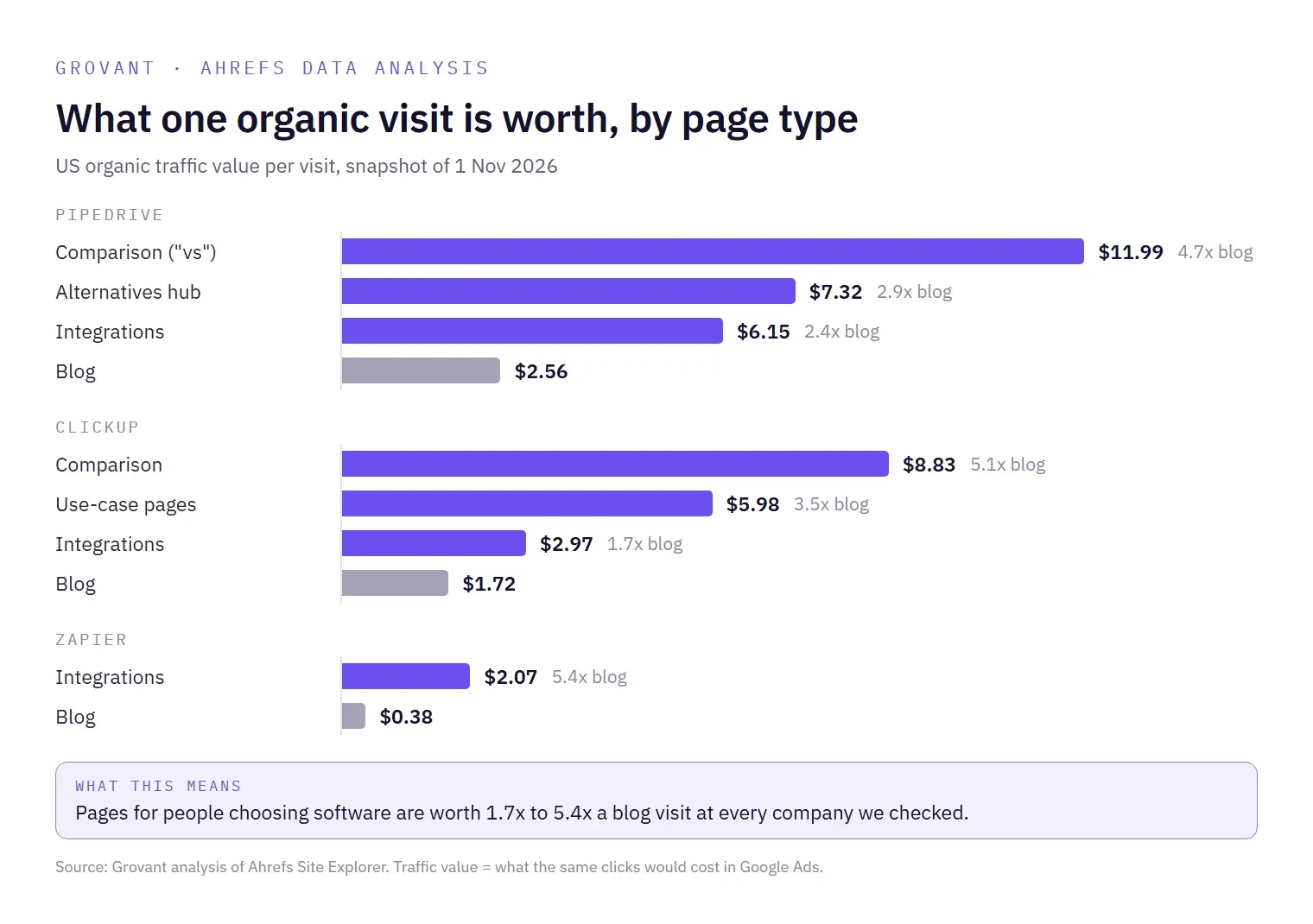
Three things jump out.
First, comparison pages punch way above their size. Pipedrive's two comparison sections get about 2,200 visits a month, under 5% of its blog's traffic. But they carry about 16% of the blog's traffic value. That's a tiny set of pages doing a lot of heavy lifting.
Second, the blog still matters. Pipedrive's blog is worth $122,000 a month in traffic value, far more than everything else combined. Nobody here is saying "kill the blog." The point is about order: a 20-person SaaS company can't build a 48,000-visit blog this year, but it can build 15 comparison pages this quarter.
Third, integration pages work, with limits. Zapier's app pages are the classic programmatic SEO story. In 2026 they're worth over 5x a Zapier blog visit. But when Ahrefs dug into Zapier's SEO, it found the deep combination pages (app A + app B + app C) got basically zero traffic. One level of pairing works. Beyond that, you're publishing pages nobody searches for.
Want a second source that points the same way? Grow and Convert reports an average 8.43% conversion rate on comparison and alternatives keywords across its clients, and 4.85% on bottom-of-funnel category keywords. Typical top-of-funnel content converts at under 0.5%. That's agency client data, not a controlled study, but it lines up with what the traffic value numbers suggest.
The four page types that drive SaaS pipeline
1. Comparison pages ("you vs competitor")
These target searches like "Pipedrive vs Salesforce" or "ClickUp vs Monday". The searcher has already narrowed it down to two or three tools. They're one decision away from a trial.
What makes them work is honesty. A buyer comparing two tools has usually used one of them already. If your page claims you win every row of the table, they close the tab. The best comparison pages say clearly who the competitor is better for, then make the case for who you're better for.
- One page per real competitor. Start with the 5 to 10 tools your sales team hears about most in calls.
- A feature and pricing table with dates. Pricing changes constantly. Put the date you checked it next to the table.
- A "who should pick them" section. It's the part buyers trust most, and it's what AI tools tend to quote.
- A switching section. Data import, migration help, contract terms. This is where the page converts.
2. Alternatives pages ("competitor] alternatives")
These target people who are unhappy with a tool and looking around. "Pipedrive alternatives" is the top keyword for Pipedrive's own /crm/compare hub, which tells you even market leaders defend this ground.
The catch: you're competing with G2, Capterra and every listicle on the web. To win, list real alternatives (yourself included, not just yourself), and be specific about why someone leaves the competitor. Pull that language straight from their negative reviews.
3. Integration pages
These catch searches like "your tool] Slack integration" or "other tool] your category] integration". For example, "lemlist pipedrive integration" is a top keyword on one of Pipedrive's marketplace pages.
The searcher already uses the other tool and wants to know if yours fits into their stack. Give them what they need: what syncs, which direction, setup time, plan requirements, and a screenshot or short video of it working. Thin "Connect X with Y" pages with a logo and a button are the ones that never rank.
4. Use-case and industry pages
These target "category] for team or industry]", like "CRM for accountants" or "project management for agencies". ClickUp's /teams/ pages, its use-case section, are worth $5.98 a visit, 3.5x its blog. Its accounting page alone carries over $5,000 a month in traffic value.
A real use-case page shows the product set up for that buyer: their workflow, their templates, their terminology, a customer in their industry. If you can swap the industry name for another one and the page still reads fine, it's too generic to rank or convert.
What works and what burns budget
| What works | What burns budget | |
|---|---|---|
| Comparison pages | Honest tables, dated pricing, a clear "who should pick them" section | "We win every row" pages that buyers and AI tools both ignore |
| Alternatives pages | Real alternatives, switching reasons pulled from actual reviews | A list of one (yourself) dressed up as a roundup |
| Integration pages | One page per real integration, with setup steps and screenshots | Thousands of auto-generated A + B + C combination pages |
| Use-case pages | Workflows, templates and a customer from that industry | Same page, industry name swapped |
| Blog | Topics your buyers search while evaluating, linked to product pages | Viral top-of-funnel posts with no path to the product |
| AI search | Clear facts on your own site plus reviews and roundups that mention you | Chasing llms.txt files and "AI schema" hacks |
That integration row deserves a warning. When Ahrefs looked at the biggest traffic losers in 2024, Datanyze had lost about 95% of its organic traffic, and more than 80% of that loss came from its programmatic company and people pages. Google's spam policies call this scaled content abuse: pages generated mainly to manipulate rankings, without adding value. Programmatic is fine. Empty programmatic is a liability.
The SaaS SEO playbook, step by step
Here's the order we'd build in for a B2B SaaS company starting from a thin site. Each step depends on the one before it.
- Fix the foundations first (weeks 1 to 2). Make sure pricing, features and integration pages are indexable and server-rendered, not hidden behind JavaScript. Most AI crawlers don't render JavaScript, so this matters twice.
- Interview sales and support (week 2). Ask which competitors come up in calls, which integrations prospects ask about, and which industries close fastest. That's your page list, already ranked by revenue.
- Ship comparison pages for your top 5 competitors (weeks 3 to 6). Highest value per visit, smallest number of pages, fastest to show results on lower-difficulty terms.
- Build the alternatives page for each of those competitors (weeks 5 to 8). Same research, different searcher.
- Write integration pages for the 10 integrations prospects ask about most (weeks 6 to 10). Real setup details, one page each.
- Add use-case pages for your 3 best-fit industries (weeks 8 to 12). Lead with the industry that closes fastest.
- Start the blog around evaluation-stage topics (month 3 onward). Pricing breakdowns, how-to-choose guides, templates. Link every post to the matching comparison or use-case page.
- Earn the third-party mentions (ongoing). Review profiles, roundups, communities. This is what gets you named in AI answers (more on that below).
- Measure pipeline, not traffic (monthly). Track demos and trials by landing page type. A comparison page with 300 visits and 12 demos beats a blog post with 30,000 visits and none.
Those numbers come from Ahrefs' study on how long it takes to rank. We go deeper on timelines, by site type, in our SEO content strategy guide.
How to show up in AI answers too
Here's the good news. The four page types above are exactly what AI tools look for when a buyer asks "what's the best CRM for a small sales team?" or "Pipedrive or HubSpot?".
But getting cited and getting recommended are different things. When we audited our own site, AI tools cited our pages 17 times and recommended us zero times. Clear pages earned the citations. The recommendations need trust signals from other sites. We walk through all 25 checks in our AI visibility audit.
For SaaS specifically, review sites carry a lot of weight. In G2's 2025 Buyer Behavior Report, AI chatbots were the #1 source shaping vendor shortlists (17.1%), with software review sites right behind (15.1%). And the chatbots read the review sites. So a complete G2 or Capterra profile with recent reviews helps you twice.
- State your facts plainly. Pricing tiers, seat limits, integrations, security certifications. AI tools quote sentences, not marketing copy.
- Keep comparison pages balanced. An answer engine summarizing "X vs Y" will lean on the page that reads like a fair review.
- Get on the roundups. Find the "best category] software" pages that AI answers cite as sources, and pitch them.
- Don't block AI search crawlers. Check robots.txt and your CDN settings for OAI-SearchBot, PerplexityBot and Bingbot.
Want the bigger picture on how ChatGPT picks which brands to name? Read our guide to ChatGPT SEO.
Does SaaS SEO still work with AI Overviews?
Fair question. Pew Research found Google users clicked a traditional result on 8% of visits when an AI summary appeared, versus 15% without one. Seer Interactive measured a 61% drop in organic click-through rate on informational queries with an AI Overview.
Look at what those studies measure, though: mostly informational searches. That's the top-of-funnel blog traffic, the cheapest traffic in our table. Someone searching "Pipedrive vs Salesforce" still wants to see both pricing pages and a real comparison before they commit a team to a tool for three years.
So yes, AI search hurts SaaS SEO. It mostly hurts the part of SaaS SEO that was worth the least. We dug into this in more detail in Is SEO dead?.
Where to start this week
Open your sales call notes and write down the five competitors that come up most. That's your first five pages. No keyword tool needed yet.
Then build them honestly, measure demos rather than visits, and earn the reviews and mentions that get you named in AI answers. It's not the flashy version of SEO. It's the version that turns into pipeline.
If you want a team that builds this for you, from the page list to the pages themselves, that's exactly what our SEO service does.