An AI visibility audit checks whether ChatGPT, Google's AI Overviews, Perplexity, Gemini and Copilot can find your site, understand who you are, and actually name you when a buyer asks for a recommendation. It covers four areas: the prompts your buyers type, the pages AI crawlers can read, your entity signals, and what other sites say about you.
We ran the full audit on grovant.co before writing a word of this. The headline result surprised us.
AI answers cited our pages 17 times. They recommended Grovant as a company zero times.
17
Times AI answers cited grovant.co
Across 5 of our pages (Ahrefs, Nov 2026)
13 of 17
Citations came from Copilot
Zero from AI Overviews, AI Mode, Perplexity or Gemini
0
AI answers that recommended Grovant
Our name shows up once, as a page title in a source list
That gap is the whole point of an audit. Getting your pages used as a source is one job. Getting your brand put on a shortlist is a different job, with different fixes. Most checklists out there blur the two together.
So below you'll get the 25 checks we used, how to score them, a free template to copy, and our own scorecard with nothing hidden. Let's dive in!
What an AI visibility audit actually measures
A traditional SEO audit asks one question: can Google crawl, index and rank this page? An AI visibility audit asks three more.
| Audit area | The question it answers | Checks |
|---|---|---|
| 1. Prompts | When a buyer asks an AI tool about your category, does your brand come up? | 1 to 7 |
| 2. Pages | Can AI crawlers fetch and read your content, and is it built to be quoted? | 8 to 14 |
| 3. Entity | Does the web agree on who you are, what you do and where you are? | 15 to 19 |
| 4. Mentions | Do the sites AI tools trust talk about you? | 20 to 25 |
Why split it this way? Because each area fails for different reasons. Our own audit shows it. Our pages pass area 2 almost perfectly, and we still barely show up in area 1. A clean technical setup gets you into the room. It doesn't get you picked.
Before you start: one rule that changes how you test prompts
Here's the thing most audit guides skip. AI answers are not stable. Ask the same question twice and you'll often get a different list.
SparkToro and Gumshoe tested this in early 2026 with 600 volunteers running the same 12 prompts 2,961 times across ChatGPT, Claude and Google's AI. There was a less than 1 in 100 chance that ChatGPT or Google's AI would return the same list of brands twice. The same list in the same order came up roughly once in 1,000 runs.
So a screenshot of one ChatGPT answer proves nothing. Not good news, not bad news.
Doing this by hand works for 10 to 20 prompts. Past that, a tracker saves your sanity. Ahrefs Brand Radar starts at $199 a month and covers AI Overviews, AI Mode, ChatGPT, Perplexity, Gemini and Copilot. Peec AI starts at $95 a month for 50 prompts. We compared the main options in our guide to the best AI visibility tools.
Area 1: Prompts (checks 1 to 7)
This is the scoreboard. Everything else in the audit exists to move these numbers.
| # | Check | How to test it | What a pass looks like |
|---|---|---|---|
| 1 | You have a written prompt list | List 15 to 30 questions buyers ask before they hire or buy: "best X for Y", "X vs Y", "how much does X cost", "is X worth it" | A saved list, split by funnel stage, reused every month |
| 2 | Brand presence in ChatGPT | Run each commercial prompt 5 times, logged out | Named in 30% or more of runs for your core prompts |
| 3 | Brand presence in Google AI Overviews and AI Mode | Search your prompts in Google, then switch to AI Mode | Named or linked in at least some answers |
| 4 | Brand presence in Perplexity, Gemini and Copilot | Same prompts, same 5-run rule | Present in at least two of the three |
| 5 | Your pages get cited as sources | Check the source links under each answer, or a tool's citation report | Your URLs appear for informational prompts in your niche |
| 6 | AI describes you accurately | Ask "What is [brand]?" and "What does [brand] charge?" in each tool | Correct services, location, pricing model. No invented facts |
| 7 | You know who wins instead of you | Note every competitor named in answers where you're missing | A ranked list of the 5 brands that beat you most often |
What we found on grovant.co
Ahrefs' AI index found our pages cited in 17 answers. Every one was an informational, pricing or platform-comparison question, things like "What is a white label SEO agency?" or "Is Webflow worth it in 2026?". Our social media management pricing guide alone showed up in five Copilot answers.
Not one of those 17 answers was a "who should I hire" prompt. That's the difference between check 5 and checks 2 to 4. AI tools trusted our explanations. They didn't think to recommend us.
It gets more humbling. Ahrefs found the word "Grovant" in exactly one AI answer. We opened it. It was the title of our own white label PPC guide, sitting in Copilot's list of sources. So we went and asked ourselves.
We ran eight hiring questions by hand in Google's AI Mode and Perplexity, things like "best white label SEO agency for a small marketing agency" and "senior marketing agency with no long-term contract for a startup". That last one is close to word for word how we describe ourselves. Grovant didn't come up once.
Asked about us by name, though, both tools knew exactly who we are. Google's AI Mode described our services and terms almost word for word from our own site. Perplexity did too, and then added a section called "Reasons for caution". We'll get to why in area 3.
And that's exactly the gap that matters for revenue. G2's April 2026 survey of 1,076 B2B software buyers found 69% chose a different vendor than planned because of a chatbot recommendation, and 1 in 3 bought from a vendor they had never heard of before.
Area 2: Pages (checks 8 to 14)
Can AI systems actually read your site? This is the most technical area, and the one where a single bad line in a config file can make you invisible.
| # | Check | How to test it | What a pass looks like |
|---|---|---|---|
| 8 | Search crawlers are allowed in robots.txt | Open yoursite.com/robots.txt. Look for OAI-SearchBot, ChatGPT-User, PerplexityBot, Claude-SearchBot, Bingbot, Googlebot | None of them blocked. Training bots (GPTBot, ClaudeBot, Google-Extended) are a separate business decision |
| 9 | Your CDN or firewall doesn't block them | Fetch a page with each bot's user agent, or check your CDN's bot settings and logs | 200 responses, no challenge pages. Cloudflare's AI bot blocking is off unless you chose it |
| 10 | Key content is in the HTML, not loaded by JavaScript | View source (not Inspect) on a key page and search for a sentence from the body | The text is in the raw HTML |
| 11 | You're indexed in Bing, not just Google | Search site:yourdomain.com on Bing. Verify in Bing Webmaster Tools | Your important pages show up. IndexNow is set up for new pages |
| 12 | Pages answer the question in the first 60 words | Read the opening of your top 10 pages | Each one states the answer plainly before any backstory |
| 13 | Facts are stated in plain sentences | Look for pricing, locations, timelines and specs on your service pages | Numbers in text or simple tables, not buried in images or PDFs |
| 14 | Pages are dated and kept current | Check visible dates and dateModified in your Article schema | Real update dates. No "2024" in a 2026 title |
Check 8 trips up a lot of sites. The bots have different jobs, and blocking the wrong one hurts. OpenAI's own documentation says OAI-SearchBot is the one that surfaces sites in ChatGPT search, while blocking GPTBot only signals that your content shouldn't be used for training. Anthropic and Perplexity split their bots the same way. Block the search bot and you've opted out of the answers, not just the training data.
Check 10 is the silent killer. When Vercel and MERJ analyzed AI crawler traffic, they found that "none of the major AI crawlers currently render JavaScript." Gemini and AppleBot were the exceptions. So if your content only appears after JavaScript runs, ChatGPT's crawler may be reading an empty page.
Check 11 matters more than people think. Copilot grounds its answers in Bing's index, so if Bing hasn't indexed a page, Copilot can't cite it. Our data backs that up: 13 of our 17 citations came from Copilot, and we use IndexNow to tell Bing about new pages the moment they're published.
What we found on grovant.co
Six out of seven. We fetched an article with the user agents for GPTBot, OAI-SearchBot, ChatGPT-User, ClaudeBot, PerplexityBot and Google-Extended, and all six got a 200. The full article text (about 7,500 words of HTML on the page we tested) is server-rendered. Openings are answer-first, and every article carries datePublished and dateModified.
The one we marked partial was check 13. Some of our service pages describe pricing as "a fixed custom quote" without a range. That's honest, but it gives an AI tool nothing to quote when someone asks what we cost.
Area 3: Entity (checks 15 to 19)
AI tools need to be confident that "Grovant" on your site, on LinkedIn and on a directory listing are all the same company. If the facts disagree, they hedge, or they skip you.
| # | Check | How to test it | What a pass looks like |
|---|---|---|---|
| 15 | Organization schema on your homepage | Run the homepage through Google's Rich Results Test or view the JSON-LD | Name, URL, logo, description, contact point all filled in |
| 16 | sameAs links to every official profile | Read the sameAs array in your Organization schema | LinkedIn, Crunchbase, review profiles (Clutch, G2) and any Wikidata entry, not just social accounts |
| 17 | Core facts match everywhere | Compare founding year, location, services and team size across your site, LinkedIn and directory listings | Identical facts on every profile |
| 18 | Real, named authors | Check the author on your articles and in the Article schema | A real person with a bio page and a LinkedIn profile |
| 19 | A knowledge base entry exists | Search Wikidata for your brand. Search your brand name in Google and look for a knowledge panel | A Wikidata item if you meet its notability bar, or a knowledge panel |
Google's Organization markup guidance describes sameAs as a link to "a social media or review site" with more information about you. Most sites stop at Facebook and Instagram. The review and business profiles are the ones that carry weight for a buying question.
What we found on grovant.co
This is where we lost the most points, and it's probably the clearest lesson in this whole audit.
- Check 15: pass. Our homepage carries full Organization schema.
- Check 16: partial. Our sameAs lists LinkedIn, Facebook and Instagram. No review platforms, no Crunchbase.
- Check 17: fail. Our Clutch profile (which also feeds The Manifest) disagrees with our own site on basic facts, including the founding year and who we work with. We didn't have to guess whether AI notices. Perplexity's "Reasons for caution" about Grovant led with exactly those contradictions.
- Check 18: fail. Our articles are bylined "Grovant Editorial", and the schema marked that up as a Person. It isn't one. (We've since switched that markup to our Organization. Real named authors are the actual fix, and they're next.)
- Check 19: fail. No Wikidata item, no knowledge panel.
Not pretty. But see how specific those fixes are? None of them need a single new blog post.
Area 4: Mentions (checks 20 to 25)
This is the area most audits underweight, and the data says it's the one that matters most for getting named.
When Ahrefs studied 75,000 brands, the factor most strongly correlated with showing up in AI Overviews was brand mentions across the web (a correlation of 0.664). Backlinks came in far lower at 0.218. It's a correlation, not proof of cause. But it lines up with everything we see when we read AI answers: they recommend the brands other sites talk about.
| # | Check | How to test it | What a pass looks like |
|---|---|---|---|
| 20 | You know which domains AI cites in your niche | Collect the source links from your area 1 prompts and count the domains | A list of the 10 domains cited most for your category |
| 21 | You're on the roundups those answers use | Open the cited "best X" listicles and check if you're included | Listed on at least 3 of the top-cited roundups |
| 22 | Review platform profiles with recent reviews | Check Clutch, G2, Capterra or your industry's equivalent | A complete profile with reviews from the last 6 months |
| 23 | Real discussion on Reddit and communities | Search Reddit and niche forums for your brand name | Organic mentions by people who aren't you |
| 24 | Press or expert mentions | Search news sites for your brand and your people | At least one independent mention in the last year |
| 25 | Video presence | Search YouTube for your brand and category terms | At least one video explaining what you do, or a mention in someone else's |
For check 20, don't guess which sites matter. Measure it. Profound's analysis of 680 million citations found each platform has its own favorites: Wikipedia led ChatGPT's citations, while Reddit led both Google AI Overviews and Perplexity. YouTube made up 5.6% of all AI Overview citations in Ahrefs' March 2026 study.
What we found on grovant.co
One point out of a possible twelve, and that point is generous. We haven't mapped the domains AI cites for our category yet, we're on no "best agency" roundups, we have one directory profile with a single review, and there's no organic Reddit or press coverage.
It also explains the pattern from area 1. Our own pages are good enough to be quoted. Nobody else is vouching for us yet, so AI tools have no reason to recommend us.
How to score your audit
Score each check 0 (fail), 1 (partial) or 2 (pass). That gives you a total out of 50. The template does the math for you.
| Score | What it means | Where to focus |
|---|---|---|
| 0 to 19 | Invisible. AI tools can't reliably find or describe you | Area 2 first. Nothing else works until crawlers can read you |
| 20 to 34 | Findable, not recommended. Your pages get used, your brand doesn't get named | Areas 3 and 4 |
| 35 to 44 | Competitive. You show up on some buying prompts | Close gaps on the prompts competitors win |
| 45 to 50 | Strong. You're a default answer in your niche | Protect it. Re-run monthly and watch for drift |
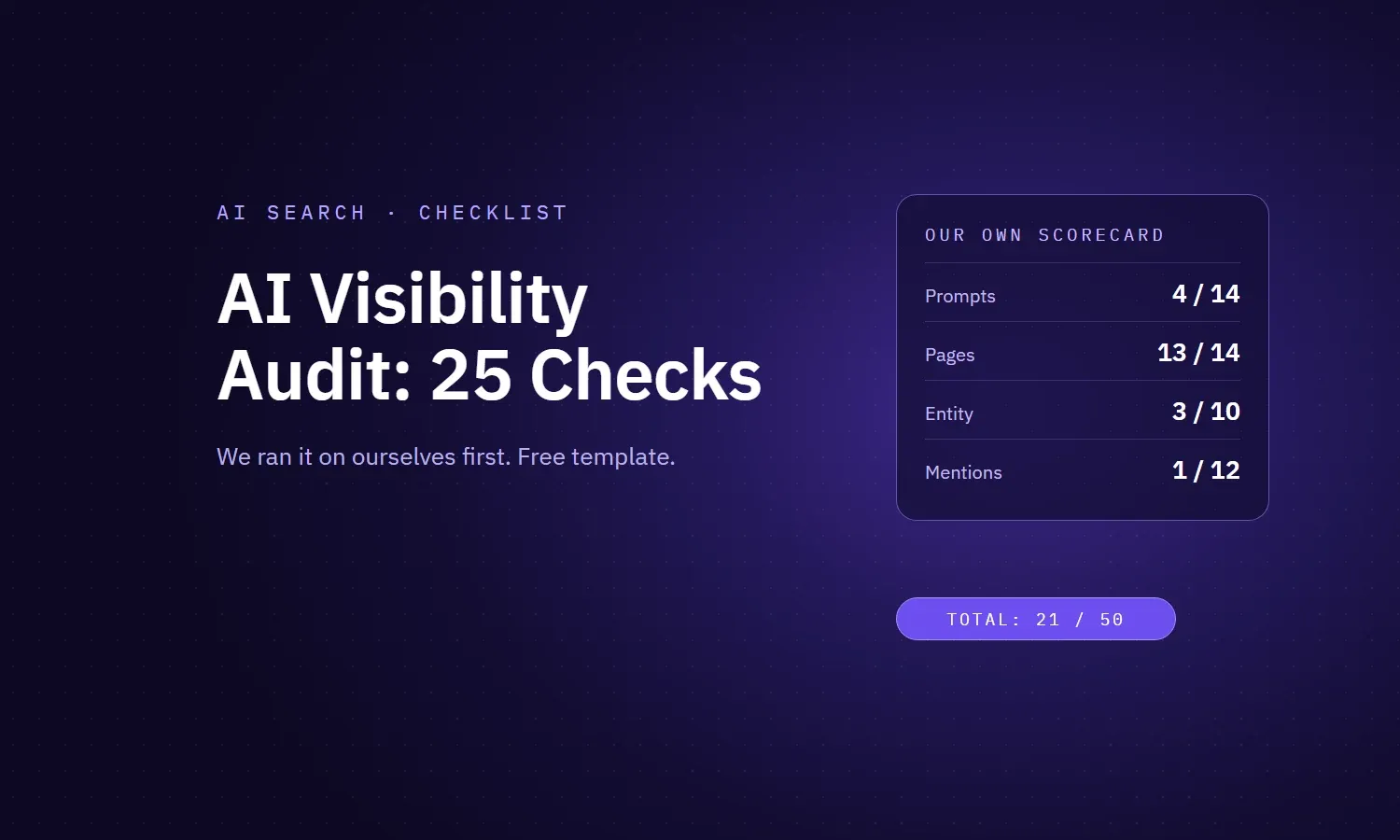
Here's how grovant.co scored on November 6, 2026:
| Area | Our score | Biggest gap |
|---|---|---|
| 1. Prompts (7 checks) | 4 of 14 | Described accurately when asked by name, never named on hiring prompts |
| 2. Pages (7 checks) | 13 of 14 | No price ranges in plain text |
| 3. Entity (5 checks) | 3 of 10 | Conflicting facts on a third-party profile, no named authors |
| 4. Mentions (6 checks) | 1 of 12 | No roundups, reviews or community mentions |
| Total | 21 of 50 | Findable, not recommended |
Twenty-one out of fifty. Just inside the "findable, not recommended" band. Notice where the points come from: 13 of our 21 are technical. That's the profile of a site with solid SEO and almost no reputation outside its own domain, which describes a lot of young companies.
What we're fixing first, in order
An audit is only useful if it tells you what to do on Monday. Here's our fix list, ordered by effort against impact:
- Fix the conflicting directory profile. Twenty minutes of work, and it removes the single biggest source of confusion about who we are.
- Put real names on articles. Swap the editorial byline for the specialists who write and review each piece, with a bio page and Person schema that's actually a person. (Step one, marking the editorial byline up as our Organization instead of a fake Person, took five minutes and is already live.)
- Add review and business profiles to sameAs. Then actually collect reviews on them.
- Publish price ranges in plain text. If buyers ask AI what we cost, we want our own number in the answer instead of a competitor's guess.
- Map, then pitch, the roundups AI already cites. Run our hiring prompts, collect the "best agency" pages listed as sources, and work through them. That's a short, specific outreach list.
- Re-run the prompts in 30 days. Same prompts, same five runs each, same scoring.
Notice what's not on the list? Writing more blog posts. Our content already gets cited. The gap is trust signals, not words on a page.
Three things that waste audit time
Obsessing over llms.txt
We have a detailed llms.txt on grovant.co, and we'll keep it, because it costs nothing to maintain. But be honest about what it does. An Ahrefs study of 137,000 sites published in June 2026 found 97% of llms.txt files got zero requests in a month, and AI retrieval bots made just 1.1% of the requests that did happen. Google's John Mueller put it bluntly back in 2025: no AI system was using it. Don't score it as a ranking factor.
Hunting for magic schema
Google's page on AI features and your website says there's "no special schema.org structured data that you need to add" to appear in AI Overviews or AI Mode. Schema helps with entity clarity (that's checks 15 and 16). It's not a secret switch.
Treating one answer as a result
We covered this above, but it's the mistake we see most. One screenshot of ChatGPT naming you (or ignoring you) tells you nothing. Five runs per prompt, presence rate, monthly. That's the method.
Run your own audit this week
Block an afternoon. Write your prompt list first, because it shapes everything else. Then work through the pages, entity and mentions checks, which mostly take a browser and a bit of patience.
If your score lands under 35, you'll probably find what we found: the fixes aren't glamorous, but they're specific, and most of them have nothing to do with publishing more content. For the bigger strategy behind all of this, read our guide to generative engine optimization and our breakdown of how ChatGPT picks which brands to recommend.
Want a second pair of eyes on your results? Our SEO team runs this exact audit for clients, with the prompt tracking done for you.