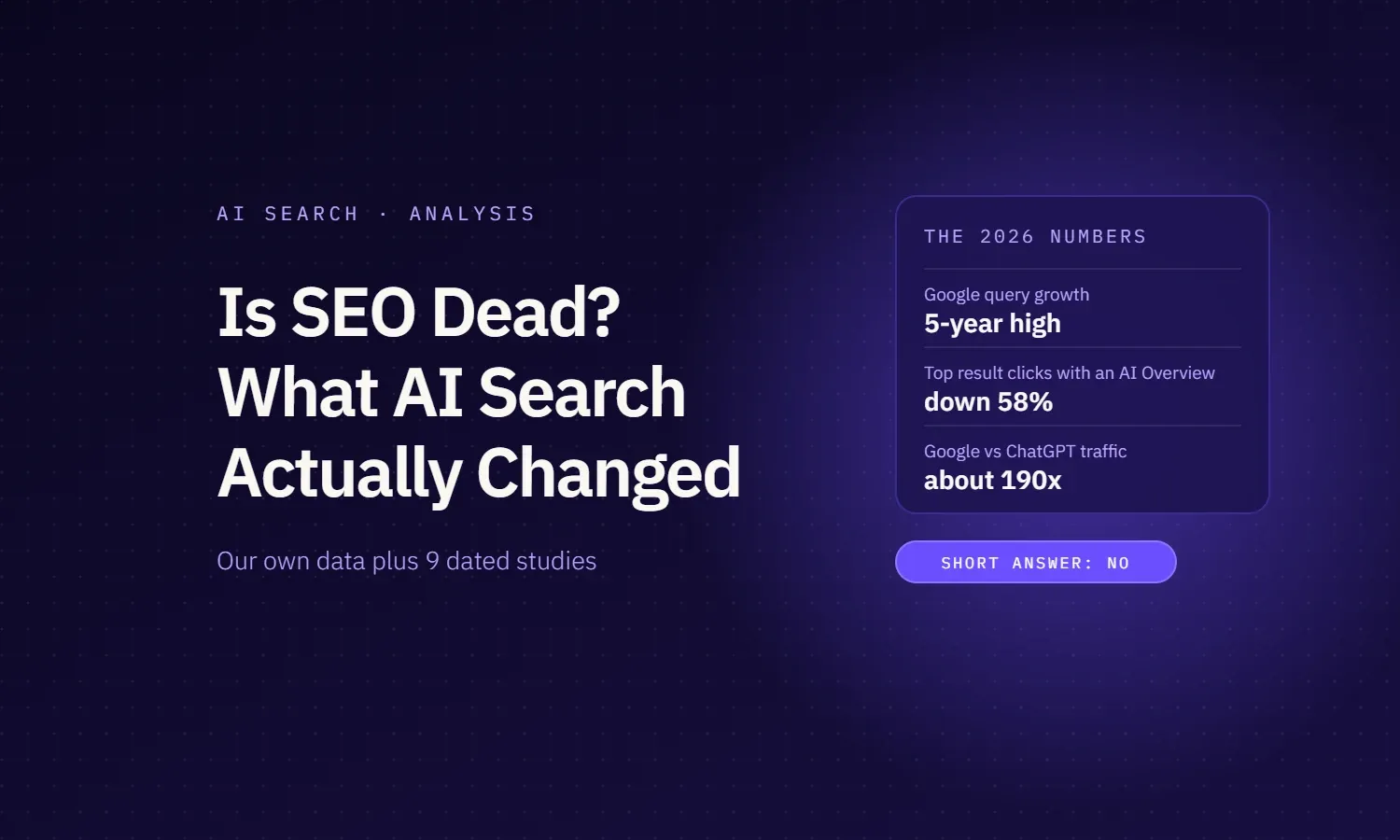
No, SEO is not dead. What died is the idea that a ranking guarantees clicks. Google searches are growing faster than at any time in the last five years, and Google still sends far more traffic than every AI assistant combined. What changed is how much a ranking is worth: when an AI Overview appears, the top result gets far fewer clicks, and AI tools now pull answers from a wider set of pages and mentions.
Key takeaways
- Search is growing, not shrinking. In October 2026 Google said its query growth was the highest in five years.
- Clicks per ranking are down. With an AI Overview on the page, the top result gets 58% fewer clicks (Ahrefs, February 2026).
- AI assistants still send little traffic. Google sends about 190 times more visits to websites than ChatGPT (Ahrefs, February 2026).
- AI answers still draw on search results, but less on the top 10 than a year ago. About 38% of AI Overview citations came from the top 10 in March 2026, down from about 76% in 2025.
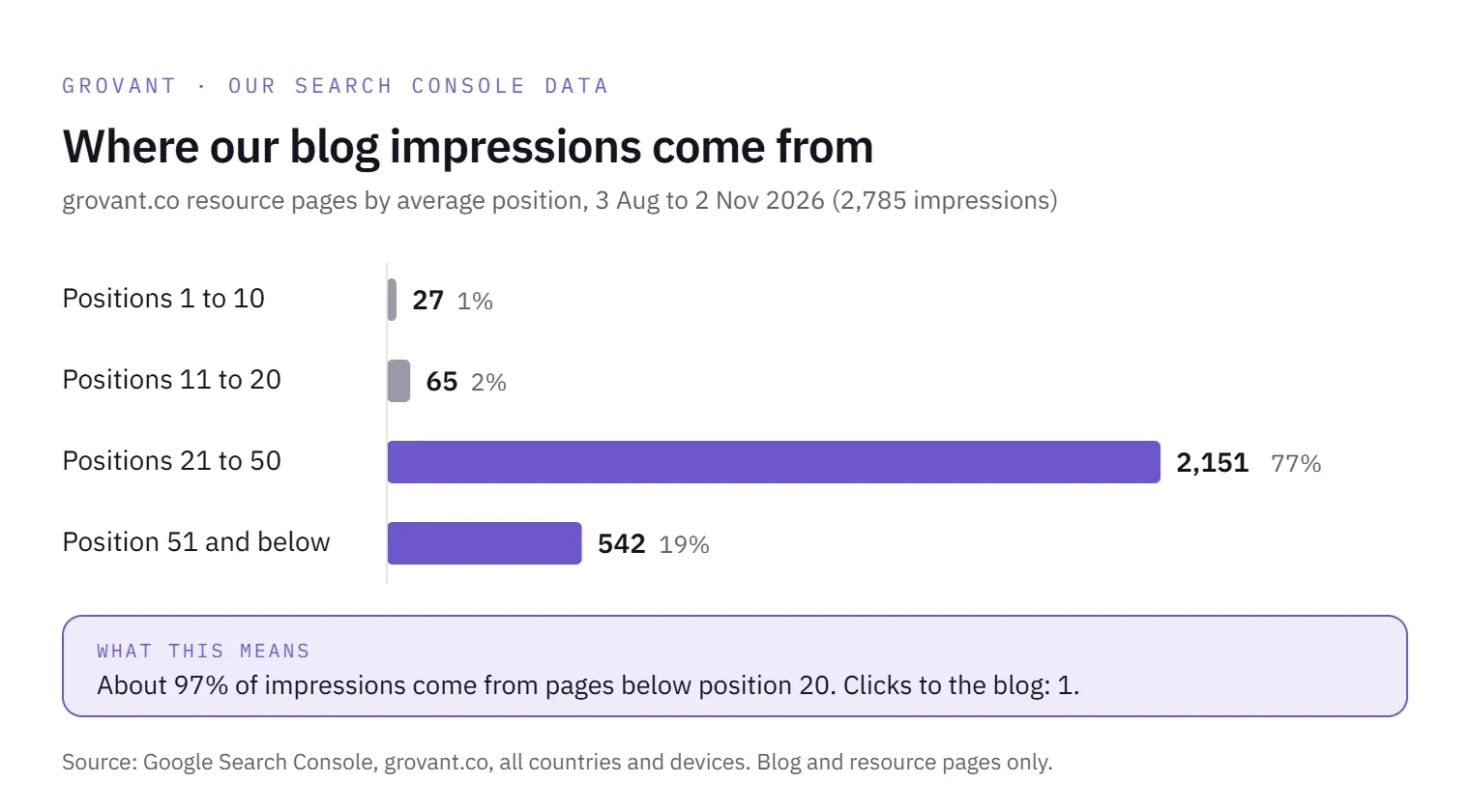
- For most small sites, the real problem is not AI. On our own site, most blog pages rank between positions 21 and 70, where almost nobody clicks, AI or not.
What changed, and what didn't
| Area | What changed | What didn't |
|---|---|---|
| Search demand | AI Mode queries are about three times longer than classic searches | People search on Google more than ever |
| Clicks | A ranking earns fewer clicks when an AI Overview appears | Google is still the biggest source of website traffic by far |
| Who gets cited | AI tools cite a wider set of pages, including ones outside the top 10, and ChatGPT leans on Bing | Pages need to be crawlable, indexed and clearly written to be used at all |
| What wins | Brand mentions on other sites, reviews and original data matter more | Helpful, answer-first pages and real authority still win |
| How you measure | Impressions and AI visibility matter alongside clicks; Search Console now reports AI impressions | Leads and sales are still the number that counts |
The pattern is simple: AI search sits on top of classic search rather than replacing it. The work that earns rankings is the same work that earns AI citations, but you now get paid for it in mentions and conversions as well as clicks. Google has also said it is not planning to make AI Mode the default for Chrome searches, which we looked at in AI Mode isn't the default.
Our own data: what Search Console shows for a young site
We looked at grovant.co's own Google Search Console data for the last three months (3 August to 2 November 2026). We are a young site, which makes this a useful test of the "SEO is dead" claim from the bottom, not the top.
| What we measured | Result |
|---|---|
| Impressions | 3,108 |
| Clicks | 36 (1.2% CTR) |
| Clicks from people searching our brand name | 18 of 36 |
| Clicks to our blog and resource pages | 1 |
| Blog impressions from pages averaging below position 20 | about 97% |
| US impressions | 2,063, average position 48, no clicks |
What this tells us:
- People are finding us in search. Over 3,000 impressions in three months for a site this new means Google is testing our pages for real queries, including ones about offshore development, private label SEO and B2B PR.
- We are not losing clicks to AI. We are not winning them yet. Almost all our blog impressions come from pages that rank on page three or lower. Nobody clicks there, AI Overview or not.
- Brand demand already works. Half of our clicks come from people searching for Grovant by name. That is the kind of demand that mentions on other sites build.
For a site like ours, "SEO is dead" would be the wrong lesson. The lesson is that ranking on page one is still the gate, and both clicks and AI citations come after it.
What the wider data shows
Our site is one data point. Here is what the larger, dated studies say.
| Finding | Source and date |
|---|---|
| Google's year-over-year query growth is "the highest it's been in the last five years" | Alphabet Q3 2026 earnings, 28 Oct 2026 |
| AI Overviews have over 2.5 billion monthly users; AI Mode passed 1 billion | Google I/O 2026, 19 May 2026 |
| With an AI Overview present, the top-ranking page gets 58% fewer clicks | Ahrefs, 300,000 keywords, Feb 2026 |
| Users clicked a result on 8% of searches with an AI summary, against 15% without | Pew Research, 68,879 searches, Jul 2025 |
| Brands cited in an AI Overview had about 35% higher organic click-through rates than brands not cited | Seer Interactive, 3,119 queries, Nov 2025 |
| Google sends about 190 times more traffic to websites than ChatGPT | Ahrefs, 76,000 sites, Feb 2026 |
| 95% of ChatGPT users also used Google in the same period | Similarweb via Search Engine Journal, Jul 2026 |
| About 38% of AI Overview citations came from the top 10 organic results, down from about 76% in 2025 | Ahrefs, 863,000 results pages, Mar 2026 |
| AI-referred visits to US retail sites converted 60% better than other traffic | Adobe via Digital Commerce 360, Aug 2026 |
Read together, the data says three things:
- Demand is up. People search more, and they ask longer questions.
- Clicks per search are down. AI summaries answer part of the question on the page, so fewer people click through.
- Being the source still pays. Pages that are cited get more of the clicks that are left, and the visitors AI tools do send tend to be ready to act.
One caution: the link between ranking and AI citation has loosened. In 2025 most AI Overview citations came from the top 10. In early 2026, after Google moved AI Overviews to a new model, most did not. Ranking still helps, but it is no longer the whole story, which is why mentions and clear, quotable pages matter more than they did.
What to do now: SEO plus GEO, in order
- Keep the basics solid. Pages must be crawlable, indexed in Google and Bing, fast and clearly structured. AI tools cannot cite what they cannot read. If you are wondering about llms.txt, we explain what an llms.txt file actually does.
- Fix rankings before chasing AI. Find the pages sitting between positions 11 and 30 in Search Console and improve those first. That is where a small lift turns impressions into clicks and makes a page more likely to be cited.
- Write pages AI can quote. Lead with the answer, use tables and plain facts (prices, terms, dates), and add original data nobody else has.
- Earn mentions off your site. Reviews, roundups, communities and press now shape both rankings and AI answers. We covered the ChatGPT side of this in our guide to ChatGPT SEO.
- Measure more than clicks. Track impressions, the new Search Console report for AI features, AI referrals in GA4 and, above all, leads and sales. To track how often AI tools mention you, see our comparison of AI visibility tools.
- Don't move your whole budget to GEO. Generative engine optimization builds on SEO; it does not replace it. Shift part of the budget toward mentions and original data, and keep the SEO foundation funded. We break down the differences in GEO vs SEO vs AEO.
Where Grovant fits
We are applying this to our own site right now: fixing pages that sit just off page one, adding original data, and tracking how often AI tools mention us. We will share what moves.
If you want senior specialists to do the same for your brand, our SEO services cover both sides: the classic SEO that earns rankings, and the mentions and quotable pages that earn AI citations. Every engagement starts with an audit of where your traffic is really going.
We work month to month, on a custom quote.
Sources
- Alphabet earnings: Q3 2026 and Q2 2026
- Google I/O 2026 keynote
- Ahrefs: AI Overviews reduce clicks, 2026 update
- Ahrefs: AI Overview citations and the top 10
- Ahrefs: ChatGPT has 12% of Google's search volume
- Pew Research: clicks with and without AI summaries
- Seer Interactive: AI Overview impact on CTR
- Search Engine Journal: Similarweb data on AI search and Google
- Digital Commerce 360: Adobe AI referral data
- grovant.co Google Search Console, 3 Aug to 2 Nov 2026