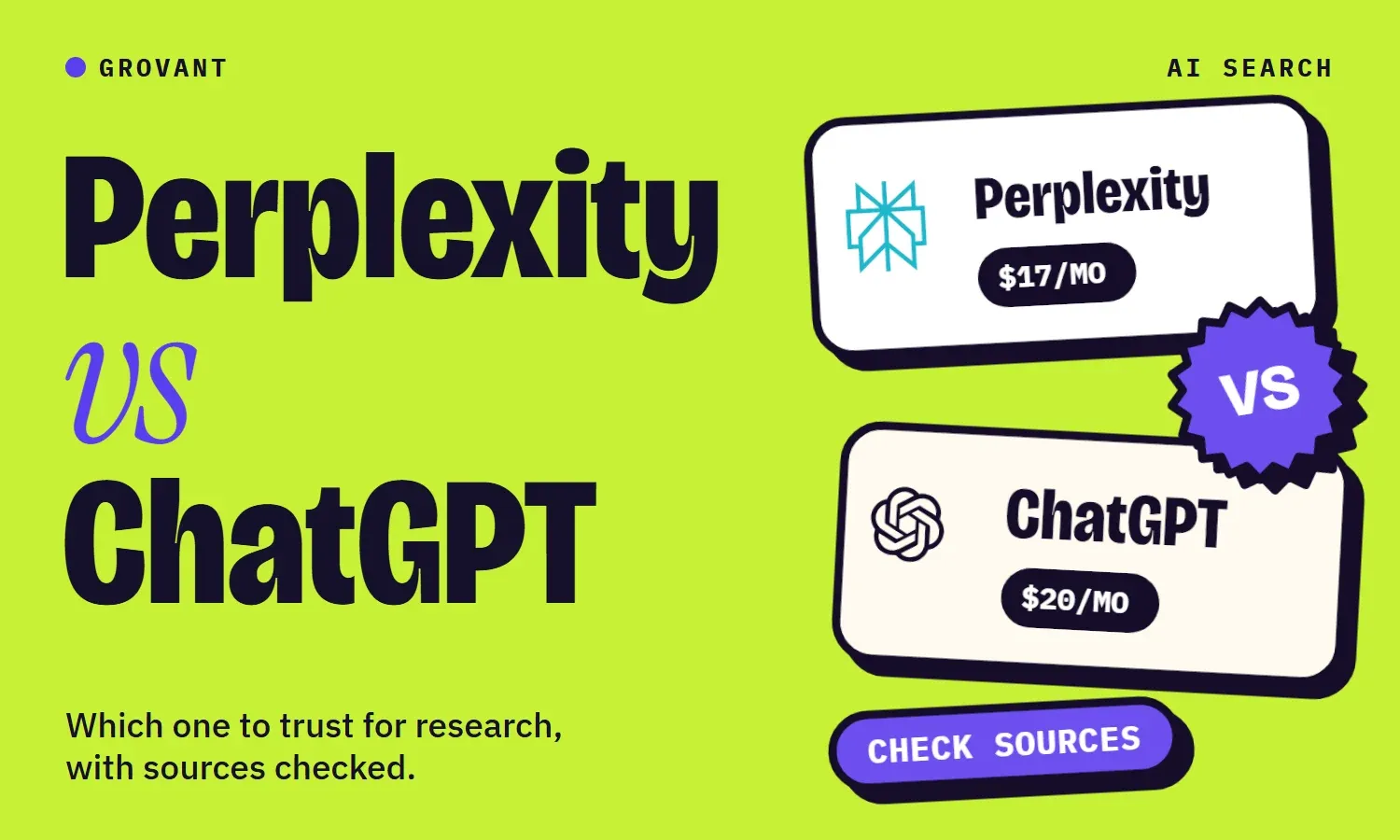
Ask Perplexity a question and you get an answer with little numbered footnotes. Ask ChatGPT the same question and you often get a better-written answer, with fewer sources and more confidence.
Which one should you trust?
That's the real question behind "Perplexity vs ChatGPT". It isn't which chatbot is smarter. Perplexity is now a front end for many of the same models ChatGPT, Claude and Gemini run on. It's about which one gets you to a correct, checkable answer faster, and what each costs.
In this guide, we'll look at how each one finds and cites sources, what independent accuracy studies actually found, prices, privacy, and the legal fights you should know about. Then we'll match each research task to the better tool.
Let's dive in!
37% vs 67%
Share of answers wrong when citing news: Perplexity vs ChatGPT search
Tow Center / CJR study, 1,600 queries
$17 vs $20
Standard paid plan: Perplexity Pro (billed yearly) vs ChatGPT Plus
Vendor pricing pages, 27 Nov 2026
200B+
Unique URLs Perplexity says its own search index tracks
Perplexity, vendor-reported
Perplexity vs ChatGPT at a glance
| Perplexity | ChatGPT | |
|---|---|---|
| What it is | An AI answer engine built around search, with a choice of models from several companies | An AI assistant with search, research, files, coding and agents built in |
| Models | Pro: GPT-6.2 Sol, Gemini 4 Neon, Claude Sonnet 5.5 and others. Max adds GPT-6.2 Astra, Gemini 4 Carbon, Claude Opus 5.5 and Claude Fable 5.2 | OpenAI's GPT-6 family only |
| Citations | Inline numbered citations on every answer, plus a sources list | Search answers may include inline citations and a Sources button |
| Free plan | Yes. 3 Pro searches a day, 1 Research query a month | Yes. Search for everyone (even signed out), limited deep research, ads possible |
| Standard paid plan | Pro, $17/month billed yearly | Plus, $20/month |
| Power plan | Max, $167/month billed yearly | Pro, $100, $200 or $500/month |
| Business plan | Enterprise Pro, $40/seat monthly or $400 yearly | Business, $20/user yearly or $25 monthly |
| Deep research | Research mode, 1 a month on Free, higher limits on paid plans | Deep research: limited on Free and Go, expanded on Plus, maximum on Pro |
| Browser | Comet, free on Mac, Windows, iOS and Android | Built into the ChatGPT desktop app (Atlas closed in August 2026) |
| Trains on your chats? | Personal plans: yes unless you opt out. Enterprise: never | Personal plans: yes unless you opt out. Business: no by default |
Is Perplexity better than ChatGPT? The verdict by task
Here's the thing most comparisons miss. These two tools aren't really competing for the same job anymore.
Perplexity is a search engine that writes. ChatGPT is a work assistant that can search. It's a bit like comparing a reference librarian to a research assistant. The librarian is faster at pointing you to the right source. The assistant is better at turning sources into a finished deliverable.
| Research task | Better pick | Why |
|---|---|---|
| Quick factual lookups | Perplexity | Built around search, with numbered citations on every answer, so checking a claim takes one click. |
| Checking what a source actually says | Perplexity | It cited news more accurately in the Tow Center study (37% wrong against 67% for ChatGPT search). |
| Academic or market research | Perplexity | Paid users can limit sources to academic papers, and Pro adds premium data from PitchBook, Statista and CB Insights. |
| Comparing answers from different AI models | Perplexity | One subscription lets you switch between OpenAI, Anthropic and Google models on the same question. |
| Long research reports | ChatGPT | Deep research is ChatGPT's strongest research feature, with higher allowances on Plus and Pro. |
| Research on your own files and data | ChatGPT | Stronger file analysis, spreadsheets, projects and memory around the research. |
| Turning research into a deliverable | ChatGPT | It writes, builds slides and sheets, codes and acts on results with ChatGPT Work. |
| Current news | Neither, alone | Both made frequent errors with news in independent studies. Always open the source. |
| Cheapest paid option | Perplexity | Pro is $17 a month billed yearly, or $10 for verified students. ChatGPT Go is $8 but has limited deep research. |
How each one finds and cites sources
Citations are the whole point of using AI for research. So how does each tool handle them?
Perplexity: citations first
Perplexity says every answer includes inline citations, and you can open the full list of sources for any answer. It runs its own crawler (PerplexityBot) and says its index tracks over 200 billion unique URLs. On paid plans you can choose where it searches, for example the web or academic sources, and Pro adds premium data sources such as PitchBook, Statista and CB Insights.
ChatGPT: answers first, sources on request
ChatGPT search is available on every plan, even if you aren't signed in. OpenAI's help page says answers "may include citations" you can click or hover over, plus a Sources button listing the pages it used. OpenAI also says it sometimes works with other search providers.
See the difference? In Perplexity, sources are the main event. In ChatGPT, they're supporting material. That matters when you're writing something a client, a board or a journalist will check.
Which is more accurate? What independent studies found
This is the part you won't find on either company's website. And the honest answer is: neither is as accurate as it sounds.
| Study | What was tested | Perplexity | ChatGPT | Takeaway |
|---|---|---|---|---|
| Tow Center for Digital Journalism, CJR (Mar 2025) | 8 AI search tools, 1,600 queries: identify the source article for a news excerpt | Wrong on 37% of queries | ChatGPT search misidentified 134 of 200 (67%) | Over 60% of answers across all tools were wrong. Perplexity was the most accurate tool tested |
| EBU and BBC News Integrity study (Oct 2025) | 3,000+ answers about news from 22 public broadcasters in 18 countries | Included, no separate score in the summary | Included, no separate score in the summary | 45% of all answers had at least one significant issue |
| Arena Search leaderboard (20 Nov 2026) | Blind votes on search-grounded answers, 1.5M+ votes | Sonar Reasoning Pro #40, Sonar Pro #42 | GPT-5.6 Sol (xHigh) #3 (1,256) | OpenAI's search models rank higher. Perplexity Pro users can also pick OpenAI and other models |
Two details from the Tow Center study are worth knowing. The paid Perplexity Pro had a higher error rate than the free version, mostly because it answered confidently instead of declining. And the free Perplexity correctly identified all ten excerpts from paywalled National Geographic articles, even though National Geographic blocks Perplexity's crawler.
So what do you do with that?
Treat both tools as a very fast way to find sources, not as the source. Perplexity makes that easier because the citations are right there. ChatGPT tends to write a more polished answer, but polish isn't accuracy. If a number is going into a report, open the page it came from. Every time.
Perplexity vs ChatGPT pricing in 2026
| Tier | Perplexity | ChatGPT |
|---|---|---|
| Free | $0. 3 Pro searches a day, 1 Research query a month, no advanced models | $0. Search, unlimited everyday chat, limited deep research and uploads, ads possible |
| Budget or student | Education Pro, $10/month with student verification | Go, $8/month (may include ads) |
| Standard | Pro, $17/month billed yearly. Choice of models, deep research, image generation, Perplexity Computer | Plus, $20/month. GPT-6 reasoning models, expanded deep research, Codex, ChatGPT Work |
| Power | Max, $167/month billed yearly. Top models (including Claude Fable 5.2 and GPT-6.2 Astra), Model Council | Pro, $100, $200 or $500/month with matching API credits |
| Team | Enterprise Pro, $40/seat monthly or $400/year. Enterprise Max, $325/seat monthly | Business, $20/user yearly or $25 monthly |
Here's the twist. A Perplexity Pro subscription gives you OpenAI's GPT-6.2 Sol, Google's Gemini 4 Neon and Anthropic's Claude Sonnet 5.5 in one place, for less than ChatGPT Plus. If what you mostly do is ask questions and read sources, that's a lot of model for $17.
But teams pay the opposite way. Perplexity Enterprise Pro costs $40 a seat, double ChatGPT Business on a yearly plan. For a 10-person team, that's $400 a month against $200. The extra buys clear, published limits (400 Pro searches a week and 50 Research queries a month per seat) and Perplexity's enterprise data terms.
Features beyond search
| Feature | Perplexity | ChatGPT |
|---|---|---|
| Agent that does tasks | Perplexity Computer, with Automations; agent features in the Comet browser | ChatGPT Work, across your apps and files |
| Browser | Comet (free since October 2025) | Built into the ChatGPT desktop app |
| Files, docs and apps | Creates files and apps (monthly limits on Enterprise) | Docs, sheets, slides and code, plus add-ins for Excel, Word and PowerPoint |
| Images and video | Image generation on Pro; limited video | Image generation on all plans; no video since Sora closed |
| Voice | Voice mode | ChatGPT Voice |
| Phones | Built into Samsung Galaxy S26 phones | iOS and Android apps |
| Developer API | Agent API: Sonar at $0.25 / $2.50 per million tokens; Search API at $5 per 1,000 requests | OpenAI API with web search tool |
Both are racing to become "the AI that does the work", not just the one that answers. ChatGPT is further along, because writing, files and code have always been its home turf. Perplexity's agent features are newer, and its strength is still the search underneath them.
Privacy, and the legal fights worth knowing about
| Perplexity | ChatGPT | |
|---|---|---|
| Personal plans train on your data? | Yes: AI Data Retention is on by default. Turn it off in Settings; it only applies going forward | Yes, unless you turn off "Improve the model for everyone" |
| Business plans | Enterprise data is never used for training. Uploaded files are kept 7 days | Business and Enterprise: no training by default |
| Ads | None in answers | Possible on Free and Go |
Then there's the legal side. If you publish research, you should know how both companies get their sources.
- Publishers vs Perplexity: Dow Jones and the New York Post (dismissal denied, August 2025, still in discovery), The New York Times (filed December 2025) and Reddit (most claims allowed to proceed, July 2026) are all suing Perplexity. None has reached a final ruling.
- Cloudflare: in August 2025, Cloudflare accused Perplexity of using undeclared crawlers to get around websites' no-crawl rules, and removed it from its verified bots list. Perplexity denied wrongdoing.
- Amazon vs Comet: Amazon won an order blocking Comet's shopping agent in March 2026. The Ninth Circuit vacated it on 4 August 2026, and the case continues.
- OpenAI isn't clean either: in The New York Times' copyright case, a court ordered OpenAI to hand over 20 million de-identified ChatGPT logs (January 2026).
None of this means you shouldn't use either tool. It means you should cite the original source, not the AI. Which is good research practice anyway.
Run your own research test in 30 minutes
Don't take our word for it, or anyone's. Here's a quick test you can run on both tools with the free or paid plan you already have:
- A number you already know. Ask for a stat from your own industry that you can verify, like a market size or a regulation date. Check whether the cited page actually says it.
- A recent event. Ask about something from the last two weeks. See which tool finds it, and how old its sources are.
- A comparison. Ask it to compare three vendors you know well. Count the factual mistakes.
- A source check. Paste a quote from an article and ask where it came from. This is exactly what the Tow Center tested.
- A deliverable. Ask each to turn its findings into a one-page brief. Judge which one you'd send to a client with the fewest edits.
Score each answer on two things: was it right, and could you check it in under a minute? That second score is where Perplexity usually earns its keep, and the fifth task is where ChatGPT does.
Should your business use Perplexity, ChatGPT or both?
| If you mostly... | Start with |
|---|---|
| Look things up and need sources you can show | Perplexity Pro |
| Write reports, proposals or content from research | ChatGPT Plus or Business |
| Want to compare GPT, Claude and Gemini without three subscriptions | Perplexity Pro |
| Analyse your own spreadsheets, PDFs and data | ChatGPT |
| Do market, competitor or investment research | Perplexity (premium data sources), checked against originals |
| Need a team plan on a budget | ChatGPT Business ($20 to $25 a seat) |
| Do a bit of everything | Both: ChatGPT for the team, Perplexity Pro for whoever does the research |
One more angle, if you run a business. Your buyers are asking Perplexity and ChatGPT the same questions you are, like "best agency for X" or "which software for Y". Both tools answer by pulling from websites they can crawl and trust. So make sure PerplexityBot and OpenAI's search crawler can reach your site, and that your pages answer real questions clearly. Our guides to getting recommended by ChatGPT, generative engine optimization and the AI visibility audit walk through it step by step.
Comparing other assistants too? See ChatGPT vs Gemini and Claude vs ChatGPT.
Sources
- Perplexity Pro and Max and Perplexity Help Center: which plan is right for you, checked 27 Nov 2026
- Perplexity Help Center: AI models by plan (as of 19 Nov 2026) and Data collection at Perplexity
- Perplexity: architecting an AI-first search API (vendor-reported index size) and Perplexity API pricing
- ChatGPT pricing, ChatGPT Business pricing, OpenAI Help: ChatGPT search and Data Controls FAQ
- Columbia Journalism Review, Tow Center: AI search engines and news citations, 6 Mar 2025
- EBU: News Integrity in AI Assistants, 22 Oct 2025
- Arena Search leaderboard, 20 Nov 2026
- Cloudflare: Perplexity's undeclared crawlers, 4 Aug 2025; Bloomberg Law: Reddit v. Perplexity, Jul 2026
Want us to deliver this for you?
One senior specialist, start to finish. Free proposal, no pressure.