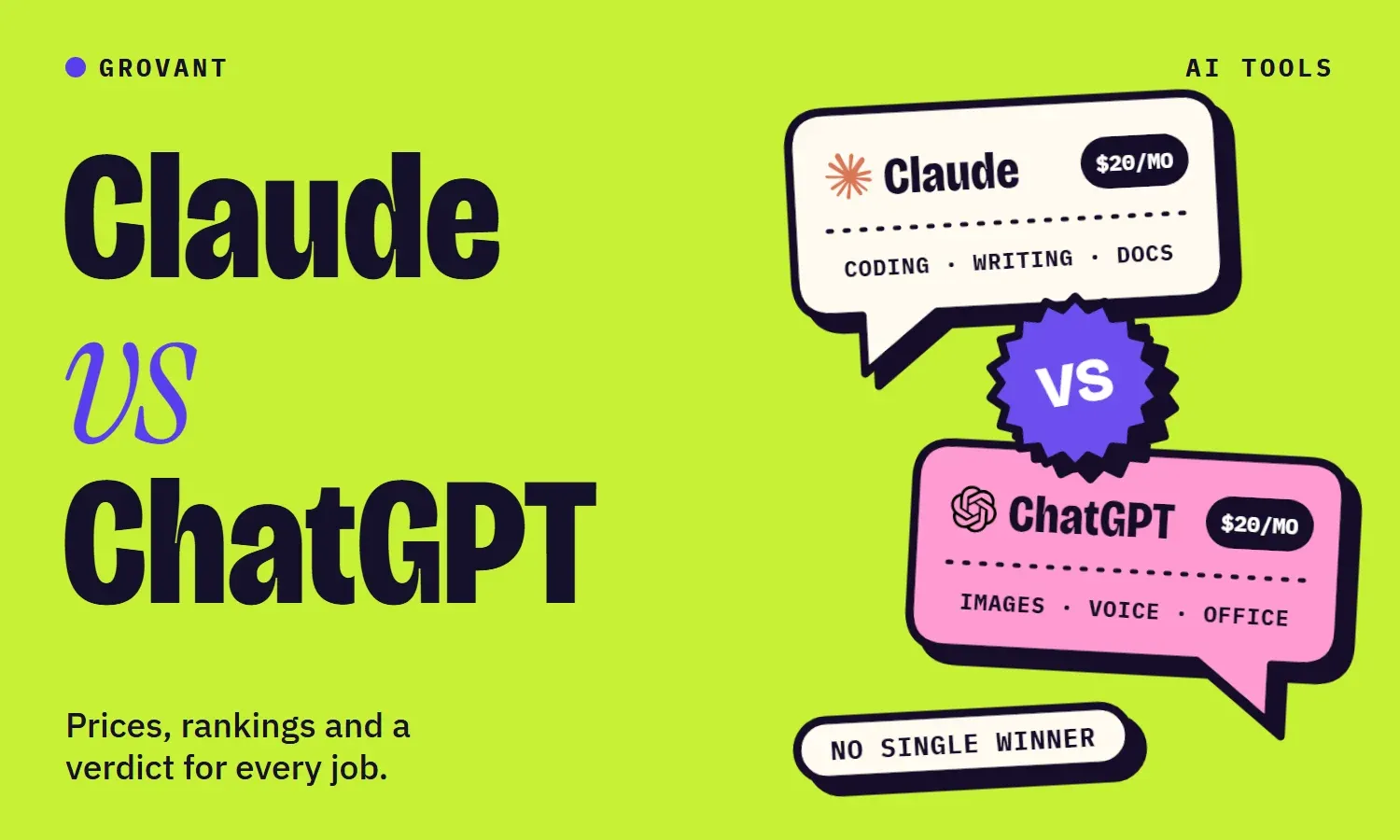
Claude or ChatGPT? If you've searched that recently, you've probably noticed something odd. The answers contradict each other.
There's a reason for that. Most of those articles were written before GPT-6 (let alone this week's GPT-6.2), before Claude's 5.5 models, and before OpenAI started retiring custom GPTs. Some still recommend a ChatGPT "Team" plan that has since been renamed. Others praise features that disappear on 11 December.
So we threw out the old notes and started from scratch. Every price, feature and ranking below comes from OpenAI's and Anthropic's own pages, independent leaderboards or published market data. And where one tool is simply better at something, we say so plainly.
Let's dive in!
$20
Standard paid plan, both tools (Claude Pro is $17/month billed yearly)
Vendor pricing pages
55% vs 31%
Enterprise LLM API spend, Anthropic vs OpenAI
Menlo Ventures, Nov 2026
55.7% vs 11.5%
Share of gen-AI web traffic, ChatGPT vs Claude
Similarweb, Oct 2026
Claude vs ChatGPT at a glance
| Claude (Anthropic) | ChatGPT (OpenAI) | |
|---|---|---|
| Current top models | Fable 5.2 (Nov 9), Opus 5.5 (Sep 22), Sonnet 5.5 (Sep 28), Haiku 5.5 (Oct 7) | GPT-6.2 Astra and Sol (Nov 17), GPT-6 Luna (Sep 22), GPT-6 Instant (Oct 7) |
| Free plan | Yes, with 5-hour and weekly limits | Yes, unlimited everyday text chat (abuse guardrails apply), ads possible |
| Cheapest paid plan | Pro, $20/month ($17 billed yearly) | Go, $8/month (may include ads) |
| Standard paid plan | Pro, $20/month | Plus, $20/month |
| Power-user plans | Max $100, Ultra $200 | Pro from $100 (three usage tiers) |
| Team plan | Team: $20/seat yearly or $25 monthly (premium seats $100/$125), 2 to 150 seats | Business: $20/user yearly or $25 monthly, 2 to 200 users |
| Image generation | No (diagrams and charts only) | Yes, on every plan |
| Voice | Voice mode (beta), all plans | ChatGPT Voice (GPT-Live), all plans |
| Context in the apps | Up to 1M tokens, varies by model | 256K (Go, Plus) or 400K (Pro) for reasoning models |
| Coding agent | Claude Code (paid plans) | Codex (limited on Free and Go) |
| Trains on your chats? | Consumer plans: your choice (opt-out). Team and Enterprise: no, by default | Consumer plans: your choice (opt-out). Business and Enterprise: no, by default |
Which is better, Claude or ChatGPT? The verdict by job
So, which one should you actually pay for?
Here's the thing. There's no single winner in 2026, and anyone who tells you otherwise is probably selling one of them. Asking which AI is "best" is a bit like asking whether a van or a sports car is the better vehicle. Better for what?
So instead of crowning one, we matched each tool to the jobs businesses actually hand it. Here's where the evidence points:
| Job | Better pick | Why |
|---|---|---|
| Coding and building apps | Claude | Claude models hold #1 and #2 on Arena's WebDev ranking (17 Nov 2026), with OpenAI's new GPT-6.2 Astra close behind at #3, and Fable 5.2 tops the Artificial Analysis Intelligence Index. OpenAI says GPT-6.2 Sol gets within 0.5 points of GPT-6.2 Astra on FrontierCode 2.0 at about a fifth of the cost. |
| Writing, editing and everyday chat | Claude, narrowly | On Arena's text ranking (17 Nov 2026), Claude Opus 5.5 is #5 and no GPT model makes the top 10. |
| Long documents and big files | Claude | Up to 1M tokens in the apps, against 256K to 400K in ChatGPT's reasoning models. |
| Images and visual content | ChatGPT | Claude doesn't generate images. ChatGPT includes image generation on every plan. |
| Voice conversations | ChatGPT | ChatGPT Voice runs on a dedicated live model; Claude's voice mode is still in beta. |
| Excel, Word, PowerPoint, Sheets | ChatGPT, slightly | ChatGPT has add-ins inside Excel, Google Sheets, PowerPoint and Word, on all plans. Claude creates .xlsx, .pptx and .docx files and connects to Microsoft 365, but works mostly from its own window. |
| Deep research reports | Tie | Both have a research mode. Claude's needs a paid plan; ChatGPT gives Free and Go users a limited allowance. |
| Agents and computer use | Too close to call | OpenAI pitches computer use as a GPT-6.2 Astra strength; Anthropic reports 89.3% for Fable 5.2 on OSWorld 2.1. They don't quote the same benchmark, so there's no clean comparison. |
| Cheapest way to start | ChatGPT | A free plan without a 5-hour cap and an $8 Go tier. Claude's cheapest paid plan is $17 to $20. |
| Team rollout and admin | Tie | Same $20 to $25 seat price, single sign-on, no training on business data by default. |
Claude vs ChatGPT pricing in 2026
Plans for individuals
| Tier | Claude | ChatGPT |
|---|---|---|
| Free | $0. Sonnet and Haiku models, limited every 5 hours and every week | $0. Unlimited everyday text chat on OpenAI's lighter models, limited uploads, images and deep research |
| Budget | No equivalent | Go, $8/month. More messages, uploads and images. May show ads |
| Standard | Pro, $20/month or $17/month billed yearly. Opus models, Claude Code, Research, Fable via usage credits | Plus, $20/month. GPT-6.2 Astra and Sol, Codex, Projects, scheduled tasks |
| Power | Max, $100/month (5x Pro usage, $100 API credits). Ultra, $200/month (10x Pro weekly usage, no 5-hour limit for verified accounts, $200 API credits) | Pro, from $100/month in three tiers, with $100, $200 or $500 of monthly API credits |
Same $20 at the standard tier, so where's the real difference? Limits.
Claude's Free and paid plans run on a rolling 5-hour window plus a weekly cap, and heavy users do hit them. ChatGPT advertises unlimited everyday text chat on every plan (subject to abuse guardrails), but it rations its more powerful models and tools.
Let's say you're a sales rep firing off 40 quick questions a day: draft this email, summarize that call, fix this sentence. ChatGPT's free and $8 tiers will stretch further. Now say you're a developer or analyst feeding in a 200-page document and working on it for three hours straight. That's where Claude Max and ChatGPT Pro are the plans to compare.
Plans for teams and companies
| Claude Team / Enterprise | ChatGPT Business / Enterprise | |
|---|---|---|
| Team price | $20/seat yearly, $25 monthly. Premium seats (5x usage): $100 yearly, $125 monthly | $20/user yearly, $25 monthly |
| Team size | 2 to 150 seats | 2 to 200 users |
| Included API credits | Up to $500/month, pooled | Up to $500/month for the workspace |
| Enterprise price | $20/seat/month plus usage at API rates, 20-seat minimum, billed yearly | Contact sales; credit-based and token-based pricing available |
| Training on your data | None by default | None by default |
| Admin and security | SSO, usage analytics; Enterprise adds SCIM, audit logs, custom retention, HIPAA-ready option | SSO, usage analytics, spend controls; Enterprise adds custom retention and data residency in ten regions |
API prices for developers
Building AI into your own product instead of buying seats? Then forget the subscription prices. What you pay per token is what decides your margins. Here are the current models, per million tokens:
| Class | Anthropic model (input / output) | OpenAI model (input / output) |
|---|---|---|
| Flagship | Fable 5.2: $8 / $40 | GPT-6.2 Astra: $8 / $40 |
| Upper-mid | Opus 5.5: $4 / $20 | No direct equivalent |
| Workhorse | Sonnet 5.5: $2 / $10 | GPT-6.2 Sol: $2 / $10 |
| Small and fast | Haiku 5.5: $0.10 / $0.50 (prompts up to 100K tokens) | GPT-6 Luna: $0.10 / $0.50 |
| Context window | 1M tokens on all four, 128K max output | 1.05M tokens, 128K max output |
| Long-prompt surcharge | Haiku 5.5 costs $0.50 / $2.50 above 100K tokens | Above 272K input tokens: 2x input and 1.5x output for the whole request |
| Batch discount | 50% | 50% |
Notice anything? The two companies now price their workhorse and small models identically. To the cent.
The differences hide in two places. At the top, there's no longer a gap: OpenAI cut its flagship price by 20 percent with GPT-6.2 Astra on 17 November, so it now costs exactly what Fable 5.2 does, $8 / $40 per million tokens. And the long-prompt rules hit different workloads differently: a chatbot answering short questions will never notice them, but a tool that reads whole contracts will. So price the workload you actually run, not the list price.
Which is smarter? What independent rankings say
Every launch comes with a shiny benchmark chart. And, surprise surprise, each company tends to show the tests it wins. That's why we start with rankings neither company controls:
| Ranking (snapshot date) | Best Claude model | Best OpenAI model | Who leads overall |
|---|---|---|---|
| Artificial Analysis Intelligence Index (Nov 2026) | #1 Fable 5.2 (65) | #2 GPT-6.2 Astra (62) | Claude Fable 5.2 |
| Arena WebDev (17 Nov 2026) | #1 Fable 5.2 (1824) | #3 GPT-6.2 Astra (1797) | Claude, places 1 and 2 |
| Arena Text (17 Nov 2026) | #5 Opus 5.5 (1507) | No GPT model in the top 10 | Google: Gemini 4 Carbon, Argon and Neon hold places 1 to 3 |
Before you read too much into that, two honest caveats. First, Google's Gemini 4 models now hold the top three places on Arena's general text ranking, ahead of both. And Google is shipping fast: next to its flagship Gemini 4 Carbon, it released Argon (13 October), Hydrogen, a faster and cheaper model for everyday agent work (12 November), and Neon, built for complex coding and analysis at a lower price (18 November). If you're open to a third option, that's worth knowing, and we'll cover it in our upcoming ChatGPT vs Gemini comparison. Second, OpenAI's own launch charts argue on cost rather than raw score: it says GPT-6.2 Sol comes within 0.5 points of GPT-6.2 Astra on FrontierCode 2.0 at about a fifth of the cost, and that GPT-6.2 Astra scores 5.5 points ahead of Claude Fable 5.2 on Agents' Last Exam (OpenAI, Nov 2026). Anthropic, for its part, reports Fable 5.2 at 69.9 percent on FrontierSWE v2 and 74.2 percent on Humanity's Last Exam with tools (Anthropic, Nov 2026). Both are vendor-reported.
Our take? On raw quality, Claude has the edge right now, especially for coding and writing. On quality per dollar, OpenAI is right there and sometimes ahead. And the lead has changed hands several times this year alone, so check the date on any ranking you rely on. Including ours.
Features compared: what each can actually do
| Feature | Claude | ChatGPT |
|---|---|---|
| Image generation | No. Makes diagrams, charts and visuals in code | Yes (ChatGPT Images), all plans; "images with thinking" on Plus and up |
| Video generation | No | No. Sora was discontinued in 2026 |
| Web search | Yes | Yes |
| Deep research | Research, paid plans | Deep research, limited on Free and Go |
| Memory | Yes, all individual plans; admin-controlled on Team and Enterprise | Yes, expanded on paid plans |
| Projects | Yes (5 on Free) | Yes, all plans |
| Documents, slides, spreadsheets | Creates .docx, .pptx, .xlsx and PDF on all plans | ChatGPT Work creates docs, sheets, decks and Sites |
| Office add-ins | Microsoft 365 connector, all plans | Add-ins for Excel, Sheets, PowerPoint and Word, all plans |
| Agent that does tasks for you | Cowork, paid plans; Claude in Chrome, paid plans | ChatGPT Work and scheduled tasks; Dot agent on Pro |
| Coding agent | Claude Code, in the terminal and IDEs | Codex |
| Connect your apps | Connectors and custom MCP servers, all plans | Apps and plugins, with custom MCP support |
| Reusable instructions | Skills, all plans | Skills and plugins (custom GPTs are being retired) |
See the pattern?
ChatGPT is the Swiss Army knife: images, a stronger voice assistant, add-ins inside Office, and a plan for every budget. Claude is the chef's knife: fewer tricks, but longer context, stronger coding, and file creation and connectors even on its free plan.
Neither is wrong. It just depends on whether you need one tool that does a bit of everything, or one that does your core work really well.
What changes on 11 December 2026
This is the part most comparison articles miss. If you're choosing now, you need to know what's about to disappear from ChatGPT, because plenty of reviews still list these as selling points:
- Custom GPTs are being retired. Personal plans can no longer create new GPTs, and standard retirement is 11 December 2026 (some workspaces have until 11 February 2027). Plugins replace them (OpenAI Help). If your team relies on custom GPTs, plan the move now.
- Advanced and Standard voice retire on 11 December. The new live voice model doesn't support video or screen sharing yet (OpenAI Help).
- Sora is already gone. The app closed in April 2026 and the API in September, so ChatGPT no longer generates video (OpenAI Help).
- "ChatGPT agent" is now ChatGPT Work. Same idea, new product, since July 2026.
Privacy and data: Claude vs ChatGPT
Will either of them train on your company's data? On Team, Business or Enterprise plans, no. Neither does by default. The differences show up on personal plans, which is exactly where most employees start using AI without telling anyone.
| Claude (Free, Pro, Max) | ChatGPT (Free, Go, Plus, Pro) | |
|---|---|---|
| Trains on your chats? | Yes unless you turn it off in Privacy Settings | Yes unless you turn off "Improve the model for everyone" |
| Retention | 30 days if you opt out of training; up to 5 years if you allow it | Deleted chats removed within 30 days, unless kept for security or legal reasons |
| Ads | None | Possible on Free and Go |
| Worth knowing | The choice also applies to Claude Code used on these accounts | A court ordered OpenAI to hand over 20 million de-identified ChatGPT logs in the New York Times copyright case (Jan 2026) |
Our advice is the same for both. If your staff will paste client data, contracts or anything confidential into AI (and they will), put them on a business plan, not personal accounts. The $20 to $25 per seat buys you no training by default, admin controls and a paper trail. That's cheap insurance.
Who uses which: market share in 2026
Here's where it gets interesting. The two products have split the market, just not the way you'd expect. ChatGPT dominates everyday consumer use. Claude dominates what businesses pay for when they build with AI.
- Consumer reach: ChatGPT. OpenAI says ChatGPT reaches 1.2 billion people a week (October 2026). Similarweb puts ChatGPT at 55.7 percent of gen-AI web traffic in October 2026, against 11.5 percent for Claude. But Claude's share was 2.1 percent a year earlier, so it's growing far faster.
- Monthly app users: Sensor Tower estimated 1.1 billion for ChatGPT and 245 million for Claude in June 2026 (TechCrunch).
- Enterprise spend: Claude. In Menlo Ventures' 2026 survey of about 400 US enterprise buyers, Anthropic took 55 percent of enterprise LLM API spend (up from 40 percent), OpenAI 31 percent and Google 9 percent.
Put those numbers side by side and the whole debate makes sense. Companies building on AI lean toward Claude. People using AI day to day lean toward ChatGPT. Both groups are making a sensible choice for their own job.
Should your business use Claude, ChatGPT or both?
| If your team mostly... | Start with |
|---|---|
| Writes proposals, reports, content or long documents | Claude |
| Builds software, websites or internal tools | Claude (Claude Code), test Codex too |
| Creates social graphics, ad visuals or mockups | ChatGPT |
| Works inside Excel, Word and PowerPoint all day | ChatGPT |
| Needs the cheapest option for occasional use | ChatGPT Free or Go |
| Builds AI into its own product via API | Test both on your real prompts; mid-tier prices are identical |
| Mixes all of the above | Both. Many teams pay for one business plan and keep the other on individual seats |
Still torn? Don't decide from a blog post. Not even this one.
Run a one-week trial on your own work instead. Pick five real tasks your team did last month: a client proposal, a messy spreadsheet, a bug, a social post, a meeting summary. Give both tools the same instructions and files. Then have the person who normally does that task judge the outputs without knowing which tool wrote which.
It's like a blind taste test. Brand loyalty disappears fast when you can't see the label. And five real tasks will tell you more than any benchmark, including the ones above.
One last thing. Whichever tool you pick, your customers are using these same assistants to decide which businesses to hire. So the bigger question isn't just which AI you use. It's whether AI recommends you. That's its own discipline. Start with our guides to getting recommended by ChatGPT, claiming your business in ChatGPT and generative engine optimization. If you're automating work with either tool, see why most AI pilots fail and what to automate first.
Want us to deliver this for you?
One senior specialist, start to finish. Free proposal, no pressure.